
Ear Infection in a Child: Symptoms, What Helps at Night, When to See a Doctor

This blog only provides tips, tricks and hints and does not replace a doctor visit. For severe symptoms, always consult a doctor.
At a glance
- ✓A middle ear infection usually follows a cold and most children get better within 3 days without antibiotics.
- ✓At night, an elevated upper body and a pain reliever (paracetamol or ibuprofen) per the leaflet are the mainstay — antibiotics are usually not needed.
- ✓Call 999 or go to A&E for swelling behind the ear (possible mastoiditis), a stiff neck or a seriously unwell child. Otherwise see your GP.
Table of Contents
- How Do You Recognise a Middle Ear Infection in a Child?
- When Is a Middle Ear Infection an Emergency — and When Is the GP Enough?
- What Helps at Night With a Middle Ear Infection?
- Does a Middle Ear Infection Always Need Antibiotics?
- How Do You Keep Track of the Course?
- Can You Prevent a Middle Ear Infection?
- Frequently Asked Questions About Middle Ear Infections
- How Long Does a Middle Ear Infection Last in a Child?
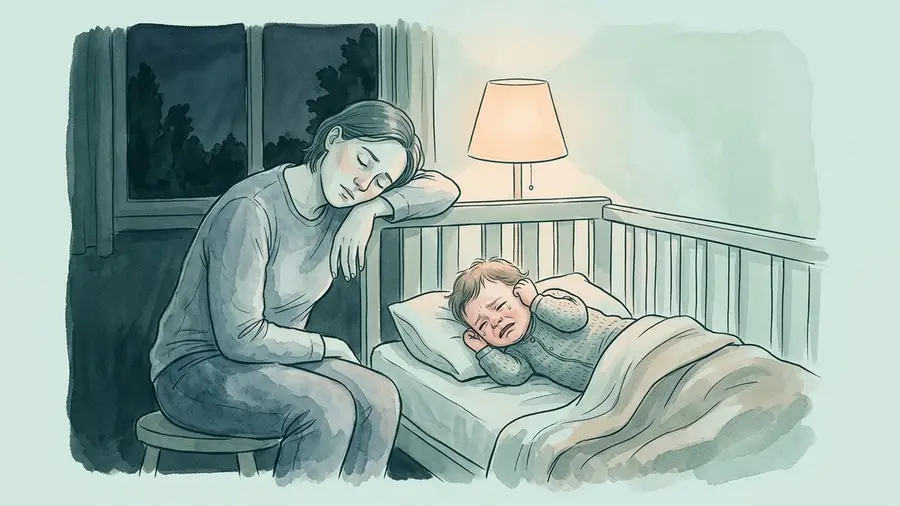
It's 3 AM. Your child wakes up screaming, grabs at one ear again and again, and won't be comforted. You sit by the bed, exhausted, and one question loops: Do I leave now — or can this wait until the morning?
For many families, this is how a middle ear infection begins — usually a few days after a cold. Here's what matters most: it typically clears up within 3 days, and a pain reliever is your most important helper through the night. Only rarely is there a true emergency behind it. How to recognise it, what helps in bed right now, and when your child really needs urgent care — you'll find it here, section by section.
ℹ️ Important note: This article does not replace professional medical advice. If in doubt or in an emergency, contact your GP or call 999.
How Do You Recognise a Middle Ear Infection in a Child?
Typical signs are sudden, stabbing ear pain that often gets worse lying down and at night. It usually comes with a high temperature, irritability and reduced hearing. Young children grab at the ear again and again, shake their head and drink less. Most of the time it starts during or a few days after a cold.
The NHS page on ear infections (last reviewed 16 January 2025) sets the expectation:
"Most ear infections clear up within 3 days, although sometimes symptoms can last up to a week."
It also lists what to watch for in a child too young to say where it hurts: rubbing or pulling the ear, not reacting to some sounds, being irritable or restless, being off their food, or losing their balance.
The reason lies in the anatomy: during a cold the Eustachian tube swells, fluid builds up in the middle ear and presses against the eardrum. That pressure is what causes the nagging pain. Lying down, the fluid can't drain — which is why the pain is usually worst at night and in bed.
Younger children who can't yet say where it hurts show it differently:
- They keep grabbing the ear or rubbing it
- They cry in a high-pitched way and are hard to settle
- They cry harder when lying down than when sitting or being held
- They eat and drink less, because swallowing increases the pressure
- Sometimes tummy ache, vomiting or a high temperature are added
Sometimes the eardrum gives way under the pressure. Then discharge runs out of the ear — and the pain eases suddenly. It looks dramatic, but it's common and usually heals on its own. You should still see your GP if this happens.
When Is a Middle Ear Infection an Emergency — and When Is the GP Enough?
A true emergency is rare but serious. The most important warning sign is swelling, redness or tenderness behind the ear — or an ear that suddenly sticks out. This can point to mastoiditis, a serious spread of the infection to the bone behind the ear. In that case, call 999 or go to A&E.
🚨 Call 999 or go to A&E immediately if your child:
- has swelling, redness or tenderness behind the ear, or an ear that sticks out — possible mastoiditis
- has a stiff neck, a rash that doesn't fade under pressure, or is unresponsive or hard to wake
- is seriously unwell, increasingly drowsy, or has a severe headache with a high temperature
- has a seizure
The NHS page on mastoiditis (last reviewed 17 August 2026) calls it "a rare but serious infection that affects the mastoid bone behind the ear". The sign to look for is "swelling behind the ear, which can cause it to stick out". Untreated, it "can lead to serious problems such as permanent hearing loss or meningitis". NHS routing for a suspected mastoiditis on its own is an urgent GP appointment or NHS 111; the 999 route above is for a child who is also seriously unwell.
In babies under 3 months, a high temperature (38°C or above) needs urgent medical advice — contact a GP or call NHS 111 straight away (call 999 or go to A&E if your baby seems seriously unwell).
If none of that applies, your child is responsive, drinking and settles after the pain reliever? Then you can usually wait until morning. But ear pain is always a reason to see your GP — only an examination reveals what's really behind it.
Contact your GP surgery, or call NHS 111, if:
- your child is under 12 months old and you think they have an ear infection
- symptoms don't start to improve after 3 days or get worse
- fluid is coming out of the ear, or there's a change in hearing
- your child has a very high temperature, feels generally unwell, is being sick, or can barely sleep or drink because of the pain
When did she last have paracetamol?
The question that drives everyone crazy at night. Mona tracks doses and intervals automatically, so no one doubles up.


What Helps at Night With a Middle Ear Infection?
Elevate your child's upper body — sitting up or half-upright, the fluid drains better and the pressure on the eardrum drops. A body-warm, soft cloth against the ear soothes many children. And an age-appropriate pain reliever (paracetamol or ibuprofen) strictly per the package leaflet is the mainstay against night-time pain.
An elevated head is the most effective immediate measure, because lying flat the fluid pools and the pressure rises. An extra pillow, a raised mattress head, or holding your child upright brings noticeable relief. For warmth: body-warm yes, hot no — hot compresses have no place on sensitive children's skin.
The concrete night-time measures — from sleeping position to the right kind of warmth — are described step by step in our article Ear Pain in a Child at Night. In most cases, waiting it out is enough: most children get better within 3 days without any antibiotics, and many are pain-free even sooner.
💡 Tip: At night, pay special attention to the gap between two doses. Half asleep at 3 AM, an accidental double dose happens fast — and it's dangerous. The leaflet gives a minimum interval for paracetamol and ibuprofen that you must always stick to.
Does a Middle Ear Infection Always Need Antibiotics?
A middle ear infection does not usually need antibiotics. For most children the infection clears on its own, and a pain reliever bridges the worst days — which is why GPs often wait and see for the first 3 days. Only if there's no improvement, or if certain risk factors apply, do antibiotics become worthwhile.
The reason for this caution: for an uncomplicated middle ear infection, antibiotics make little difference to symptoms, while side effects like diarrhoea are real. The NHS puts painkillers first — "painkillers such as paracetamol or ibuprofen" — and says to see a GP if earache has not improved after 3 days, or sooner for a child under 12 months. Serious complications such as mastoiditis are rare, so most children do just as well with a wait-and-see approach.
Antibiotics are mainly considered when:
- your child is systemically very unwell or shows signs of a more serious illness
- a child under 2 years has an infection in both ears
- there is discharge coming from the ear
- symptoms don't improve after 3 days or the child is at high risk of complications
Whether your child needs antibiotics is a decision for your GP, based on examining the ear — not a gut call at 3 AM, and not this article. Diagnosis and treatment belong with a clinician; what you can contribute is an accurate account of the days before. What matters is that you keep an eye on the course and know when those 3 days are up.
How Do You Keep Track of the Course?
With a middle ear infection, what counts is the course over several days: when the pain started, which ear is affected, how high the temperature was and when — and above all, at what time you gave which pain reliever, and at what dose. In the middle of the night, half asleep, this knowledge slips away fast.
In Mona, you log the onset of pain, the temperature and every dose with a timestamp in seconds. You can see at a glance when the next dose is allowed, and you avoid the accidental double dose at 3 AM. Over the days a clear picture builds: is it improving — or are the 3 days up without any change?
Your GP will ask exactly this: How long has the pain been there? Which ear? How high was the temperature, and when was the last dose of which medicine? Those answers are already sitting in your Mona history — instead of being guessed from memory while running on no sleep.
The pediatrician asks. You can answer.
Symptom timeline, fever curve, last medication: With Mona you have it all in seconds, instead of guessing from memory.
Can You Prevent a Middle Ear Infection?
You can't fully prevent a middle ear infection — it usually follows ordinary colds, which are part of childhood. You can still lower the risk: a smoke-free environment, plenty of fluids when your child has a cold, and breastfeeding in the early months are all considered helpful.
It also helps to keep water out of the affected ear when bathing and washing hair until the infection has fully settled. If your child gets ear infections again and again, ask your GP — recurring infections can sometimes be caused by glue ear, meaning fluid that stays in the middle ear.
Frequently Asked Questions About Middle Ear Infections
How Long Does a Middle Ear Infection Last in a Child?
Most ear infections clear up within 3 days, although sometimes symptoms can last up to a week. Most children get better within those first 3 days without any antibiotics, and many are pain-free sooner. If symptoms don't start to improve after 3 days, or they get worse, contact your GP.
Is a Middle Ear Infection Contagious?
The middle ear infection itself doesn't pass from child to child. What is contagious is the underlying upper-airway infection — the cold from which the ear infection develops. Usual hygiene like handwashing and using tissues helps limit that trigger, but not the inflammation inside the ear directly.
Can My Child Bathe or Swim With a Middle Ear Infection?
While the infection is acute, try to keep water out of the ear. A quick shower is usually fine if the ear stays protected; it's better to skip swimming and diving until everything has settled. If there's a hole in the eardrum (discharge), be especially strict — ask your GP if you're unsure.
How Do I Know the Middle Ear Infection Is Getting Better?
A good sign is when the pain eases from day to day, the temperature comes down, and your child eats, drinks and plays again. Sleeping more calmly at night also points to improvement. If things stay the same after 3 days, or get worse, the ear should be examined again.
Does My Child Need to Stay Home — and When Can They Go Back to Nursery?
As long as your child has strong pain or a high temperature, they belong at home. Rule of thumb: once they've been fever-free for 24 hours without fever-reducing medication, pain-free and active again, they can go back to nursery. The infection itself isn't a reason for long exclusion — their overall state decides.
What If the Pain Reliever Isn't Enough at Night?
First check whether the minimum interval to the next dose has passed — you must not give more before then. Does an elevated upper body plus warmth help as well? If none of that is enough and your child is suffering badly, call NHS 111. For warning signs like swelling behind the ear: call 999 or go to A&E.
Summary: 999, GP, or Wait and See?
| Situation | What to do? |
|---|---|
| Swelling/redness behind the ear, ear sticking out, seriously unwell child | Call 999 or go to A&E |
| Stiff neck, unresponsive, non-blanching rash, seizure | Call 999 or A&E |
| Baby under 3 months with a high temperature (38°C+) | GP or NHS 111 straight away (999 if seriously unwell) |
| Child under 2 with discharge from the ear, or no improvement after 3 days | GP same day or NHS 111 |
| Very high temperature or strong pain despite pain relief | See your GP soon |
| Child is responsive, pain relief works, falls back asleep | Elevate, pain relief — track the course in Mona |
About this article
Sources
- NHS: Ear infections(accessed 2026-07-13)
- NHS: Mastoiditis(accessed 2026-07-13)
- NICE NG91: Otitis media (acute) — antimicrobial prescribing(accessed 2026-07-13)
You might also like

Track symptoms easily
With Mona you stay on top of things – even at 3 AM.