
Sunstroke or Heatstroke in Children? Symptoms, Differences and First Aid

This blog only provides tips, tricks and hints and does not replace a doctor visit. For severe symptoms, always consult a doctor.
At a glance
- ✓Sunstroke = direct sun on the head, body temperature stays normal. Heatstroke = whole body overheats — a life-threatening emergency requiring 999.
- ✓Heatstroke warning signs: hot dry skin without sweating, confusion or unresponsiveness, seizures — call 999 immediately.
- ✓Mild sunstroke: move your child to cool shade, raise their upper body, cool with a damp cloth, encourage fluids — and log the timeline in Mona.
Table of Contents
- What Is the Difference Between Sunstroke and Heatstroke?
- Which Warning Signs Mean Heatstroke — Call 999 Now?
- What Are the Symptoms of Sunstroke in a Child?
- Are Babies and Toddlers Especially at Risk?
- How Do You Give First Aid for Sunstroke?
- When Is a GP Appointment Enough — and When Does It Need to Be Faster?
- Frequently Asked Questions About Sunstroke and Heatstroke in Children
- How do I know whether my child has sunstroke or heatstroke?
It's a hot summer afternoon. Your child has been outside for hours — and now they're complaining of a headache, restless, with a head that feels burning hot. Is this sunstroke? Or something worse? That question determines whether you start first aid right now or call 999 immediately.
The reassuring news: most heat-related conditions in children are very manageable — if you recognise the signs. Sunstroke often settles with cool shade and rest. Heatstroke is a life-threatening emergency. The difference comes down to a handful of clear symptoms. Here's what to look for.
Important note: This article does not replace professional medical advice. If in doubt or in an emergency, call 999, contact NHS 111, or speak to your GP.
What Is the Difference Between Sunstroke and Heatstroke?
Sunstroke and heatstroke sound similar but are fundamentally different conditions. Sunstroke occurs when direct sunlight falls on an uncovered head and neck for a prolonged period, irritating the meninges (the membranes surrounding the brain) — the body temperature remains normal. Heatstroke means the entire body has overheated and can no longer cool itself — this is a medical emergency.
The most visible difference is in the skin: with sunstroke, only the head is hot and flushed, while the rest of the body stays cool or normal. With heatstroke, the skin all over the body is hot and dry — the child is not sweating, because the body's cooling system has failed. Young children are particularly vulnerable: they sweat less than adults and struggle to regulate their body temperature effectively.
Rule of thumb: Hot head, cool body = sunstroke. Hot body, dry skin with no sweating = heatstroke — call 999.
Which Warning Signs Mean Heatstroke — Call 999 Now?
Heatstroke is a medical emergency. Call 999 immediately if your child shows any of the following signs — regardless of how long they were in the sun.
Call 999 or go to A&E immediately if your child has:
- Hot, dry skin without sweating — the body's cooling system has failed
- A very high body temperature (NHS describes heatstroke as associated with a very high temperature)
- Confusion, unusual behaviour, or is difficult to rouse
- Seizures or convulsions
- Fast, shallow breathing
- Loss of consciousness
- A glazed expression or unsteady walking — early sign of circulatory involvement
While waiting for emergency services: move your child to a cool, shaded place, open tight clothing, and cool the body with damp (not ice-cold) cloths. Do not apply ice directly to the skin. Only offer fluids if your child is fully conscious and can swallow safely.
The pediatrician asks. You can answer.
Symptom timeline, fever curve, last medication: With Mona you have it all in seconds, instead of guessing from memory.


What Are the Symptoms of Sunstroke in a Child?
Sunstroke develops when direct sunlight on an unprotected head and neck causes the meninges to become irritated. The body temperature stays normal — only the head becomes hot and flushed.
Typical symptoms (based on German Red Cross and BZgA sources):
- Headache and neck pain — often described as stabbing
- Stiff neck
- Flushed, hot head while the rest of the body remains cool
- Dizziness, ringing in the ears (tinnitus)
- Nausea and vomiting
- Restlessness and confusion
- In more severe cases: circulatory symptoms or loss of consciousness
Important — symptoms can be delayed: Sunstroke symptoms often appear hours after sun exposure, frequently in the evening. Was your child at the park at 2 pm and is now complaining of a headache at 7 pm? Sunstroke could be the cause. Without preceding heat exposure, other causes of headache are usually more likely. This is why noting the time spent outdoors and when symptoms started helps a great deal — Mona is designed exactly for this.
Are Babies and Toddlers Especially at Risk?
Yes. Babies and young children overheat far more quickly than adults. According to BVKJ sources, children sweat significantly less than adults and need proportionally more fluids. Babies under one year should not be exposed to direct sunlight at all. For infants: any signs of overheating warrant prompt medical assessment — better safe than sorry.
How Do You Give First Aid for Sunstroke?
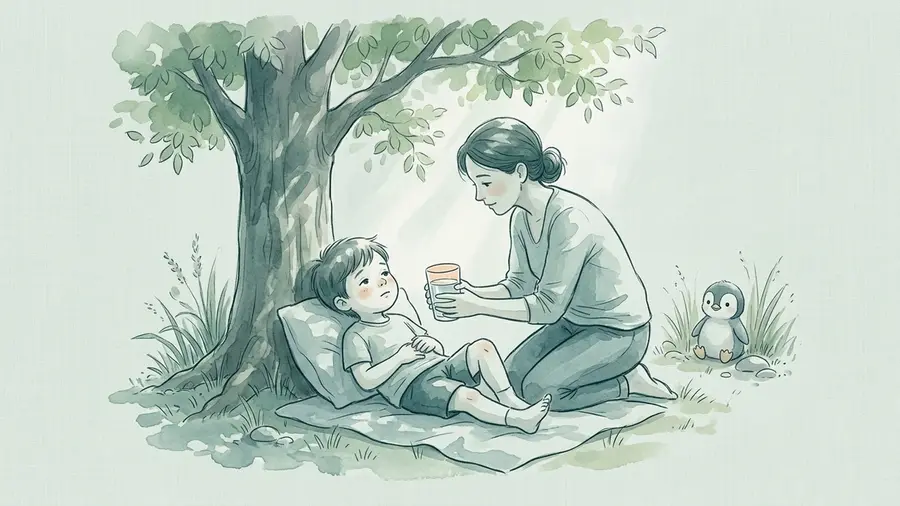
Move your child immediately into a cool, shaded environment and raise their upper body slightly. Cool the head and neck with damp, lukewarm (not ice-cold) cloths, and offer small sips of water — only if your child is fully alert and conscious.
Step by step (based on German Red Cross and Johanniter guidance):
- Out of the sun — immediately into shade or a cool room
- Raise the upper body — lay your child down with their head slightly elevated
- Cool head and neck — damp, lukewarm cloths (no ice, no cold packs directly on skin)
- Offer fluids — small sips, only if fully conscious
- Never leave them alone — check consciousness and breathing regularly
- Call 999 if: loss of consciousness, seizures, no improvement after a short time, or if an infant or very young child is affected
Tip for the doctor's visit: Note down when your child was in the sun, how long for, when symptoms appeared, and how much they had to drink. This timeline helps your GP or paediatrician distinguish sunstroke from other causes — and it's exactly what Mona's symptom log is for.
When Is a GP Appointment Enough — and When Does It Need to Be Faster?
For mild sunstroke — your child is alert, drinking, and symptoms are improving within around 30 minutes of moving to a cool place — a GP appointment the next day is usually fine. If symptoms are not improving or your child cannot drink, contact your GP the same day or call NHS 111. For any heatstroke warning signs or loss of consciousness, always call 999 immediately.
NHS 111 — when is it useful? Your child had a mild episode of sunstroke, you gave first aid and they've improved noticeably — but you're unsure whether a doctor's visit is needed? Call NHS 111 for guidance, especially in the evenings or at weekends.
Frequently Asked Questions About Sunstroke and Heatstroke in Children
How do I know whether my child has sunstroke or heatstroke?
The key difference: with sunstroke, only the head is hot and flushed while the rest of the body stays cool. With heatstroke, the whole body is overheated and the skin is hot and dry — your child is not sweating. Any confusion, seizures, or loss of consciousness should be treated as heatstroke — call 999 immediately.
Can sunstroke symptoms appear hours later?
Yes. Sunstroke symptoms can be delayed — sometimes by several hours after sun exposure. If your child was outside in the afternoon and develops a headache or dizziness in the evening, sunstroke may be the cause. Noting the time outdoors and when symptoms started helps your GP make an assessment.
Should I cool my child with cold water?
Avoid ice-cold water or cold packs directly on the skin — these can put additional strain on circulation. Damp, lukewarm cloths on the head and neck are the right approach. Cool gently and steadily, without causing them to become cold.
Can children get heatstroke without being in direct sunlight?
Yes. Heatstroke results from the whole body overheating — this can happen in a hot car, a stuffy room, or during intense physical activity in very warm and humid conditions, without any direct sun exposure. Never leave children unattended in a car on a warm day.
Can sunstroke become dangerous?
Mild sunstroke in older children usually resolves well with first aid. In infants and toddlers, or if symptoms worsen — loss of consciousness, seizures, changes in breathing — call 999 even for suspected sunstroke. When in doubt, always seek medical advice.
How long does sunstroke last?
Mild symptoms often resolve within a few hours with proper first aid. Headaches may linger for a day or two. If your child is not improving within 30 minutes of first aid, or if symptoms worsen, see a GP or call NHS 111.
What if my child falls asleep in the sun without a hat?
Move them into the shade immediately and monitor them closely. Sunstroke may not show itself for several hours. Prevention: always use a hat, seek shade (especially between 10 am and 4 pm), and keep children well hydrated.
Summary: Sunstroke or Heatstroke — What to Do?
| Situation | What to do? |
|---|---|
| Hot dry skin with no sweating, confusion, seizures | Call 999 / A&E — suspected heatstroke |
| Loss of consciousness in the heat | Call 999 / A&E |
| Infant or toddler with any signs of overheating | Call 999 / A&E or see a doctor immediately |
| Sunstroke — symptoms persist, child won't drink | GP today or NHS 111 |
| Sunstroke — improving after 30 min first aid, child is drinking | Monitor, GP appointment tomorrow, log in Mona |
| Mild sunstroke, recovering well, no warning signs | First aid, rest, plenty of fluids, avoid sun |
About this article
Sources
- NHS: Heat exhaustion and heatstroke(accessed 2026-06-15)
- BZgA kindergesundheit-info.de: Risiko Sonne — Sonnenstich, Hitzschlag(accessed 2026-06-15)
- DRK: Erste Hilfe bei Sonnenstich(accessed 2026-06-15)
- DRK: Erste Hilfe bei Hitzschlag(accessed 2026-06-15)
- DGUV KinderKinder: Gefaehrliche Hitze — Hitzschlag(accessed 2026-06-15)
You might also like

Track symptoms easily
With Mona you stay on top of things – even at 3 AM.