
Insect Sting in Children: When Is Swelling Normal – and When to Call 999?

This blog only provides tips, tricks and hints and does not replace a doctor visit. For severe symptoms, always consult a doctor.
At a glance
- ✓Swelling, redness and itching at the sting site are a normal local reaction — no need to panic.
- ✓It becomes dangerous when other parts of the body react: difficulty breathing, difficulty swallowing, loss of consciousness or circulatory problems are signs of anaphylaxis.
- ✓Call 999 immediately for difficulty breathing, difficulty swallowing, a sting in the mouth or throat, loss of consciousness, or if your child has a known severe allergy.
Table of Contents
- Is swelling after an insect sting normal?
- What signs mean call 999 immediately?
- When is a GP visit enough — and when can I wait and watch?
- What first aid should you give after an insect sting?
- Common questions about insect stings in children
- Why does the sting site swell up so much?
- How long does swelling last after an insect sting?
- Does a big swelling mean my child is allergic?
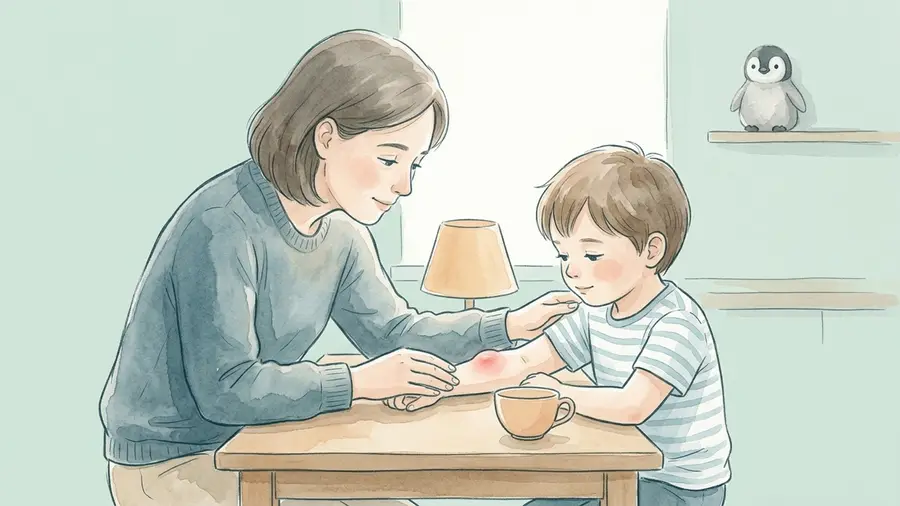
Your child comes in from playing, crying — a wasp sting on the arm. The site is swelling up, turning red, and your child is in pain. You ask yourself: Is this still normal? Or do I need to act quickly?
The good news is that the vast majority of insect stings in children are harmless. Swelling, redness and itching directly at the sting site are a normal body reaction. What really matters: Does the reaction stay local — or does it spread to other parts of the body? That is exactly what determines whether you should watch and wait or act immediately. You can make that call yourself — right there with your child, within seconds. The warning signs are in the next section.
Is swelling after an insect sting normal?
Local swelling, redness and itching directly around the sting site are a completely normal body reaction to the injected insect venom. According to the BVKJ (Association of Paediatric and Adolescent Physicians), these local reactions are not a sign of an insect venom allergy — they occur in everyone.
The key point: the reaction only affects the sting site and its surroundings. Even quite visible swelling on its own is not considered an allergic reaction according to DAAB (German Allergy and Asthma Association). It only becomes serious when organs beyond the skin are involved, such as the airways, circulatory system or digestive tract.
What signs mean call 999 immediately?
If symptoms appear after an insect sting that go beyond the sting site, this could be a life-threatening anaphylactic reaction. According to gesundheitsinformation.de and DAAB, these reactions can develop very quickly — sometimes within minutes. Do not wait to see if things get worse.
Call 999 immediately if your child has:
- Difficulty breathing, wheezing or coughing — the airways are swelling shut
- Difficulty swallowing or a hoarse voice — possible throat swelling
- A sting in the mouth, throat or neck — even without an allergy, the swelling can block the airways (DRK and BVKJ)
- Swollen face, swollen lips or tongue
- Dizziness, fainting or loss of consciousness — signs of circulatory shock
- Seizures or shaking
- Nausea or vomiting combined with other symptoms
- Pale, blue or grey skin or lips
- Known severe insect venom allergy — always call 999 immediately, even if the reaction seems mild so far
For a sting in the mouth or throat: call 999 immediately and, in parallel, let your child suck ice cubes or ice cream (if swallowing is possible) — swelling can spread to the airways very quickly.
The pediatrician asks. You can answer.
Symptom timeline, fever curve, last medication: With Mona you have it all in seconds, instead of guessing from memory.


When is a GP visit enough — and when can I wait and watch?
If the swelling stays at the sting site and no other symptoms appear, you can usually provide first aid and monitor the situation. If the reaction is pronounced, a GP visit makes sense — not as an emergency, but soon.
See your GP or call NHS 111 if:
- The swelling is increasing significantly and spreading
- Your child is in a lot of pain or cannot be calmed down
- You are unsure about the situation
- A known allergy is present but no emergency kit is available
Watch and wait if:
- The reaction remains at the sting site
- Your child is alert and breathing normally
- No symptoms appear elsewhere on the body
What first aid should you give after an insect sting?
The most important immediate measure is cooling. It eases pain, slows the spread of swelling and helps calm your child. According to DRK and BVKJ, these steps apply:
- Stay calm — your child picks up on your composure
- Remove the stinger (bee stings only): scrape it away with a fingernail or tweezers — do not squeeze it, as this injects more venom
- Cool the site — a cool pack or ice cubes wrapped in a cloth; never ice directly on the skin
- Watch and monitor — keep a close eye on your child for at least 30 minutes: are they breathing normally? Is the reaction changing?
- Relieve itching — a cooling gel from the pharmacy can help; do not scratch, as this increases infection risk
Tip: Note the time of the sting and how the swelling changes — when did it start, how large did it get, when did it subside? These details help your GP assess the reaction. Mona is exactly the right tool for this.
Common questions about insect stings in children
Why does the sting site swell up so much?
The swelling is caused by the insect venom triggering an inflammatory response. This is a normal protective reaction of the immune system. According to DAAB, even extensive swelling at the sting site alone is not a sign of an insect venom allergy — only when other organ systems are involved does it become an allergic reaction.
How long does swelling last after an insect sting?
Exact durations vary depending on the child, sting site and type of insect. A normal local reaction generally subsides gradually. If the swelling spreads further, becomes more severe, or new symptoms appear, a GP visit is advisable. If in doubt, check with your GP or call NHS 111.
Does a big swelling mean my child is allergic?
Not necessarily. According to BVKJ and DAAB, significant local swelling at the sting site alone does not mean there is an allergy. The body only shows an allergic reaction when symptoms appear elsewhere — for example breathing or circulation problems, or swelling on the face. If the reaction was strong, it may be worth asking your GP about allergy testing.
What should I do if my child is stung in the mouth or throat?
Call 999 immediately — regardless of whether an allergy is known. According to DRK and BVKJ, stings in the mouth can cause the mucous membranes to swell so severely that the airways are blocked. At the same time: let your child suck ice cubes or ice cream if swallowing is possible, and cool the throat externally while you wait.
What if my child is known to be allergic to insect venom?
An emergency kit should always be within reach — typically an antihistamine, a corticosteroid and an adrenaline auto-injector (e.g. EpiPen). Discuss the exact contents and how to use it with your GP. After a sting: use the emergency kit immediately and still call 999 — adrenaline can slow the reaction down but not stop it.
Can insect stings be dangerous for children without an allergy?
Yes, in certain situations. Stings in or around the mouth, throat or neck can be life-threatening even without a known allergy, because local swelling can block the airways. A very large number of stings at once can also cause severe reactions without an allergy. If in doubt, always call 999.
How do I recognise an infected sting site?
Infection usually appears after a day or more: the sting site becomes increasingly red, warm, painful and swollen rather than improving, and may develop pus. In that case, see your GP promptly — an infection can be treated with antibiotics.
Summary: Insect sting in children — what to do?
| Situation | What to do? |
|---|---|
| Difficulty breathing, difficulty swallowing, loss of consciousness, circulatory shock | Call 999 — suspected anaphylaxis |
| Sting in mouth, throat or neck | Call 999 + give ice to suck |
| Known severe insect venom allergy + sting | Use emergency kit + call 999 immediately |
| Significant spreading swelling, first noticeable reaction | GP today or NHS 111 |
| Swelling at sting site, child alert, breathing normally | Cool, monitor — see GP if it gets worse |
| Small swelling, itching, no other symptoms | Cool, relieve itching, monitor |
About this article
Sources
- NHS: Insect bites and stings(accessed 2026-06-22)
- NHS: Anaphylaxis(accessed 2026-06-22)
- BVKJ kinderaerzte-im-netz.de: First aid for insect stings(accessed 2026-06-22)
- BVKJ kinderaerzte-im-netz.de: Insect venom allergy — symptoms(accessed 2026-06-22)
- DAAB: Insect venom allergy(accessed 2026-06-22)
- gesundheitsinformation.de: Anaphylactic reaction after insect stings(accessed 2026-06-22)
- DRK: First aid for insect stings(accessed 2026-06-22)
- DRK: Insect sting in the mouth(accessed 2026-06-22)
- AWMF S2k Guideline: Diagnosis and therapy of bee and wasp venom allergy (2024)(accessed 2026-06-22)
You might also like

Track symptoms easily
With Mona you stay on top of things – even at 3 AM.