
Scarlet Fever in Children: Symptoms, What to Expect, and When They Can Go Back to Nursery

This blog only provides tips, tricks and hints and does not replace a doctor visit. For severe symptoms, always consult a doctor.
At a glance
- ✓Scarlet fever is a bacterial infection caused by group A streptococcus — typical signs are a sudden high temperature, sore throat, a strawberry-red tongue, and a fine, sandpaper-like rash.
- ✓It is treated with a course of antibiotics — finish every dose your GP prescribes, even once your child feels better.
- ✓Back to nursery: 24 hours after the first dose of antibiotics, once your child is well enough — you do not need a doctor's note to return.
Table of Contents
- How Do I Recognise Scarlet Fever in My Child?
- How Serious Is Scarlet Fever — and What Are the Warning Signs?
- How Is Scarlet Fever Treated?
- When Can My Child Go Back to Nursery?
- How Do You Keep Track of How It's Going?
- How Can I Stop It Spreading in the Family?
- Frequently Asked Questions About Scarlet Fever
- Can adults catch scarlet fever too?
Your child has been complaining of a sore throat since yesterday, their temperature shot up suddenly — and this morning you spot a fine red rash on their chest and neck that feels like sandpaper. Their tongue looks strikingly red. You're asking yourself: Is this scarlet fever — and how serious is it?
Here's what matters most: scarlet fever is a bacterial infection caused by group A streptococcus. And because it's bacterial, antibiotics work reliably. Once treatment starts, scarlet fever quickly loses its sting — your child is usually no longer infectious after about a day, and almost always recovers fully. How to recognise scarlet fever, how it's treated, and when your child can go back to nursery — you'll find it here, step by step.
Important note: This article does not replace professional medical advice. If in doubt or in an emergency, contact your GP or call 999.
How Do I Recognise Scarlet Fever in My Child?
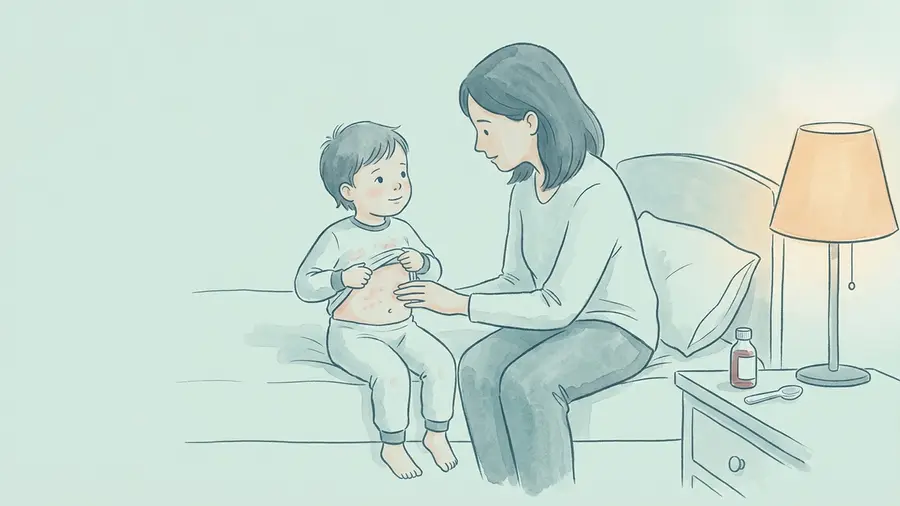
Scarlet fever usually starts suddenly with a high temperature, a bad sore throat, and swollen neck glands. One to two days later, a fine, sandpaper-like rash appears on the chest and tummy — together with a strawberry-red tongue and a noticeably pale area around the mouth.
The NHS page on scarlet fever (last reviewed 23 December 2024) describes the sequence and the timing:
"a high temperature, a sore throat and swollen neck glands"
with the rash following "12 to 48 hours later", starting on the chest and tummy and feeling "rough, like sandpaper".
The cause is group A streptococcus bacteria — the same bugs that can cause a bacterial sore throat. The rash starts on the chest and tummy, then spreads, and it's often most obvious in warm areas like the armpits and groin. It does not appear on the face, but the cheeks can look flushed and red, while the skin around the mouth stays pale. Press a glass against the rash and it briefly fades.
The tongue is a giveaway. It often has a white coating at first; after a few days the coating peels, leaving the tongue red, swollen, and covered in little bumps — the classic "strawberry tongue". As the rash fades towards the end of the illness, the skin may peel like sunburn, especially on the hands and feet. This is harmless and a sign that the infection is settling.
How Serious Is Scarlet Fever — and What Are the Warning Signs?
With prompt antibiotic treatment, scarlet fever is usually mild and clears up without any lasting problems. It rarely turns serious — mainly if it's left untreated, or if warning signs appear such as difficulty breathing, a stiff neck, or your child becoming very unwell. Those signs need medical help straight away.
The complications parents worry about — such as rheumatic fever or a kidney problem — are rare, and finishing the antibiotics is exactly what protects against them. So what matters is less the exact number on the thermometer and more how your child seems overall, plus a handful of clear red flags. In children, a high temperature is 38°C or above.
🚨 Call 999 or go to A&E if your child:
- has difficulty breathing — rapid breathing, nasal flaring, drawing in between the ribs
- has a stiff neck and can't bring their chin to their chest (possible meningitis)
- has a rash that does not fade when you press a glass against it (this can indicate sepsis)
- is drowsy and hard to wake, floppy, or not responding as usual
- has a fit (febrile seizure) for the first time
- has cold hands and feet, or blue, grey, pale or blotchy skin
In babies under 3 months, a temperature of 38°C or above always needs urgent medical advice — contact a GP or call NHS 111 straight away (call 999 or go to A&E if your baby seems seriously unwell). If none of the red flags apply and your child is drinking, responsive, and settled between temperatures, the next step isn't 999 — it's your GP. Whether this is scarlet fever, and which antibiotic your child needs, is a decision for a clinician, made by looking at the throat and, if needed, taking a swab. This article only helps you recognise the pattern and describe it accurately.
When did she last have paracetamol?
The question that drives everyone crazy at night. Mona tracks doses and intervals automatically, so no one doubles up.


How Is Scarlet Fever Treated?
Scarlet fever is treated with a course of antibiotics, most often penicillin, for as long as your GP prescribes. Because the illness is bacterial, this works reliably: the temperature often settles within about a day, and your child is usually no longer infectious 24 hours after the first dose.
The NHS (reviewed December 2024) is unambiguous about this: "If you have scarlet fever a GP will prescribe antibiotics", and "Keep taking the antibiotics until they're finished, even if you feel better."
The single most important thing is to finish the whole course — even once your child feels much better after two or three days. Keep giving the antibiotics until they're finished. Stopping early can let bacteria survive, bring the symptoms back, and in rare cases make later complications more likely.
Important: Never stop the antibiotics on your own just because the temperature has gone. Only the full course protects reliably against a relapse and against rare complications like rheumatic fever.
If your child is allergic to penicillin, your GP will prescribe a different, suitable antibiotic. Alongside the antibiotics, the usual self-care helps: plenty of cool fluids, soft foods for a sore throat, and paracetamol for a high temperature if needed (do not give aspirin to children under 16).
When Can My Child Go Back to Nursery?
Your child can go back to nursery once they've had a suitable antibiotic for 24 hours and are well enough to be there. Before that, they're infectious and should stay at home — that single day of treatment is what changes the picture. You do not need a doctor's note to return.
NHS advice puts it in one line: "Stay away from nursery, school or work for 24 hours after you take the 1st dose of antibiotics."
The reasoning is simple. You can spread scarlet fever to other people until 24 hours after the first dose of antibiotics — after that, the risk of passing it on drops sharply, provided the temperature has settled and your child feels better.
Without antibiotics, it's a very different picture: an untreated child can stay infectious for two to three weeks. That's one of the main reasons scarlet fever is treated — antibiotics cut the infectious period from weeks down to a single day.
💡 Tip: Let the nursery or school know your child has scarlet fever, so other families and staff are aware and can watch for symptoms. Also tell them if anyone in the household is pregnant, as they may need advice.
How Do You Keep Track of How It's Going?
With scarlet fever, three things are worth recording: the temperature over time, every antibiotic dose with the time and amount, and how the rash and sore throat change from day to day. The course is the tricky part of everyday life — two or three times a day, for a week and more, between work and siblings, it's easy to lose track of a dose.
In Mona you log each dose with the time in a few seconds and see at a glance when the next one is due — so you carry the course reliably to its end without missing a dose. The temperature chart builds itself, and a short daily rash note shows you in black and white whether the treatment is working.
That pays off at the next appointment. Your GP will ask: how long has the temperature lasted? When was the first antibiotic dose? Are the rash and sore throat improving? Those answers are already in your timeline, instead of something you have to piece together from memory.
The pediatrician asks. You can answer.
Symptom timeline, fever curve, last medication: With Mona you have it all in seconds, instead of guessing from memory.
How Can I Stop It Spreading in the Family?
Scarlet fever spreads through droplets — coughing, sneezing, saliva — and through shared items. The most effective protection is washing your hands often with soap and water. During the infectious phase, do not share cutlery, cups, towels, or toothbrushes, and air the rooms regularly.
Once the unwell child has had antibiotics for about 24 hours, the risk of spreading it drops sharply. If a sibling develops similar symptoms — sore throat, high temperature, rash — take them to the GP as well. Healthy household contacts are not usually given antibiotics as a precaution; only those who actually become ill are treated.
Frequently Asked Questions About Scarlet Fever
Can adults catch scarlet fever too?
Yes. Group A streptococcus can infect adults who aren't immune to that particular strain, so parents and siblings aren't automatically protected. Washing hands often and not sharing cups or cutlery during the infectious phase lowers the risk. Anyone who develops a sore throat and high temperature should see their GP.
Can my child get scarlet fever more than once?
Yes. There are several bacterial strains producing different toxins, so having had scarlet fever once doesn't give lasting protection against catching it again. A child can have scarlet fever more than once in their life. Each new episode is treated with a fresh course of antibiotics.
How long does scarlet fever last?
With antibiotics, the temperature and sore throat usually improve noticeably within a day or two. The rash fades over several days, and towards the end the skin on the hands and feet may peel. Even so, the antibiotic course continues to the end of what your GP prescribed. The NHS is explicit about it: "Keep taking the antibiotics until they're finished, even if you feel better."
Does scarlet fever always need antibiotics?
Your GP decides. Antibiotics shorten the infectious period, ease symptoms faster, and lower the small risk of later complications such as rheumatic fever. For confirmed scarlet fever, antibiotics are the standard treatment. Never stop the prescribed course on your own.
When is my child no longer infectious?
Your child is usually no longer infectious 24 hours after the first dose of a suitable antibiotic — provided the temperature has gone and they clearly feel better. Without antibiotics, they can stay infectious for two to three weeks. That's the big advantage of treatment.
What if my child is allergic to penicillin?
If your child is allergic to penicillin, your GP will prescribe a different, suitable antibiotic. Make sure you mention the allergy before it's prescribed. The alternative medicine also needs to be taken for the full prescribed period — not just until the temperature disappears.
Do I need to tell the nursery about the scarlet fever?
Yes, let the nursery know so other families and staff can watch for symptoms. You do not need a doctor's note for your child to return — it's enough that they're no longer infectious, which is usually 24 hours after the first antibiotic dose and once they're well enough.
Summary: When Do I Need to Act with Scarlet Fever?
| Situation | What to do? |
|---|---|
| Difficulty breathing, stiff neck, febrile seizure, child unresponsive | Call 999 / A&E |
| Rash that does not fade when pressed with a glass | Call 999 / A&E |
| Baby under 3 months with a temperature of 38°C or above | GP or NHS 111 straight away (999 / A&E if seriously unwell) |
| Suspected scarlet fever: high temperature, sore throat, sandpaper rash | See your GP — diagnosis and antibiotics |
| Temperature rises or won't settle after 1–2 days of antibiotics | GP same day or NHS 111 |
| Child on treatment, temperature settling, rash fading | Recover at home — keep track of it in Mona |
About this article
Sources
- NHS: Scarlet fever(accessed 2026-07-13)
- NHS: High temperature (fever) in children(accessed 2026-07-13)
- NICE NG143: Fever in under 5s(accessed 2026-07-13)
You might also like

Track symptoms easily
With Mona you stay on top of things – even at 3 AM.