Diarrhoea and Vomiting in a Child for 3 Days: What Helps, When to See Your GP

This blog only provides tips, tricks and hints and does not replace a doctor visit. For severe symptoms, always consult a doctor.
At a glance
- ✓Three days of diarrhoea is usually still a normal viral course — NHS says the diarrhoea of a stomach bug typically lasts 5–7 days and the vomiting 1–2. What matters is hydration and warning signs, not the day count.
- ✓See your GP right away if: infant under 3 months, sunken eyes, dry mouth, no urine for over 8 hours, blood in stool or vomit, lethargy, or high fever on top.
- ✓What matters on day 3 is a documented timeline. When was the last episode of vomiting, how many watery stools, when was the last urine — these answers drive the GP's decision.
Table of Contents
- Sind 3 Tage Durchfall und Erbrechen bei Kindern normal?
- Welche Warnzeichen brauchen jetzt sofort einen Arzt?
- Was hilft an Tag 3 noch — und was nicht mehr?
- Trinken: was, wie und wie viel
- Essen: jetzt darf wieder was rein
- Wann genau ruft man an Tag 3 den Kinderarzt an?
- Wie kommst du als Eltern durch Tag 3?
- Vier Notizen, die jeden Anruf beim Arzt verkürzen
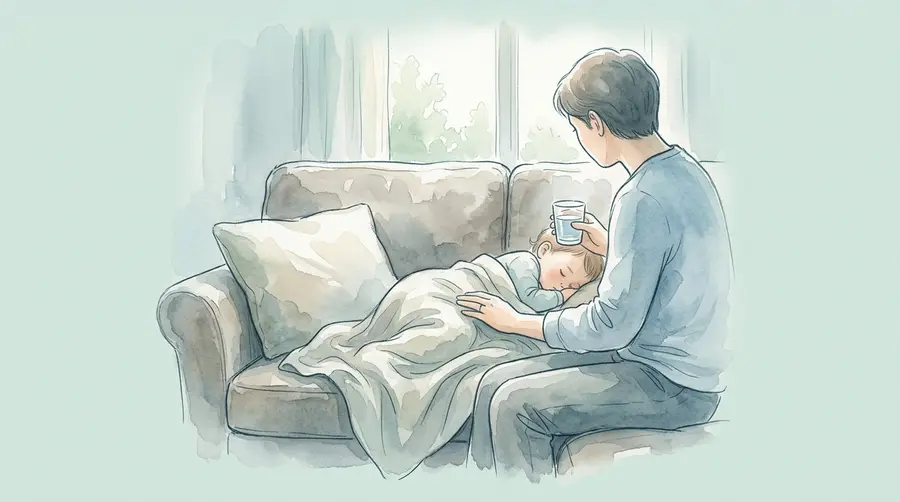
It's day three. The laundry is piling up, the floor is still sticky, and your child is lying pale on the sofa. Vomiting, diarrhoea — and you're asking yourself: When will this finally end, and at what point is it no longer normal?
Parents bring this exact question to GP surgeries every day. The most important thing first: three days of diarrhoea is usually still within the normal range — NHS guidance is that the diarrhoea of a stomach bug typically lasts 5 to 7 days and the vomiting 1 to 2. What decides things isn't the day count but how your child is doing: keep fluids up and watch for the warning signs below. Call your GP or NHS 111 straight away if a warning sign appears, and see a GP if the vomiting lasts more than 2 days or the diarrhoea more than a week. What to do concretely is up next.
Important note: This article does not replace medical advice. If you are unsure or in an emergency, contact 999, NHS 111, or your GP.
Is 3 days of diarrhoea and vomiting normal in children?
Yes — three days of diarrhoea is usually still normal. NHS guidance is that the diarrhoea of a stomach bug typically lasts 5 to 7 days, while the vomiting usually settles within 1 to 2 days. So watery stool on day three isn't cause for alarm on its own. What should prompt a call is a warning sign (see below), vomiting that lasts more than 2 days, or diarrhoea that runs beyond about a week — not the day count itself.
In a typical viral stomach bug — rotavirus in toddlers, norovirus in older children — vomiting usually comes first. It often eases up after 24 hours. The diarrhoea follows and can stretch over several days. Day 1: vomiting dominates. Day 2: vomiting and diarrhoea alternate. Day 3: usually just diarrhoea, often watery, slowly turning softer.
If your child's course looks different — vomiting still strong on day 3, diarrhoea getting more watery instead of firmer, new symptoms like abdominal pain or high fever — that no longer matches the normal pattern. That observation is the kind of insight only you as a parent can deliver.
Which warning signs need a GP right now?
These signs mean: don't wait. Sunken eyes, dry mouth, no urine for over 8 hours, lethargy, blood in stool or vomit, high fever on top, any infant under 3 months, or any child under 7 months or 8 kg — if even one applies, call your GP today, contact NHS 111, or go to A&E.
In babies under 3 months, vomiting or diarrhoea needs urgent medical advice — contact a GP or call NHS 111 straight away (call 999 or go to A&E if your baby seems seriously unwell).
See your GP today, call NHS 111, or go to A&E if your child:
- has sunken eyes or, in babies, a sunken fontanelle
- has a dry mouth, dry lips, or no tears when crying
- has fewer than one wet nappy in 8 hours or hasn't urinated for more than 8 hours
- is lethargic or severely drowsy, not really alert or responsive
- is breathing deeply and rapidly through the mouth
- has blood in vomit or stool, dark green vomit, or unstoppable vomiting for more than 4 hours
- has a high fever on top of vomiting and diarrhoea
- is under 7 months or under 8 kg with diarrhoea
These thresholds reflect NHS guidance. They are intentionally conservative. It's not your job in this moment to make a medical assessment — it's your job to call if even one of these signs applies. GP surgeries and NHS 111 expect exactly these calls.
The pediatrician asks. You can answer.
Symptom timeline, fever curve, last medication: With Mona you have it all in seconds, instead of guessing from memory.
What still helps on day 3 — and what doesn't anymore?
By day 3 the stomach has usually calmed down. Vomiting is rarer, but diarrhoea may still be watery. The focus shifts from "calm the stomach" to "replace fluid and salts." Instead of teaspoon-by-teaspoon, your child can now sip larger amounts. Light foods like toast, grated apple, or banana can come back in — if wanted.
Drinking: what, how, and how much
NHS guidance recommends an oral rehydration solution from the pharmacy (ORS). It provides not just water but also the sodium and glucose, in the right ratio, your child has lost over three days. After each loose stool or vomiting episode, a rough guide is 50–100 ml for infants and 100–150 ml for toddlers — over several minutes, not all at once. The detailed teaspoon-by-teaspoon method for children who can't keep anything down is covered in the sister article on stomach flu and fluids.
What you should also avoid on day 3:
- Soft drinks and cola — too much sugar, worsen diarrhoea
- Pure fruit juices — further irritate the gastrointestinal tract
- Loperamide and similar anti-diarrhoeal drugs — NHS guidance is clear that these should not be given to children under 12, and any use in children needs to be discussed with your GP first
- Salt sticks as a sole remedy — they don't replace an electrolyte solution
Eating: something can go in again
As soon as your child no longer feels nauseous, you can offer light foods — the so-called BRAT foods: Banana, Rice, Apple (grated), Toast or rusk. Gentle dishes like rice, banana, or toast are ideal. NHS guidance is to get back to normal eating once your child is rehydrated: a long, restricted "diet" tends to prolong diarrhoea rather than help.
Tip: On day three, write down especially carefully when the last vomiting was, when the last stool, how many wet nappies there were — and when your child last had visible energy. These notes are what your GP asks first, both on the phone and at the surgery. Parents who kept day 1 and day 2 in their head usually have gaps by day 3 — that's human, but avoidable.
When should you call your GP?
Call straight away — at any point, not just on day 3 — if your child shows a warning sign: drinking much less than usual, urinating noticeably less, unusual tiredness, or abdominal pain. Beyond the warning signs, NHS guidance is to see a GP if the vomiting lasts more than 2 days or the diarrhoea more than 7 days. Three days of diarrhoea on its own, in a child who is drinking and alert, is still within the normal range.
Concretely, call your GP or go in if at least one of the following applies:
- Diarrhoea lasting more than 7 days, or vomiting lasting more than 2 days (NHS)
- Very frequent watery stools: infant more than 4 in 24 hours, toddler more than 6, school-age child more than 8–10 (NHS guidance)
- Vomiting that won't stop or persists unstoppably for over 4 hours (especially in infants)
- Refusal to drink for more than 8 hours in infants, more than a day in toddlers
- Abdominal pain that won't ease or a hard, tense abdomen
- Visible weight loss — in small children noticeable from just a few hundred grams
- Fever on top above 39 °C, or fever that rises again after day 2 (see also fever in children: when it's dangerous)
Important: A phone call to your GP surgery is not an emergency and not a nuisance. Calls about exactly this situation are part of every GP surgery's daily routine. Better one call too many — especially if your gut tells you something is different this time than during earlier infections.
How do you as a parent get through day 3?
Day 3 is exhausting not just for your child — but for you too. The laundry is endless, the sofa smells, and maybe you haven't slept through in two nights. If you feel the overview slipping: that's normal. There are a few tricks that make the day, and especially the call to the office, much easier.
Four notes that shorten every doctor's call
When you call the surgery, the receptionist almost always asks the same four things — before you ever get through to the GP:
- When did it start? Date and rough time of the first vomiting or diarrhoea.
- How often is your child vomiting/stooling today? A rough number is enough — three, six, more than ten.
- When was the last urine? This single answer often decides whether you need to come in today or tomorrow.
- Is your child drinking anything — and keeping it down? A cup, a few sips, nothing?
Parents who have these four answers at hand get a much more concrete recommendation over the phone. Parents who don't — completely understandable on day 3 — often end up with "better come in," even when that wouldn't have been necessary.
Why a written timeline is worth so much on day 3
On day 1 you remember everything. On day 2 already less. By day 3 memory blurs — was that vomiting episode the fifth or the sixth? Was the last urine this morning or yesterday evening? These gaps aren't carelessness, they're the natural effect of sleep deprivation and constant stress. Writing things down isn't pedantry, it's a medical favor to your future self.
Tip: You don't need a perfect diary — a few keywords on a piece of paper or in your phone are enough. "8:15 vomiting," "11:30 ORS 50 ml, kept down," "14:00 watery stool, no blood," "16:00 urine (yellow)." With this list you'll get through the initial intake at the surgery in two minutes instead of ten.
Frequently asked questions about 3 days of diarrhoea and vomiting
How long is diarrhoea in a child still normal?
NHS guidance is that the diarrhoea of a stomach bug usually lasts 5 to 7 days, and the vomiting 1 to 2 days. So three days of diarrhoea is still within the normal range. See a GP if the diarrhoea runs beyond about a week, the vomiting beyond 2 days, or any warning sign appears — the day count on its own isn't the trigger.
My child has had diarrhoea for 3 days but no more vomiting — is that okay?
That's typical. Vomiting usually subsides first, while diarrhoea can drag on for several days. What matters isn't whether vomiting continues, but: Is your child drinking enough? Urinating regularly? Awake and responsive? If yes, keep watching. If not — or if you're unsure — call your GP today.
Should I still give ORS on day 3 or is water enough?
NHS guidance is to keep giving the oral rehydration solution (ORS) as long as watery stools or vomiting are occurring. Plain water in large amounts can upset the salt balance in small children. Once your child is eating normally and only soft stools remain, water and tea are fine — the precise recommendation comes from your GP surgery.
When can my child go back to nursery after 3 days of stomach flu?
The NHS advises staying off until your child has had no vomiting or diarrhoea for 48 hours. For reportable pathogens like norovirus or E. coli, longer wait times may apply. Ask both your GP and the nursery or childminder — the rules can vary. Afterward: thorough hand hygiene at home, since many pathogens remain contagious for days.
When do I need to take my child to A&E?
For sunken eyes, sunken fontanelle in babies, lethargy, blood in stool or vomit, no urine for over 8 hours, or any infant under 3 months with stomach-flu symptoms. Also for unstoppable vomiting lasting more than 4 hours, or for a child under 7 months or under 8 kg — your child belongs in medical hands, A&E or 999.
My child still won't eat anything on day 3 — is that a problem?
Not necessarily. Loss of appetite after stomach flu is normal and can last a few days. As long as your child drinks enough, urinates regularly, and seems alert, that's okay. If drink refusal is added or your child still won't try food 24 hours after improvement, a call to your GP surgery is worth it.
Do probiotics help with diarrhoea?
The evidence is mixed. Some probiotics may shorten diarrhoea by about one day, others show no effect. NHS guidance does not routinely recommend them. If you want to give probiotics, talk to your GP first — self-medication without consultation isn't necessary.
Summary: 3 days of diarrhoea and vomiting — what to do?
The shortest decision rule looks like this:
| Situation | What to do? |
|---|---|
| Infant under 3 months with vomiting or diarrhoea | Urgent — NHS 111 / GP straight away (999 if seriously unwell) |
| Sunken eyes, lethargy, blood in vomit/stool, sunken fontanelle | Call 999 or go to A&E |
| No urine for more than 8 hours, dry mouth, no tears | See your GP today or call NHS 111 |
| Unstoppable vomiting for more than 4 hours | See your GP today or call NHS 111 |
| High fever on top of diarrhoea and vomiting | See your GP today or call NHS 111 |
| Diarrhoea more than 7 days, or vomiting more than 2 days | Call your GP today |
| More watery stools than age-typical (infant > 4, toddler > 6, school-age > 8–10 / 24 h) | Call your GP today |
| Day 3, child drinks, urinates regularly, alert and responsive | Continue observing, ORS or tea |
Day-3 status check at a glance
| Observation | When it becomes critical |
|---|---|
| Wet nappies / urine frequency | Infant: no wet nappy in 8 h. Toddler: no urine in 8 h |
| Tears when crying | No more tears → fluid deficit |
| Mouth and lips | Dry lips, sticky mouth → see your GP today |
| Alertness / responsiveness | Lethargic, hard to wake → call 999 |
| Breathing | Fast and deep through mouth → see your GP today |
| Abdomen | Hard, tense, painful to touch → see your GP today |
| Stool | Blood, black, mucus-streaked → see your GP today |
Good to know: Three days of stomach flu means exhausting days for your child — and often for you too. Both are draining but rarely dangerous, as long as you keep an eye on the warning signs above and call your GP if one appears — or if things drag on beyond the usual few days. A short written timeline is the simplest help here — for you today and for every future surgery call.
About this article
Sources
- DGKJ Elterninformation: Mein Kind hat Durchfall(accessed 2026-05-10)
- AWMF S2k-Leitlinie: Akute infektiöse Gastroenteritis im Säuglings-, Kindes- und Jugendalter (Update 2024)(accessed 2026-05-10)
- BVKJ Kinderärzte im Netz: Durchfall — Sofortmaßnahmen(accessed 2026-05-10)
- BZgA kindergesundheit-info.de: Durchfall bei Babys und Kleinkindern(accessed 2026-05-10)
- BZgA kindergesundheit-info.de: Erbrechen bei Babys und Kleinkindern(accessed 2026-05-10)
- gesundheitsinformation.de (IQWiG): Durchfall(accessed 2026-05-10)