Ear Pain in a Child at Night: What Helps Immediately, When to See a Doctor

This blog only provides tips, tricks and hints and does not replace a doctor visit. For severe symptoms, always consult a doctor.
At a glance
- ✓Night ear pain in children is usually acute otitis media — it typically resolves on its own within 2 to 3 days.
- ✓Immediate help: elevate the upper body, apply a warm cloth, give age-appropriate pain relief — many traditional home remedies are unproven.
- ✓Call 999 for swelling behind the ear, apathy, purulent discharge or a severely sick child. Otherwise see your GP in the morning.
Table of Contents
- Was hilft sofort gegen Ohrenschmerzen nachts?
- Wann ist es ein Notfall — und wann reicht der Morgen?
- Wann reicht der Kinderarzt am Morgen?
- Was passiert im Ohr — und warum nachts?
- Häufige Fragen zu nächtlichen Ohrenschmerzen
- Wie lange dauert eine Mittelohrentzündung beim Kind?
- Helfen Ohrentropfen oder Zwiebelsäckchen wirklich?
- Mein Kind hat Ausfluss aus dem Ohr — was tun?
It's half past two. Your child wakes up crying, grabs at one ear and won't be comforted. You sit by the bed and one question loops: Do I leave now — or can this wait until morning?
Almost every child goes through this. More than 80 % of children develop acute otitis media in their early years — the most common cause of nighttime ear pain. The most important thing first: it typically resolves on its own within 2 to 3 days. For most children, head elevation, warmth and a pain reliever are enough to get through the night. Which warning signs mean a real emergency — you'll read below.
ℹ️ Important note: This article does not replace professional medical advice. If in doubt or in an emergency, always contact your GP or call 999.
What Helps Immediately Against Ear Pain at Night?
Sit your child upright or elevate the upper body — this lets inflammatory secretions drain more easily from the middle ear. Place a warm, soft cloth against the ear. Give an age-appropriate pain reliever (paracetamol or ibuprofen) strictly per the package leaflet. Speak calmly, hold your child close — closeness helps.
An elevated head is the single most important immediate measure. Lying flat, fluid pools in the middle ear, pressure on the eardrum rises — and that pressure is what causes the stabbing, pulsing pain at night. A slanted sleeping position (raised mattress head, an extra pillow, holding your child in a carrier) brings noticeable relief.
For warmth, a body-warm cloth or hand-warm (not hot) compress is enough — as long as your child finds it comforting. Anything hot is off limits for sensitive children's skin. For dosing, see our guide Ibuprofen or Paracetamol for Children — both relieve pain reliably, ibuprofen also reduces inflammation.
When Is It an Emergency — and When Can It Wait Until Morning?
Call 999 or go to A&E for: painful swelling or redness behind the ear, purulent or bloody ear discharge combined with high fever, apathy, a child who won't wake, or suspected foreign object.
In babies under 3 months, a temperature of 38°C or above needs urgent medical advice — contact a GP or call NHS 111 straight away (call 999 or go to A&E if your baby seems seriously unwell).
🚨 Call 999 or go to A&E immediately if your child:
- has swelling, redness or tenderness behind the ear (possible mastoiditis, a dangerous complication of otitis media)
- has purulent or bloody discharge from the ear plus a very sick child, high temperature or apathy
- has a stiff neck, high-pitched crying, altered consciousness or a rash that doesn't fade under pressure
- has ear pain after a fall, blow, or a suspected foreign object in the ear
When did she last have paracetamol?
The question that drives everyone crazy at night. Mona tracks doses and intervals automatically, so no one doubles up.
When Is the Morning Soon Enough?
If your child stays responsive, can drink and talk (or cry) and the pain reliever takes effect, you can usually wait until morning. Ear pain is always a reason to see your GP — only an exam reveals whether it's middle ear infection, ear canal infection, a foreign object, or referred pain from teeth or jaw.
Call your GP surgery on the next working day if:
- Your child can barely sleep or drink because of pain
- High fever is also present
- You see fluid coming from the ear
- Your infant is under 6 months old
- Symptoms persist > 2 days despite elevation and pain relief — antibiotics may become necessary
What's Happening Inside the Ear — and Why at Night?
Acute otitis media usually develops during a cold: mucus blocks the small Eustachian tube, fluid builds up in the middle ear, bacteria or viruses multiply. Lying down, this fluid can't drain — pressure builds at night, and that's why the pain is usually worst in bed.
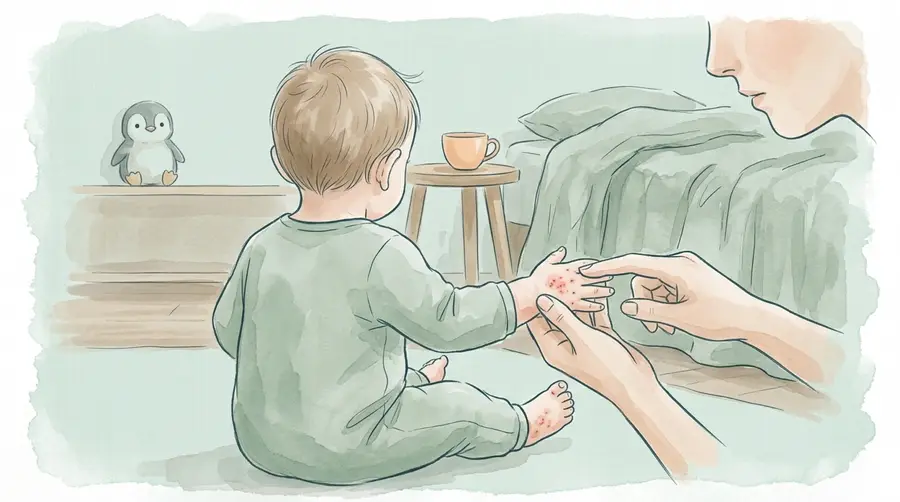
Children typically get otitis media between six months and 6 years — in that age range the Eustachian tube is still short and flat, which makes drainage harder. Young children who can't yet speak show pain differently:
- They repeatedly grab the ear, poke a finger in, shake their head
- They cry harder when lying down than sitting or being carried
- They drink or eat poorly, because swallowing increases pressure
- Sometimes vomiting, diarrhoea or fever are added
💡 Tip: Even at night, jot down when the pain started, which side, how high the fever was, and what time you gave which pain reliever. These notes help your GP in the morning — and help you not forget anything despite sleep deprivation. More tips: The Memory Gap at the GP Appointment.
Frequent Questions About Nighttime Ear Pain
How Long Does a Middle Ear Infection Last in a Child?
Acute otitis media typically resolves on its own within 2 to 3 days. Roughly 80 % of children show clear improvement within the first three days. If symptoms persist beyond two days despite pain relief and head elevation, see your GP — antibiotics may become necessary.
Do Ear Drops or Onion Pouches Actually Help?
Many home remedies are popular but scientifically unproven. Onion pouches, red-light warming and cherry-stone pillows can soothe some children — but they don't help every family. Ear drops should only be used in consultation with a GP — especially if the eardrum may not be intact.
My Child Has Discharge From the Ear — What Should I Do?
Clear or purulent fluid can mean the eardrum has given way under pressure. This is common and usually heals on its own. Still: see your GP the same day. Wipe only from the outside, never insert anything into the ear canal. If your child is very sick or feverish: call 999.
Can My Child Go Back to Nursery With Otitis Media?
As long as your child has strong pain or fever, they should stay home. Rule of thumb: when your child is fever-free for 24 hours without fever-reducing medication, pain-free and active again, they can return. Some GPs recommend protecting the ear from water until the inflammation has fully resolved.
Are Antibiotics Always Necessary for Ear Pain?
No. For most children, a wait-and-see strategy with pain relief is enough — spontaneous healing is the rule. Antibiotics are mainly considered for infants under 6 months, bilateral inflammation, purulent discharge, or no improvement after 2 days. Your GP decides based on the examination of the ear.
How Can I Prevent Nighttime Ear Pain?
Otitis media can't be fully avoided — it often follows colds. Helpful: a smoke-free environment, plenty of fluids when sick, short-term decongestant nasal drops as directed, and breastfeeding in early months. If your child has ear pain several times a year, an ENT specialist should check for fluid buildup or adenoid issues.
Summary: Emergency, GP, or Wait Until Morning?
| Situation | What to do? |
|---|---|
| Swelling/redness behind the ear, very sick child | Call 999 or go to A&E |
| Infant < 3 months with fever | Urgent — NHS 111 / GP straight away (999 if seriously unwell) |
| Purulent discharge + high fever + apathy | Call 999 |
| Stiff neck, altered consciousness, non-blanching rash | Call 999 |
| Clear ear discharge, child otherwise responsive | GP same day |
| Symptoms persist > 2 days despite pain relief | GP soon |
| Infant 3–6 months with ear pain or fever | NHS 111 or see a GP |
| Child is responsive, pain relief works, falls back asleep | Elevate, warmth, call your GP in the morning |
About this article
Sources
- gesundheitsinformation.de: Mittelohrentzündung(accessed 2026-05-10)
- gesundheitsinformation.de: Was können Eltern bei einer Mittelohrentzündung tun?(accessed 2026-05-10)
- AWMF S2k-Leitlinie Akute Otitis media (017-005)(accessed 2026-05-10)
- Kinderärzte im Netz (BVKJ): Mittelohrentzündung — Symptome & Krankheitsbild(accessed 2026-05-10)
- Kinderärzte im Netz (BVKJ): Mittelohrentzündung — Therapie(accessed 2026-05-10)
- Kinderärzte im Netz: Hochgelagerter Kopf lindert nachts den Schmerz(accessed 2026-05-10)
- Kinderärzte im Netz AT: Ohrenschmerzen sind immer ein Grund zum Arzt(accessed 2026-05-10)
- HNO-Ärzte im Netz: Mögliche Komplikationen einer akuten Mittelohrentzündung(accessed 2026-05-10)