Hand, Foot and Mouth Disease in Children: How Long Contagious and When Back to Nursery?

This blog only provides tips, tricks and hints and does not replace a doctor visit. For severe symptoms, always consult a doctor.
At a glance
- ✓Hand, foot and mouth disease almost always runs a mild course — most children recover within 7 to 10 days without treatment.
- ✓Your child is most contagious during the first week of illness; the virus can be shed in stool for weeks afterward.
- ✓Back to nursery: when your child has been fever-free for 24 hours, the blisters are drying, and they feel well enough to participate.
Table of Contents
- Was ist die Hand-Fuß-Mund-Krankheit eigentlich?
- Wie lange dauert die Hand-Fuß-Mund-Krankheit?
- Wie lange ist mein Kind ansteckend?
- Was bedeutet die wochenlange Stuhlausscheidung praktisch?
- Wann darf mein Kind wieder in die Kita?
- Was sagt die Kita oft trotzdem?
- Welche Hausmittel helfen wirklich?
- Schmerzen und Fieber lindern
You're changing your child's nappy and you spot them: small red dots on the palms, on the soles of the feet, plus a fussy child who refuses to eat. Inside the mouth: painful blisters. You search "hand foot and mouth disease" — and immediately read about weeks of contagiousness.
Take a breath. Hand, foot and mouth disease (HFMD) sounds dramatic, but in the vast majority of cases it's harmless and resolves on its own. What parents really need to know: how long your child is contagious, when they can go back to nursery, and the few warning signs that mean a call to the GP. That's what this article covers — short, concrete, with the sources behind every claim.
ℹ️ Important note: This article does not replace professional medical advice. If in doubt or in an emergency, always contact your GP or emergency services.
What Is Hand, Foot and Mouth Disease?
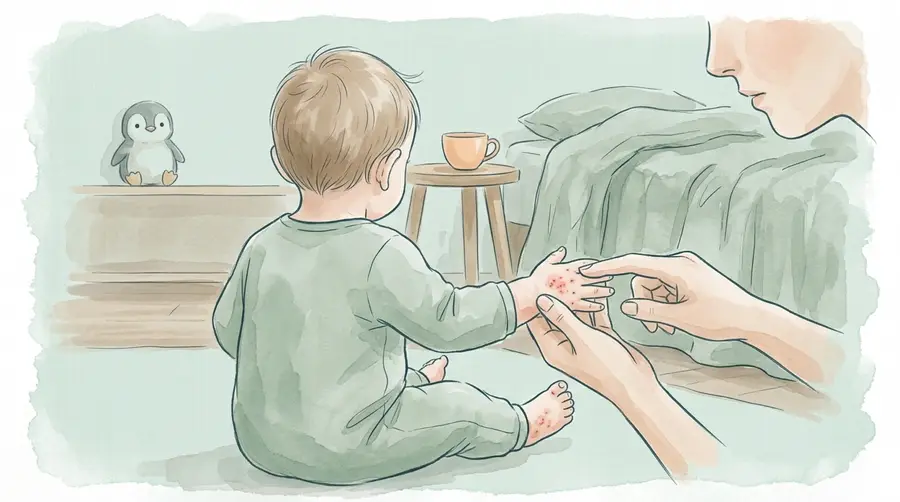
Hand, foot and mouth disease is a contagious viral illness caused by enteroviruses — most commonly coxsackievirus. It mainly affects children under five and shows up most often in summer and early autumn. Typical signs: fever, painful mouth blisters, and a non-itchy rash on the palms, soles, and sometimes on the buttocks, knees, or elbows.
Despite the alarming name, HFMD is not the same as foot-and-mouth disease in animals — different viruses, completely separate. There is no vaccine available in most countries, and a past infection only protects against that specific virus. Your child can technically get HFMD more than once, with a different enterovirus each time.
The good news: most cases are mild and self-limiting. According to NHS guidance, most children have mild symptoms for 7 to 10 days, and complications from HFMD are rare. The unsettling part is mostly the appearance — blisters and rashes on a small child look worse than the actual illness usually is.
How Long Does Hand, Foot and Mouth Last?
Most children recover within 7 to 10 days without treatment (NHS). The first signs (fever, sore throat, no appetite) appear 3 to 6 days after exposure (NHS guidance). Mouth blisters follow within 1 to 2 days, then the rash on hands and feet a day or two later. Symptoms peak in the first few days and are usually gone within a week.
The progression has a typical pattern: fever first, then the painful red spots inside the mouth — especially toward the back of the tongue, gums, and inside cheeks — that turn into blisters and small open sores. Only after that does the rash on the palms and soles appear. Some children also get spots on the buttocks, legs, or elbows.
A useful fact for context: roughly 80% of people who get infected with HFMD viruses have no symptoms at all. Many children pass through the infection completely unnoticed. Only a portion show the full picture with blisters and rash.
The pediatrician asks. You can answer.
Symptom timeline, fever curve, last medication: With Mona you have it all in seconds, instead of guessing from memory.
How Long Is My Child Contagious?
Per NHS guidance, your child is most contagious during the first week of illness. Children may also shed the virus from the respiratory tract for 1 to 3 weeks, and the virus can be present in stool for weeks after symptoms resolve. In real life, full isolation is impossible — what matters is hand hygiene and how your child clinically feels.
Transmission happens through three routes: direct contact with saliva or fluid from the blisters, contact with stool (for example during nappy changes), and respiratory droplets in the first days. That's why nurseries are classic summer hotspots — shared toys, close contact, communal nappy-changing.
💡 What hygiene actually means: Wash hands thoroughly with soap after every nappy change and bathroom visit — both yours and your child's. Don't share dishes, cutlery, towels, or pacifiers. Wash toys that go into the mouth. Throw used tissues straight into the bin. These simple steps significantly reduce risk for the rest of the family.
What Does Weeks of Stool Shedding Mean in Practice?
Even after the blisters have healed, your child can still shed the virus through stool for weeks. But NHS guidance does not recommend isolating children for that long — it would be unworkable for most families and would barely slow the spread anyway. Diligent hygiene is enough in nearly all situations.
When Can My Child Go Back to Nursery?
Per NHS guidance, children can return to nursery or school as soon as they feel well enough — there's no need to wait until all the blisters have healed. Rule of thumb: at least 24 hours fever-free without medication, eating and drinking normally, blisters drying. There is no medical "non-contagious" certificate — it's about the clinical state.
This rule surprises many parents because it doesn't match the intuitive expectation of "contagious = stay home." The reasoning from NHS / public health guidance: since the virus continues to be shed in stool for weeks after symptoms resolve, longer isolation wouldn't meaningfully prevent spread. What matters is the clinical state — how your child actually feels.
⚠️ Worth knowing: Some nurseries have stricter rules than the NHS medical minimum — they may require fully healed blisters before return. That's a facility policy, not a medical mandate. If your child is fully recovered, ask the nursery manager: NHS guidance is that as long as the child is fever-free, feels well, and has no uncontrolled drooling, they can return.
What Nurseries Often Say Anyway
Many nurseries insist on longer waiting periods out of caution or tradition — sometimes until the rash has completely cleared. That's house policy, not a medical requirement. If your child is back to their usual self, ask the manager kindly: NHS guidance is clear — drying blisters and 24 hours fever-free is enough.
What Home Remedies Actually Help?
There is no specific cure for HFMD — only symptomatic relief. Pain medication if needed, fever reducers when your child is uncomfortable, plenty of fluids, and cool soft foods. Antibiotics don't help because it's a viral infection. The proven measures are simple to apply — and that's exactly the point.
Pain and Fever Relief
Paracetamol or ibuprofen help if your child is visibly suffering — for example because mouth blisters make swallowing painful or fever is disrupting sleep. Always dose strictly by body weight and follow the label or your GP's instructions. Never give aspirin to children under 16 (risk of Reye's syndrome).
Hydration Is the Top Priority
Mouth blisters make drinking uncomfortable — and that's where the real risk of HFMD lies: dehydration, because your child drinks less due to pain. What helps:
- Cold drinks: water, diluted juice, unsweetened tea — straight from the fridge.
- Soft, cool foods: yogurt, pudding, applesauce, popsicles, chilled soups.
- Avoid sour and spicy: orange juice, lemon, vinegar — they sting open sores.
- Small sips often are better than large amounts at once.
NHS guidance is direct on this: contact your GP or NHS 111 if you suspect your child is dehydrated. Watch for fewer wet nappies, dry lips, no tears when crying, and lethargy.
Caring for the Blisters
Leave the blisters alone — don't pop them, don't let your child scratch them. Dress your child in cotton, keep nails short, keep skin clean and dry. In most cases, that's all you need to do.
When Should I Call the GP?
Three signals warrant a prompt call: your child is drinking too little or showing signs of dehydration; fever lasts more than 3 days or rises again after a calmer phase (NHS guidance); or you see unusual symptoms like neck stiffness, difficulty breathing, altered consciousness, or a rash that doesn't fade under pressure — then call 999 or go to A&E immediately.
Complications from HFMD are rare (NHS), but possible: aseptic meningitis, encephalitis, and very rarely cardiac or pulmonary involvement. They are uncommon precisely because the disease almost always stays mild — but knowing the warning signs and calling without hesitation when something feels off is the safest approach.
In babies under 3 months, a temperature of 38°C or above needs urgent medical advice — contact a GP or call NHS 111 straight away (call 999 or go to A&E if your baby seems seriously unwell).
🚨 Call 999 or go to A&E immediately if your child:
- has a stiff neck — cannot bring chin to chest
- has difficulty breathing or very rapid breathing, with retractions between the ribs
- is unresponsive, lethargic or hard to wake
- has a rash that doesn't fade under pressure (the glass test)
- has a febrile seizure or unusual jerking movements
Infants and Pregnancy
In very young infants — especially in the first two weeks of life — enterovirus infections can in rare cases turn severe. So the rule is: anyone with active HFMD should avoid contact with newborns. During pregnancy, infections usually stay mild; around the due date there is more reason for caution — when in doubt, talk to your midwife or GP.
Weeks Later: Nails Can Lift Off
A rare but harmless late effect: about 4 to 8 weeks after the illness, individual finger- or toenails can come off (a phenomenon called onychomadesis). It looks alarming, but it's self-resolving — the nails grow back fully. If your child has no pain, you don't need a special visit — just mention it at the next regular check-up.
How Can I Track the Course at Home?
If you want to be sure later about what was when — how high yesterday's fever was, when the first blisters appeared, whether your child drank less today than yesterday — short daily notes help. Reconstructing three days later in a sleep-deprived haze rarely works. A simple symptom diary takes that weight off you.
With Mona, you log what matters in seconds: temperature curve, new blisters, fluid intake, medication. That helps you assess the course realistically — and at your GP appointment you have answers ready instead of guessing. For more on why systematic observation matters, see Is My Child Constantly Sick — Is That Normal? and When Is Children's Fever Dangerous?.
Frequently Asked Questions About Hand, Foot and Mouth Disease
How Long Is My Child Contagious After the Blisters Appear?
Per NHS guidance, children are most contagious during the first week of illness when fever and blisters are active. The virus can also be shed via the respiratory tract for 1 to 3 weeks and through stool for weeks after symptoms resolve. Full isolation isn't practical — diligent hand hygiene is what matters most.
When Can My Child Go Back to Nursery After HFMD?
Per NHS guidance, your child can return as soon as they feel well enough — no need to wait for the blisters to heal. Rule of thumb: 24 hours without fever, normal eating and drinking, child generally feeling fine again. Individual nurseries may apply stricter house rules — check with your nursery.
Can Adults Get Hand, Foot and Mouth Disease?
Yes — adults can be infected too, often with milder or even no symptoms. If you as a parent notice typical blisters or sore throat, you can continue to care for your child but should avoid contact with newborns, pregnant people, and immunocompromised individuals until the blisters have dried.
Is Hand, Foot and Mouth Disease Dangerous in Pregnancy?
Per NHS guidance, enterovirus infections in pregnancy usually run a mild or even asymptomatic course. The main concern is around the due date, when the virus can be transmitted to the newborn and severe courses are more likely in the first two weeks of life. Pregnant parents should discuss any suspected case with their midwife or GP.
What Helps with the Mouth Pain?
Cool, soft foods like yogurt, pudding, or popsicles ease the discomfort in the mouth. Avoid sour and spicy foods. Pain relievers like paracetamol or ibuprofen help if your child won't drink due to pain — always dosed by body weight. For large bleeding sores or persistently poor drinking, contact your GP.
Can My Child Get HFMD More Than Once?
Yes. HFMD is caused by several different enteroviruses — a past infection only protects against that specific virus, not all of them. Some children get HFMD more than once across different summers, with a different enterovirus each time. There is no broadly available vaccine in most countries.
Are the Nails Falling Off Weeks Later a Cause for Concern?
No. About four to eight weeks after HFMD, individual finger- or toenails can lift off — this is called onychomadesis and is a harmless late effect. The nails grow back fully without lasting damage. If your child has pain, swelling, or several nails affected at once, mention it to your GP for reassurance.
Summary: Call, A&E, or Watch at Home?
| Situation | What to Do? |
|---|---|
| Stiff neck, breathing difficulty, altered consciousness, non-fading rash | Emergency — call 999 / A&E |
| Baby under 3 months with fever or blisters | Urgent — NHS 111 / GP straight away (999 if seriously unwell) |
| Child barely drinking, fewer wet nappies, lethargic | GP / NHS 111 today |
| Fever lasting more than 3 days or rising again | GP today |
| Contact with a newborn or late-pregnancy parent during contagious phase | Call your GP |
| Blisters, moderate fever, child still drinks and plays at times | Watch, cool foods, plenty of fluids |
| Blisters drying, 24 h fever-free, child feels well | Nursery-ready (check facility rules) |
Worth knowing: HFMD usually doesn't require any reporting and there's no specific treatment — the illness resolves on its own, typically within a week. Inform your nursery so other parents can watch for symptoms in their children. The most important things you can do at home: keep your child hydrated and watch for the warning signs above.
About this article
Sources
- RKI-Ratgeber Hand-Fuß-Mund-Krankheit (HFMK)(accessed 2026-05-10)
- Gesundheitsinformation.de (IQWiG): Hand-Fuß-Mund-Krankheit(accessed 2026-05-10)
- Infektionsschutz.de (BZgA): Hand-Fuß-Mund-Krankheit(accessed 2026-05-10)
- Kinderärzte im Netz (BVKJ): HFMK-Elternmerkblatt(accessed 2026-05-10)
- Kinderärzte im Netz (BVKJ): Warum Kinder mit HFM-Punkten die Kita besuchen dürfen(accessed 2026-05-10)
- Kinderärzte im Netz (BVKJ): Schwangere und Neugeborene(accessed 2026-05-10)