
Conjunctivitis in Children: Is It Contagious and When Can They Go Back to Nursery?
This blog only provides tips, tricks and hints and does not replace a doctor visit. For severe symptoms, always consult a doctor.
At a glance
- ✓You can spot conjunctivitis by red, watery or sticky eyes. Viral and bacterial forms are contagious; an allergic one is not.
- ✓Most conjunctivitis in children is mild and clears up on its own within 1 to 2 weeks without antibiotics.
- ✓See your GP if your child has eye pain, changes in vision, light sensitivity, or swelling around the eye — and contact your GP if your child is under 2. Children usually do not need to be kept off nursery or school.
Table of Contents
- Is my child's conjunctivitis contagious?
- When should I see a doctor?
- Does my child need to stay off nursery or school?
- What helps with conjunctivitis — and when are antibiotics needed?
- Frequently asked questions about conjunctivitis in children
- How long is conjunctivitis contagious?
- Does conjunctivitis always need antibiotics?
- Can my child go swimming with conjunctivitis?
Your child's eye is red, watery and crusted shut in the morning. Your first thought: is this contagious — and do they need to stay home? Here's the reassuring part first: most cases of conjunctivitis are mild and clear up on their own. You just need to know the few warning signs, and how the UK childcare rules actually work. That's exactly what we'll cover.
Is my child's conjunctivitis contagious?
It depends on the cause. Viral and bacterial conjunctivitis are contagious and usually spread by hands — often from one eye to the other. Allergic conjunctivitis is not contagious; it's triggered by pollen, dust or pet hair rather than germs. The type of discharge often gives you the first clue about which one you're dealing with.
| Form | Typical sign | Contagious? |
|---|---|---|
| Bacterial | Yellow-white discharge that sticks the eyelids together (especially in the morning) | Yes |
| Viral | More watery, clear discharge, often with a cold | Yes |
| Allergic | Strong itching, usually both eyes red, no infection | No |
This is a rough guide, not a diagnosis. In small children, viral and bacterial forms can't always be told apart by appearance — when in doubt, your GP can take a look.
When should I see a doctor?
Most conjunctivitis can simply be watched at home. Speak to your GP if your child has eye pain, light sensitivity, any change in vision, or redness and swelling of the skin around the eye. Always contact your GP if your child is under 2 years old. For non-urgent advice you can also ask your community pharmacist, or call NHS 111 out of hours.
- changes in vision or increased sensitivity to light
- pain in the eye (rather than just irritation), or a severe headache with nausea
- redness, swelling or warmth of the skin around the eye, especially with a temperature
- conjunctivitis and is under 2 years old, or is a newborn baby
- no improvement after a few days, or symptoms that are getting worse
Your GP is the right first port of call and can refer you to an eye specialist if needed.
The pediatrician asks. You can answer.
Symptom timeline, fever curve, last medication: With Mona you have it all in seconds, instead of guessing from memory.


Does my child need to stay off nursery or school?
In most cases, no. NHS guidance is clear that children do not need to be kept away from nursery or school just because they have conjunctivitis. You only need to keep your child at home if they are feeling very unwell in themselves. This is more relaxed than the rules in some other countries, where a doctor's note is sometimes asked for.
That said, conjunctivitis does spread easily, so good hygiene matters while the eye is still red and weepy. Check your individual nursery's policy too — some settings have their own house rules even where the NHS does not require exclusion. Track the course in Mona: when the eye first turned red, what the discharge looks like, and any other symptoms. With partner sync, whoever does the nursery drop-off has the full picture.
What helps with conjunctivitis — and when are antibiotics needed?
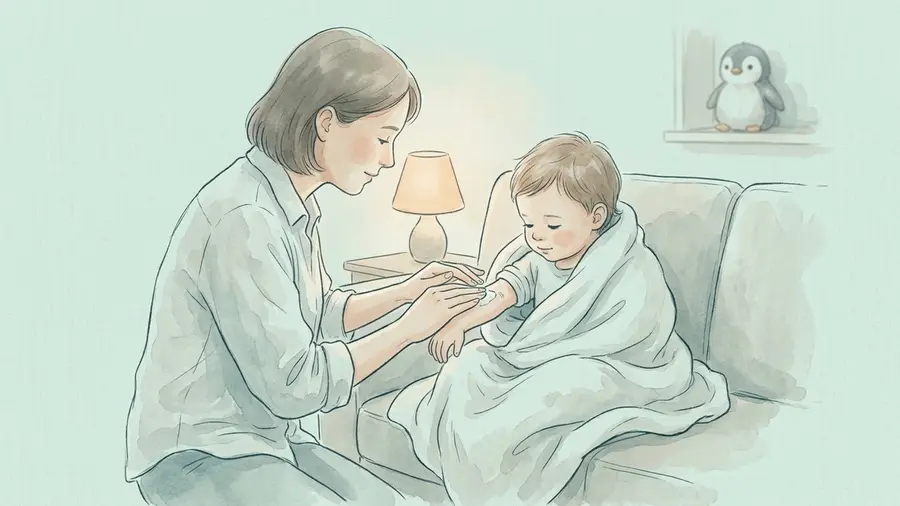
Gentle care is usually enough. Clean sticky eyelids carefully with cotton wool dipped in warm water, wiping from the nose side outwards and using a fresh piece for each eye. Most conjunctivitis in children clears within 1 to 2 weeks without any treatment, and lubricating "artificial tears" can ease irritation in the meantime.
Most children do not need antibiotics, and they don't work against viral or allergic conjunctivitis at all. If antibiotic drops are appropriate, that's a decision for your GP or pharmacist. Don't reach for leftover eye drops at home — the right treatment for a child's eye belongs in medical hands.
Frequently asked questions about conjunctivitis in children
How long is conjunctivitis contagious?
It depends on the cause. As a rule of thumb, a contagious form can spread for as long as the eye is red and weeping. Careful and frequent hand-washing is the single most effective way to stop it passing through the household and the nursery. When in doubt about returning to childcare, ask your GP.
Does conjunctivitis always need antibiotics?
No. Most conjunctivitis clears on its own, and antibiotics don't help with viral or allergic forms at all. Even bacterial conjunctivitis usually gets better without them. Whether antibiotic drops are worthwhile is a decision for your GP or pharmacist, not something to start from the medicine cabinet.
Can my child go swimming with conjunctivitis?
While the eye is inflamed and contagious, it's best to skip the pool — both to protect other swimmers and because chlorinated water irritates an already sore eye. Wait until the inflammation has settled, and check with your GP or pharmacist if you're unsure.
How do I stop the whole family catching it?
Frequent hand-washing is the most important protection, especially after touching the eyes. Everyone gets their own towel, flannel and pillow, and you don't share eye drops or make-up. That usually keeps this kind of hand-to-eye spread contained within a household.
Can conjunctivitis clear up on its own?
Yes — that's actually the norm. Most conjunctivitis in children clears within 1 to 2 weeks without treatment. The important thing is to keep an eye on the warning signs above and keep the eye clean while it settles.
When should a baby with sticky eyes see a doctor?
In newborns and young babies, always get a red, very sticky or pus-filled eye checked promptly, and contact your GP if your child is under 2. Babies can't tell you what they feel, and their eyes are more delicate. It's better to ask once too often than to miss a more serious cause.
Summary: when to see a doctor about conjunctivitis
| Situation | What to do |
|---|---|
| Vision changes, eye pain, light sensitivity, swelling around the eye | See your GP today (or 999 / A&E if severe) |
| Newborn or baby with a red, sticky eye, or a child under 2 | Contact your GP promptly |
| Red, watery or sticky eye, child otherwise well | Watch at home, keep the eye clean, focus on hygiene |
| Strong itching, both eyes, no infection | Think allergy — ask your GP |
Conjunctivitis often looks more dramatic than it is. If you jot down the basics — which eye, since when, what kind of discharge, any other symptoms — it's easier to judge the situation and to tell your GP exactly what's been going on.
About this article
Sources
- NHS: Conjunctivitis(accessed 2026-06-30)
- NHS: Common cold (eye care and self-care basics)(accessed 2026-06-30)
You might also like

Track symptoms easily
With Mona you stay on top of things – even at 3 AM.