
RSV in babies: symptoms, how long it lasts and when it is serious

This blog only provides tips, tricks and hints and does not replace a doctor visit. For severe symptoms, always consult a doctor.
At a glance
- ✓RSV starts like a cold in most babies. It becomes serious when it reaches the lower airways as bronchiolitis — then your baby breathes faster than usual, coughs harder and feeds less.
- ✓Call 999 for difficulty breathing, grunting noises, the tummy sucking under the ribs, pauses in breathing, blue or grey skin, tongue or lips, or a floppy baby who will not wake up.
- ✓NHS: symptoms are usually worst between days 3 and 5, and the cough usually gets better in 3 weeks. There is no medicine for the virus — fluids, a clear nose and rest are what matter.
Table of Contents
RSV in babies: symptoms, how long it lasts and when it is serious
Your baby had nothing but a runny nose for two days. Now there is a cough, the breathing looks faster than usual, and at the bottle they take a few sips and turn their head away.
Here is the key point first: RSV is extremely common in babies, and most get through it with a cold, a cough and a raised temperature. What matters is not the virus itself but one single thing — whether your baby is still breathing comfortably and feeding.
Which signs count, when to call for help and how long this normally lasts — section by section below.
Important: This article does not replace professional medical advice. If you are unsure, contact your GP or NHS 111. In an emergency, call 999 or go to A&E.
How do you recognise RSV in your baby?
RSV usually starts like an ordinary cold. The NHS lists sneezing, a runny or blocked nose and a slightly high temperature as the early signs. After a few days it can move into the lower airways as bronchiolitis. Then your baby breathes more quickly, coughs harder and finds it difficult to feed.
The NHS page on bronchiolitis names the symptoms of that second stage directly: "a cough, breathing more quickly, finding it difficult to feed or eat, noisy breathing (wheezing or crackling sounds), becoming irritable". And it is clear about the cause: "Bronchiolitis is caused by a viral infection, usually respiratory syncytial virus (RSV)."
The comparison that matters is with your own baby, not with a number. There is no breath count you need to time and hold against a threshold. What tells you something is whether the breathing looks harder than yesterday, and whether feeds are getting shorter.
Which warning signs need urgent help?
Call 999 if your baby is struggling to breathe, or if you notice grunting noises or their tummy sucking under the ribs. The same goes for pauses in breathing, for blue or grey skin, tongue or lips, and for a floppy baby who will not wake up. Everything else goes to your GP, the same day.
Call 999 or go to A&E immediately if your child:
- is having difficulty breathing — the NHS says "you may notice grunting noises, their tummy sucking under their ribs or they may be breathing quickly"
- has pauses when they breathe
- has skin, tongue or lips that are blue or grey
- is floppy and will not wake up or stay awake
These four points are the NHS emergency list for bronchiolitis, condensed from its own wording. Below that level, the NHS asks you to get an urgent GP appointment or help from NHS 111. Four things trigger that call: a cold that is getting worse, feeding or eating much less than normal, a dry nappy for 12 hours or more, or a child who is very tired, irritable or does not seem themselves.
Temperature has its own thresholds on the same page. Under 3 months, 38C counts; over 3 months, it is 39C or higher. Either one is a reason to get urgent advice. Babies under 3 months need a lower bar in general — speak to your GP or NHS 111 straight away rather than waiting, and call 999 only if your baby is seriously unwell.
Still feeding, awake, responsive and breathing calmly? Then this is very likely an infection that runs its course at home, with a cough, some bad nights and a lot of nose wiping.
How much has your child actually drunk today?
With tummy bugs, that's the question that matters. Mona logs fluids, vomiting and wet nappies in seconds — so you can see whether it's enough.


How long does RSV last in a baby?
Most babies come through within a week or so. The NHS is specific about the shape of it: "Symptoms are usually worst between days 3 and 5, and the cough usually gets better in 3 weeks." So the worst days come in the middle, not at the start — and the cough outlasts everything else by a long way.
That long cough is the normal course, not a sign that something was missed. What counts during those weeks is the direction of travel. A baby who is gradually feeding more and breathing more easily is on the way up. A baby who was improving and then clearly gets worse again needs to be seen — the NHS asks you to get urgent advice when a cold is getting worse rather than better.
For nursery and childcare there is no fixed exclusion period on the NHS bronchiolitis page. The practical line is the one that applies to any respiratory infection. Keep a baby at home while they are unwell. And keep newborns away from anyone with a cold — that part the NHS does say explicitly.
What helps your baby at home?
There is no medicine that clears the virus. The NHS self-care advice for bronchiolitis is short: "encourage your child to drink lots of fluids", "keep your child upright as much as possible when they're awake", and "give children's paracetamol to babies and children over 2 months old" if they are uncomfortable.
What works in practice:
- Smaller feeds, more often. A baby with a blocked nose cannot manage a full feed. Five short attempts get more in than two abandoned ones.
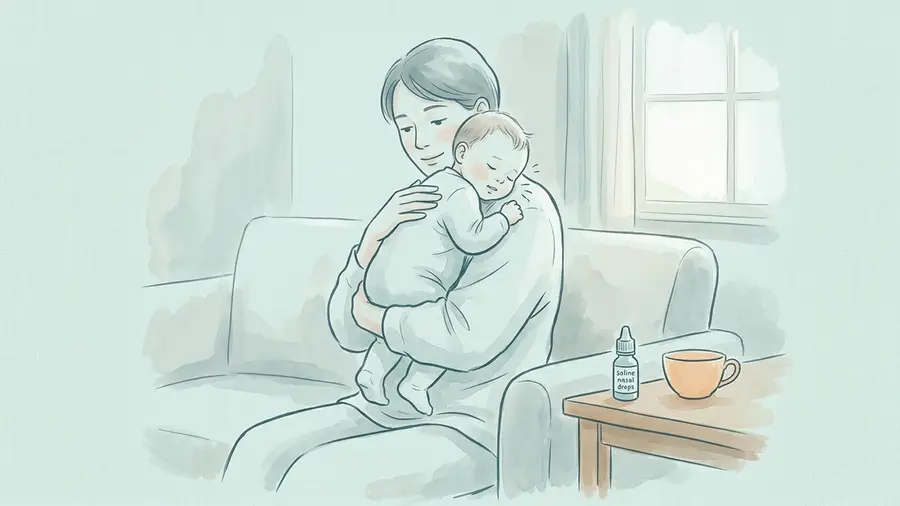
- Clear the nose before feeding. A little saline, then offer the breast or the bottle.
- Hold them upright. Many babies breathe more easily on a shoulder than lying flat.
- Count the wet nappies. They are the most reliable sign that enough is going in — and the NHS uses a dry nappy for 12 hours or more as a trigger for urgent advice.
Paracetamol does not treat RSV. It can make an uncomfortable baby more comfortable. Follow the dose on the packaging, and check with your pharmacist or GP if you are unsure. Which medicine suits when is covered in Ibuprofen vs paracetamol for children.
The point that matters most at 3am: in babies it is not how dramatic the cough sounds that counts, but how the breathing looks and how much is going in. For coughs more broadly, see Cough in children.
How do you keep track of breathing and feeds?
Two things decide how this gets judged: how your baby breathes and how much they drink. Both change slowly, over hours. That is exactly why it is hard to notice at home. Writing down feeds and wet nappies shows you the trend instead of leaving you to guess.
Four things are enough across a day: the time, how much your baby drank, whether the nappy was wet, and whether the breathing looks calmer or harder than at the last feed. Add the temperature if you took it. Nothing more — and with a coughing baby on your arm, nothing more is realistic.
In Mona you log a feed, a nappy and a temperature in seconds. The timeline then shows whether feeds have been getting smaller since yesterday — the one question you cannot answer from memory in the middle of the night. If your partner or a grandparent takes over for a few hours, they see the same picture.
Your GP will ask: when did the cough start? How much is your baby feeding compared with before? How many wet nappies in the last 24 hours? Has there been a temperature? With a record in front of you, you answer from your notes instead of from memory.
The pediatrician asks. You can answer.
Symptom timeline, fever curve, last medication: With Mona you have it all in seconds, instead of guessing from memory.
How can you protect your baby from RSV?
In the UK the main protection comes before birth. The NHS offers an RSV vaccine in pregnancy, recommended from 28 weeks and in every pregnancy. It is timed so your baby is covered for the first months after birth. Those are the months in which RSV is most likely to make a baby seriously unwell.
The RSV vaccine page states both parts. On who it is for: "you're 28 weeks pregnant or more – the vaccine is recommended during every pregnancy". And on why the timing matters: "This will help make sure each baby is protected for the first 6 months after they're born, when they're most likely to get seriously ill if they get RSV."
The vaccine is normally given "around the time of your 28-week antenatal appointment", although the NHS notes it "can be given later if needed, including up until you go into labour". It is also offered to adults aged 75 or over.
Alongside that, the NHS lists practical steps to stop bronchiolitis spreading:
| What to do | NHS wording |
|---|---|
| Hands | "wash your hands and your child's hands often" |
| Toys and surfaces | "wash or wipe down toys and clean surfaces regularly" |
| Shared items | "avoid sharing things like cutlery and cups" |
| Tissues | "use disposable tissues and throw them away as soon as you've used them" |
| Newborns | "keep newborn babies away from anyone with a cold or the flu" |
| Smoking | "do not smoke around your child" |
None of this makes RSV avoidable. Nearly every child meets the virus early, and most meet it more than once. What these steps change is the odds during the months when a baby is least able to cope with it.
Common questions about RSV in babies
Is RSV dangerous for my baby?
For most babies RSV behaves like a cold. It becomes serious when it reaches the lower airways as bronchiolitis, which the NHS says "can be serious in some children, who may need to be treated in hospital". What decides the course is not the diagnosis but how well your baby breathes and feeds.
At what age is RSV most risky?
The first few months are the most vulnerable. The NHS lists babies born very prematurely, babies with a heart or lung condition and babies with a weakened immune system as more likely to become seriously unwell. The RSV vaccine in pregnancy is timed to protect the first 6 months after birth for exactly this reason.
How long is my baby infectious with RSV?
The NHS bronchiolitis page does not give a fixed infectious period, so there is no number to quote here. The practical advice it does give is to keep newborn babies away from anyone with a cold or flu, wash hands often and use disposable tissues while anyone in the house is unwell.
Does my baby need antibiotics for RSV?
RSV is a virus, so antibiotics do not clear it. The NHS self-care advice for bronchiolitis is fluids, keeping your child upright and children's paracetamol if they are uncomfortable. If your baby was improving and then clearly gets worse again, get urgent advice rather than waiting it out.
Can my child get RSV twice?
Yes. The NHS puts it plainly on its RSV vaccine page: "RSV is a common cause of coughs and colds. Most people get it several times during their life." A second infection is normal and is usually milder than the first.
My baby has been coughing for three weeks — should I worry?
A cough that runs on for weeks is the normal pattern. The NHS says the cough usually gets better in 3 weeks. It needs looking at if it gets worse again, if a new temperature appears, or if your baby starts feeding less or breathing harder alongside it.
Summary: when do you call 999, and when your GP?
| Situation | What to do |
|---|---|
| Difficulty breathing · grunting · tummy sucking under the ribs · pauses in breathing · blue or grey skin, tongue or lips · floppy and will not wake up | Call 999 or go to A&E |
| Baby under 3 months with a temperature of 38C, or over 3 months with 39C or higher | Urgent — GP or NHS 111 straight away (999 if seriously unwell) |
| Cold getting worse · feeding much less than normal · dry nappy for 12 hours or more · very tired, irritable or not themselves | Urgent GP appointment or NHS 111 today |
| Cold, cough, mild temperature, baby still feeding and responsive | Fluids, upright, clear nose — keep a record of feeds and breathing in Mona |
About this article
Sources
- Bronchiolitis — NHS(accessed 2026-09-22)
- RSV vaccine — NHS(accessed 2026-09-22)
You might also like

Track symptoms easily
With Mona you stay on top of things – even at 3 AM.