
Sick Child Sleeping a Lot: When to Let Them Sleep and When to Wake Them

This blog only provides tips, tricks and hints and does not replace a doctor visit. For severe symptoms, always consult a doctor.
At a glance
- ✓How much an ill child sleeps tells you little on its own — some sleep more, some are restless and clingy, some carry on as if nothing were wrong.
- ✓What matters is rousability: a sleeping child can be woken and responds afterwards. A child who is hard to wake or does not seem to recognise you is a red flag.
- ✓Hard to wake, unresponsive, a stiff neck, severe breathing difficulty or a seizure means A&E or 999 — regardless of how long they have slept.
Table of Contents
Sick Child Sleeping a Lot: When to Let Them Sleep and When to Wake Them
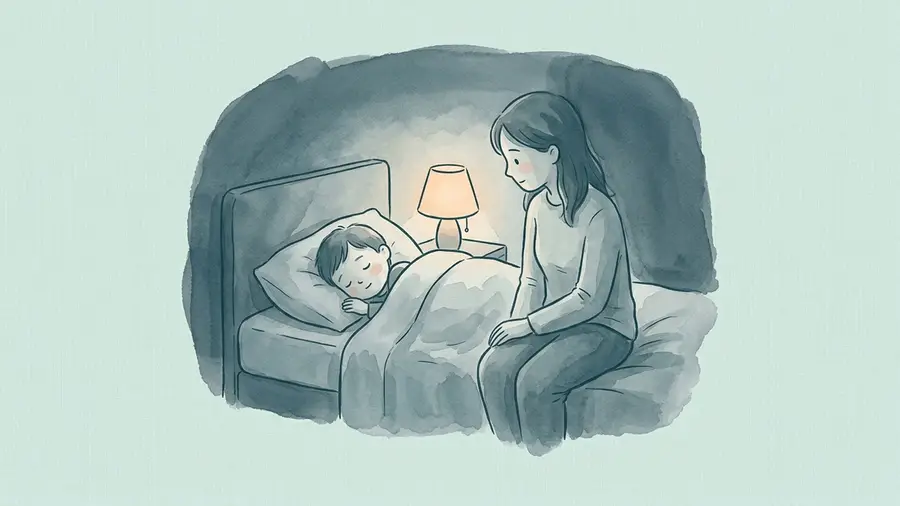
It is Wednesday afternoon, your child has been ill since yesterday, and this is already their third long sleep of the day. You stand in the doorway watching the duvet rise and fall. Should you let them sleep? Or is sleeping this much a bad sign?
The short answer: the amount of sleep on its own is not a reliable warning sign. Children respond to infections very differently — and what actually matters is something other than the number of hours.
What to watch instead, when you should wake your child, and which signs cannot wait — one section at a time.
Important: This article does not replace professional medical advice. If in doubt, call 111 for advice, or 999 in an emergency.
Is it normal for an ill child to sleep this much?
Usually, yes. Children need more rest when fighting an infection, and many take it as extra sleep. What matters is not the quantity but the state in between: a child who can be woken, drinks and recognises you is doing exactly the right thing — even after twelve hours straight.
What is striking is how differently children behave when unwell. Some become quiet and sleep far more than usual. Others are restless, cry easily and want to be held constantly. And some carry on romping around the house with a feverish infection as though nothing were wrong at all.
All of that falls within normal. Which is precisely why "sleeping a lot" or "sleeping very little" is not a useful yardstick on its own. What matters is that your child gets enough rest and proper care — the form that rest takes is secondary.
What is genuinely worth watching: how easily can your child be woken? What are they like once awake? Are they drinking? Do they recognise you? Those four questions tell you more than any number of hours.
When is sleepiness a warning sign?
The distinction that matters is between sleeping and not responding. A sleeping child can be woken, looks at you and reacts — even if they are tired and grumpy afterwards. A child who cannot properly be roused, or who does not come back to an alert, engaged state, is a different situation entirely.
Go to A&E or call 999 if your child is:
- Hard to wake up, won't stay awake or doesn't seem to recognise you
- Not responding to family or carers, or very irritable
- Showing a stiff neck or severe breathing difficulty
- Having a seizure (fit)
These signs apply regardless of how long your child has slept. A child who will not wake properly after eight hours is an emergency. A child who cheerfully asks for juice after twelve hours is not.
38.7°C at 02:14, and again at 04:30?
You don't have to remember. Mona logs fever, medication and sleep in 10 seconds, and your partner sees it instantly.


When should you wake an ill child?
As a rule, sleep is good, and you do not need to wake an ill child by the clock. There are two reasons to do it anyway.
The first is drinking. A child who sleeps for many hours is not taking any fluids during that time — and with a temperature, diarrhoea or vomiting, that is the critical point. Better to wake your child gently for a few sips than to let them sleep through and hope. If your child refuses to drink altogether, that needs medical advice.
The second is checking their state. When you are unsure how your child is doing, the brief waking is the test: do they wake? Do they look at you? Do they answer? That is not disturbing their recovery — it is the single most useful observation you can make.
With a temperature there is more to watch: if your child stays listless even after the temperature comes down, if it lasts more than three days, or if vomiting, diarrhoea or a rash appear alongside it, seek advice. More in Fever in children: when is it dangerous?
What helps an ill child sleep?
Ill children often sleep worse, not better — coughing, a blocked nose and fever dreams break up the night. A few things reliably help.
A low-stimulus room
Darkened, cool, well-aired, and no screens in the hour beforehand. An ill child is more sensitive to stimulation than usual.
Allow closeness
Children who are unwell often want far more physical closeness than normal. That is not a step backwards in their sleep development, it is a phase. A child who sleeps closer during an infection goes back to their old pattern afterwards.
Keep the rhythm where you can
Long late-afternoon naps tip the night over. If your child is sleeping a lot during the day, it helps to keep the last stretch from running too late — as far as that can be steered at all.
How do you keep track of how it is going?
With an infection that runs over several days, the decisive question is never "how are they right now?" but "is this better or worse than yesterday?". And that is exactly the question you cannot answer from memory when you have slept badly for three nights yourself.
Worth noting down: when your child slept and for how long, what they were like when woken, how much they drank, the temperature with the time, and which medicine they had and when. Five things, each captured in seconds.
In Mona you log a temperature or an amount drunk in passing, and the timeline shows you across the days where things are heading — whether the fever peaks are coming down, whether the waking periods are getting longer, whether your child is drinking more again. That is the information that gives you a footing at three in the morning, when your own head no longer provides one.
Your GP will ask exactly this: how long has your child been ill, how high was the temperature in the evening, how much have they drunk in the last 24 hours, when did they last have which medicine. With a kept record you read that off instead of guessing.
The pediatrician asks. You can answer.
Symptom timeline, fever curve, last medication: With Mona you have it all in seconds, instead of guessing from memory.
Common questions about sleep in ill children
How long can I let my ill child sleep?
There is no fixed hour limit. As long as your child can be woken, responds afterwards and drinks enough, they can sleep as long as they want. Wake them gently in between for fluids — particularly with a temperature, diarrhoea or vomiting.
My child has been sleeping much more than usual for days — is that bad?
Not automatically. What matters more than the quantity is how your child seems during waking periods. If they respond, recognise you, drink and perk up in between, an increased need for sleep during an infection is unremarkable. If they stay listless, they need to be seen straight away.
How do I tell tired apart from unresponsive?
A tired child can be woken and reacts afterwards — looking at you, answering, perhaps grizzling. A child who is hard to wake, won't stay awake or doesn't seem to recognise you is a different matter. That unusual stillness is a red flag, not a sign of recovery.
Should I wake my child at night to take their temperature?
Usually not. If your child is sleeping calmly, breathing normally and was responsive earlier, sleep matters more than the reading. It is different if you are genuinely unsure about their state — then the waking itself is the information, not the number.
My child is ill but tearing around as if nothing is wrong — should I stop them?
That happens too. Some children carry on as though completely well despite a feverish infection. Still make sure they get enough rest breaks and proper care. You do not have to force your child into bed, but the day can be quieter than usual.
When does a sleeping child need urgent care?
When they cannot properly be woken, seem confused or do not recognise you, when the neck is stiff, when breathing is severely laboured, or after a seizure. Then it is A&E or 999, regardless of how long they have slept.
Summary: let them sleep, or act?
| Situation | What to do |
|---|---|
| Hard to wake · won't stay awake · doesn't recognise you · not responding · stiff neck · severe breathing difficulty · seizure | Call 999 or go to A&E |
| Stays listless after the temperature comes down · refuses all fluids · temperature over three days · young baby | Call 111 or contact your GP the same day |
| Sleeping a lot but wakes, recognises you and drinks | Let them sleep, wake gently for fluids — and keep a record of how it is going |
About this article
Sources
- How to recognise if your child is seriously ill — North Tees and Hartlepool NHS Foundation Trust(accessed 2026-09-08)
- Unwell child — Alder Hey Children's Hospital NHS Foundation Trust(accessed 2026-09-08)
- When a child feels unwell — kindergesundheit-info.de (BZgA)(accessed 2026-09-08)
You might also like

Track symptoms easily
With Mona you stay on top of things – even at 3 AM.