
Gave Your Child a Double Dose by Accident? What to Do Now

This blog only provides tips, tricks and hints and does not replace a doctor visit. For severe symptoms, always consult a doctor.
At a glance
- ✓Contact 111 for advice now if your child has had an extra dose of ibuprofen, or if you've given more paracetamol than it says on the packet, leaflet or prescription.
- ✓Do not try to make your child sick (they could choke) and do not give them anything to eat or drink.
- ✓Call 999 if your child is unconscious, not breathing, having a fit or has severe difficulty breathing. If you're told to go to A&E, do not drive. Bring the packet or leaflet, any remaining medicine, and any other medicines your child takes.
Table of Contents
Gave Your Child a Double Dose by Accident? What to Do Now
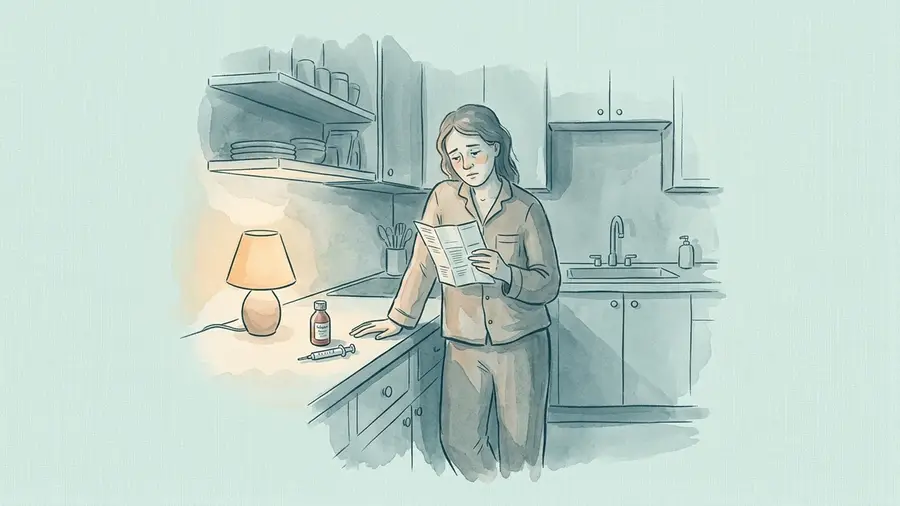
You gave the syrup because the temperature had climbed again. Twenty minutes later your partner mentions, in passing, that they already gave a dose before bed. It takes a couple of seconds for the sentence to land.
You do not have to work out how serious this is on your own. Whether the amount matters depends on the medicine, the dose and your child's age and weight, and that is what NHS 111 is for. What to do in the next few minutes is in the first section.
What do you do right now?
Get advice rather than waiting to see whether anything happens. Pick up the packet and the leaflet inside it, then call 111 or use 111 online, and call 111 for a child under 5. Do not wait until morning, because how long ago the dose was given is part of the assessment. Have the time of both doses ready.
If you are not sure whether a double dose was given at all, treat it as one and call anyway. "We are not sure" is an ordinary answer on that call. And do not wait for your child to seem unwell: whether an amount matters depends on the medicine, the dose and your child's weight, not on how they look in the moment.
Call 999 or go to A&E if your child:
- is unconscious, cannot be woken or has stopped breathing
- has severe difficulty breathing, is choking or gasping
- is having a fit
- may be having a serious reaction after ibuprofen: an allergic reaction (such as a swollen throat or tongue, a raised and itchy rash and difficulty breathing), bleeding in the stomach (such as bad stomach pain, vomiting blood, blood in their poo or poo that's black and sticky), or inflammation in the brain (such as a stiff neck, headache, vomiting, a high temperature or confusion)
- may have swallowed medicine that was not meant for them
- becomes seriously unwell in any other way
If they are unconscious but still breathing, put them in the recovery position and keep checking their breathing. If they are awake, keep talking to them to make sure they have not lost consciousness. If they are unresponsive and not breathing, start CPR and follow the 999 call handler's instructions.
If you think your child is having any other serious side effect, such as yellowing of the skin or the whites of the eyes, pale poo and dark pee, bruising easily or nosebleeds, call NHS 111. That is the route the NHS pages on ibuprofen and paracetamol give. If a sign fits more than one list, act on the higher one: an extra dose plus any sign in the 999 list means 999.
What you avoid matters just as much. The NHS page on poisoning is clear: do not try to make your child sick, because they could choke and stop breathing, and do not give them anything to eat or drink. If you are told to go to A&E, do not drive yourself. Ask someone to drive you, or call 999 and ask for an ambulance.
Take these with you if you are told to go in: the packet or the leaflet inside it, any remaining medicine, and any other medicines your child takes. If you are not sure what was swallowed, look for packaging, containers or medicines and bring what you find. If your child is sick, put some of the vomit in a container for the doctors; it can help them find out what caused the poisoning.
On the phone you will be asked what your child took, how much, and when. The active ingredient and the strength are printed on the packet, which is why it should be in your hand when you call.
How much is too much paracetamol or ibuprofen?
There is no single figure, because the dose is set by your child's age and weight and printed on the packet. What the NHS does give is the timing. For paracetamol, wait at least 4 hours between each dose and do not give more than 4 doses in 24 hours; paracetamol is for children over 2 months; babies aged 2 to 3 months can have it only if they weigh over 4kg and were born after 37 weeks, and usually no more than 2 doses in a day, so check the leaflet. Do not give paracetamol for more than 3 days without speaking to a doctor or pharmacist. That comes from the NHS page on paracetamol for children.
Ibuprofen has longer gaps. Doses can be given every 6 to 8 hours. Children aged 1 to 9 can have up to 3 doses in a day and babies aged 6 to 12 months 3 or 4. Babies aged 3 to 6 months can only have ibuprofen if they weigh over 5kg, and then usually only up to 3 times in a day; the leaflet gives the amount for your product. The leaflet sets the maximum for your product. Do not give it for more than 3 days to children aged 6 months or older, or for more than 24 hours to babies aged 3 to 6 months, without speaking to a doctor or pharmacist, as the NHS guide to giving ibuprofen sets out. Only give as much as your child needs to ease the symptoms, and stop when it is no longer needed. If your child becomes ill with vomiting, diarrhoea or a high temperature while taking ibuprofen, talk to a pharmacist or doctor, because there is a risk of dehydration.
Two rules prevent many accidental doubles. Do not give ibuprofen and paracetamol at the same time, although you can alternate between them if a health professional such as a doctor or nurse tells you to. And avoid other medicine containing paracetamol, such as cold and flu medicine: that is where a "second" medicine quietly turns into a second dose of the same drug. If you are not sure whether a medicine suits your child, or whether it can be given with another medicine, ask a pharmacist or doctor. If you are unsure which one to reach for in the first place, we compared them in ibuprofen vs paracetamol for children.
When did she last have paracetamol?
The question that drives everyone crazy at night. Mona tracks doses and intervals automatically, so no one doubles up.


Why do double doses happen in the first place?
Almost never through carelessness. It is the same handful of gaps every time, and all of them are about missing information rather than missing care.
The most common one is the handover between two adults. One gives a dose at 10pm and goes to bed. The other takes over at 2am and sees a child with a temperature, but no record of what has already been given. The second gap is the night itself: at 2am, a two-minute action from four hours earlier genuinely does not feel like it happened.
Then there is the form the medicine comes in. Syrup and suppositories feel like two different things even when the active ingredient is the same. And finally the clock: without a written time, you reconstruct the gap by feel, and in the middle of the night feel easily misjudges how recent something was.
How do the two of you keep track of who gave what?
Before we built the Mona app, we used to send each other the details back and forth on WhatsApp. It worked, but over longer illnesses, like the flu last spring, it became hard to follow. At the doctor's appointment it was also difficult to show exactly how things had gone.
Four details prevent almost every double dose: the time, the medicine, the dose and who gave it. The last one gets left out most often, and in a household with two adults it is the one that matters most, including for the daily vitamin D supplement. The entry belongs with the dose itself, not with the tidying up afterwards.
That is what the medicine log in Mona is built for. You enter the dose with its timestamp right after the syringe, before you put your child back down, and if your partner is following the same timeline, they see it before they reach for the packet. At the next appointment your GP will ask what your child had, how much, when the last dose was, and how many doses there have been in the past 24 hours. Those four answers sit together in the timeline instead of scattered across a chat.
The pediatrician asks. You can answer.
Symptom timeline, fever curve, last medication: With Mona you have it all in seconds, instead of guessing from memory.
What if your child spits the dose out or is sick?
Do not simply give it again. If your child vomits shortly after a dose, get advice before repeating it, from a pharmacist, your GP or NHS 111. Whether to repeat a dose is a decision for your GP or pharmacist, even when you are certain most of it came straight back up, because there is no way to judge from the outside how much was absorbed.
A missed dose works the other way round. For ibuprofen, give the missed dose as soon as you remember, unless it is nearly time for the next one; then skip it and give the next dose at the usual time. Never give 2 doses to make up for a forgotten one.
Write down the dose that went wrong, too. A dose that was spat out or brought back up belongs in the timeline with its time. Otherwise it turns into the next uncertainty at 3am: did that count as a dose or not?
How do you stop it happening again?
The strongest single fix is a fixed role. Decide before the night who is giving medicines, and keep that through until morning rather than swapping with whoever wakes up. Whoever takes over reads the last entry first and picks up the packet second.
Put the light on before you measure. In half-darkness it is easy to draw up the wrong amount, and a kitchen spoon is not a measuring device. Shake the bottle for at least 10 seconds, use only the syringe or spoon supplied with the medicine, and check the strength on the bottle (for example 120mg in 5ml or 250mg in 5ml for paracetamol): infant and older-child liquids differ, and each is for its own age range. And log the dose before you put your child back down: the entry made afterwards is the one that never happens.
If you are not sure how to give a medicine, or your child has problems taking it (spitting it out, refusing it, taking only half), ask a pharmacist, doctor or nurse for advice rather than working around it.
999, 111 or keep an eye?
| Situation | What to do |
|---|---|
| Unconscious, cannot be woken, having a fit, or severe difficulty breathing | Call 999 or go to A&E |
| Extra dose given, child awake and responsive, no sign from the 999 list | Call 111 or use 111 online, packet to hand |
| Not sure whether a dose was doubled | Treat it as a double dose and call 111 |
| Dose spat out or vomited | Do not repeat it; get advice first |
| Dose forgotten | Never give 2 doses to make up for it |
| Correct gap kept, child settled | Keep watching and log every dose with its time in Mona |
About this article
Sources
- NHS: Paracetamol for children(accessed 2026-10-10)
- NHS: How and when to give ibuprofen for children(accessed 2026-10-10)
- NHS: Poisoning(accessed 2026-10-10)
You might also like

Track symptoms easily
With Mona you stay on top of things – even at 3 AM.