
“Did I Miss Something?” – When Your Child Is Ill and the Doubts Won't Go Away

This blog only provides tips, tricks and hints and does not replace a doctor visit. For severe symptoms, always consult a doctor.
At a glance
- ✓The doubt “did I miss something?” is normal — it comes from holding little numbers and times in your head instead of writing them down.
- ✓Writing it down lifts the load: note the time, temperature and how much your child drank — then you can check instead of guessing.
- ✓See a doctor: babies under 3 months at 38°C or above (urgent — NHS 111/GP), a high temperature lasting 5 days or more, or any quick deterioration — and always when your gut says something is wrong.
Table of Contents
- Why do I keep thinking I've missed something?
- How do I get rid of the feeling that I've missed something?
- How do I know when I really should see a doctor?
- What if I'm still worried?
- Common questions about doubts when your child is ill
- Is it normal to keep thinking I've missed something?
- What should I write down when my child is ill?
- When should I take my child to the doctor with a fever?
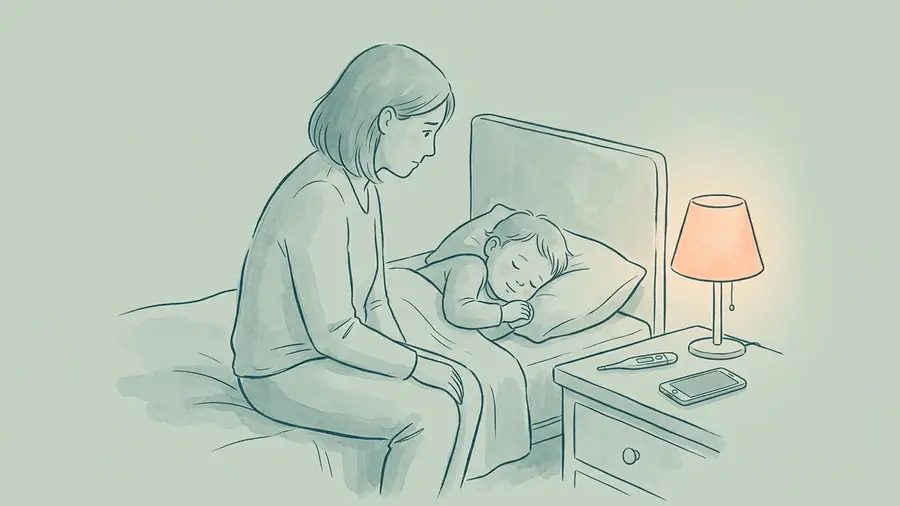
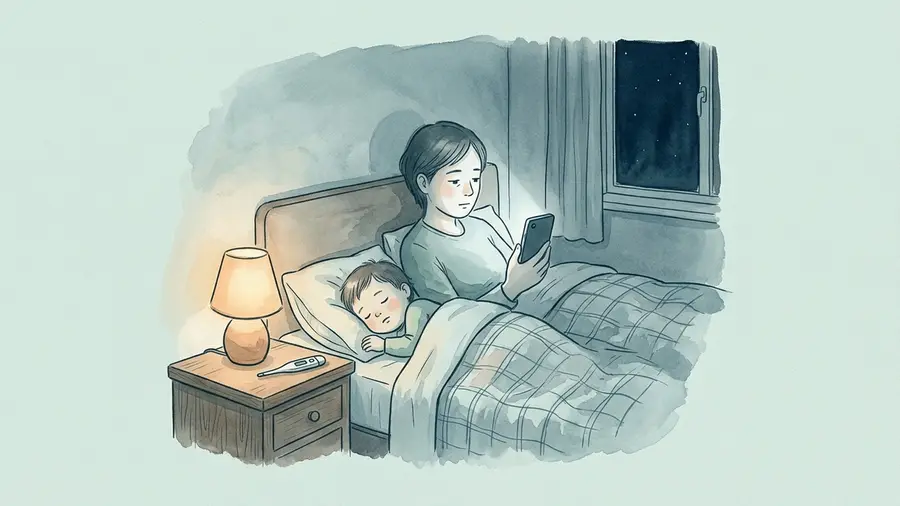
It's 3 a.m. Your child is finally asleep, and you're lying awake. The same questions keep circling: was the fever higher this morning than yesterday? Has she had enough to drink? Should I have called the doctor after all? And, growing louder in between: did I miss something?
You probably haven't missed anything. This doubt is part of being a parent — almost everyone knows it. It doesn't come from being careless. It comes from juggling little numbers and times in your head all day without writing any of them down.
And that's exactly where the way out is: what's written down can't keep circling in your head at night. How to do it — and how to tell when a doctor really is needed — comes next.
Important note: This article does not replace professional medical advice. If in doubt or in an emergency, always contact your GP, NHS 111, or call 999.
Why do I keep thinking I've missed something?
Because you're trying to remember everything you haven't written down. When a child is ill, a flood of small details builds up all day — temperatures, times, how much they drank. Your head can't hold all of it. The doubt isn't carelessness; it's the normal gap that opens up when you rely on memory alone.
On top of that, you've probably been short on sleep for days. Sleep deprivation hits exactly the parts of the brain responsible for short-term memory and your sense of time. No wonder it blurs whether the fever this morning was 38.7 or 39 degrees.
And then there's the standard you hold yourself to: a good parent should just know this. You don't have to. No one can reliably keep every temperature, every dose and every feed in their head for three days straight. That isn't a weakness — it's simply how memory works under strain.
The feeling gets strongest when the fever runs across several days and the nights stay short. That slow loss of the overview has its own chapter in “Day 3 of Fever – and You've Lost Track Completely”.
How do I get rid of the feeling that I've missed something?
You write it down. Once the time, temperature and how much your child drank are written down, you no longer have to hold them in your head — and the nagging doubt loses its ground. You stop guessing whether the last dose was “around eleven.” You look, and you know.
It sounds almost too simple, but that's exactly where the relief sits. It isn't the perfect record that counts, but that the information gets out of your overloaded head and into a safe place.
Three things are entirely enough:
- Time + medicine + dose, every time you give something. This guards against gaps that are too short and against an accidental double dose.
- Temperature with the time, a few times a day. That shows you the trend, not just the current reading.
- Roughly how much was drunk — one tick per cup, bottle or feed is plenty.
Tip: Keep the note or your phone wherever the thermometer lives. Then writing it down isn't an extra step — it happens automatically, in the same movement.
A note on the fridge is easily mislaid at 3 a.m. Mona keeps exactly these things for you: the medication log with times, the fever curve, how much was drunk. It remembers what you forget when you're running on no sleep.
If you and your partner take turns through the night, a shared record is doubly worth it — who last gave what is then visible to you both. There's more on that in “Mum works the night shift — and no one knows when the last fever dose was”.
And when there is no one to take turns with? Those nights have their own piece: “Your child's temperature rises at night and you are on your own”.
The pediatrician asks. You can answer.
Symptom timeline, fever curve, last medication: With Mona you have it all in seconds, instead of guessing from memory.


How do I know when I really should see a doctor?
By turning the vague “something's not right” into concrete criteria. There are clear points where a doctor is needed — depending on your child's age and how long the fever has been going. And there are red flags where you must act straight away, whatever the temperature reads.
Here's how the NHS frames it:
- Baby under 3 months with a temperature of 38°C or above — get urgent advice, contact a GP or call NHS 111 straight away.
- Baby 3 to 6 months with a temperature of 39°C or above — contact a GP or call NHS 111.
- Any child whose high temperature has lasted 5 days or more — see your GP.
- Your child won't drink, shows signs of dehydration (nappies that aren't very wet, sunken eyes, no tears when crying), or you're worried — contact a GP or NHS 111, whatever the number says.
For more on age-specific thresholds, see “Fever in children: when is it dangerous?”.
Immediate action required: Call 999 if your child:
- has a stiff neck and can't bring their chin to their chest
- has a rash that does not fade when you press a glass against it
- has difficulty breathing or is breathing very fast
- has a fit (febrile seizure) for the first time and cannot stop shaking
- is drowsy and hard to wake, or is not responding as they normally do
- has unusually cold hands and feet, or changes to their skin colour such as blue, grey or blotchy skin
And the most important point to end this section on: your gut doesn't need a number to justify it. If your child seems different to you today than usual — quieter, floppier, just not quite there — you're allowed to call, even without the thermometer hitting a particular mark. Better to call once too often than once too late.
What if I'm still worried?
Then you call rather than keep searching — and that's completely fine. NHS 111 is there for exactly these moments, day or night. No one there will think you're overcautious. It's their job to make sense of your worry, and yours to take it seriously enough to pick up the phone.
And when you call, the very thing you wrote down helps you. Instead of “I think the fever was higher today,” you can say: “Since last night between 38.5 and 39.4, last dose of ibuprofen at 2 p.m., not much to drink today.” Diffuse worry becomes a few clear sentences — and those make it easier for the doctor to help you.
That the doubts are there at all doesn't mean you're doing something wrong. It means your child matters to you. Writing things down only takes the sting out of those doubts — it turns them into something you can hold in your hand.
Common questions about doubts when your child is ill
Is it normal to keep thinking I've missed something?
Yes, it's very common. Almost all parents know this nagging doubt, especially at night and after several short nights. It comes from holding lots of small pieces of information in your head instead of writing them down. Once you note them, the feeling usually loses its power on its own.
What should I write down when my child is ill?
Three things are enough: the time and dose of every medicine, the temperature with the time a few times a day, and roughly how much your child drank. This guards against an accidental double dose and shows you the trend, not just the current reading. At the GP, you'll have it all ready.
When should I take my child to the doctor with a fever?
For babies under 3 months, any temperature of 38°C or above means getting urgent advice straight away — contact a GP or call NHS 111. For babies 3 to 6 months, 39°C or above. For any child, a high temperature lasting 5 days or more. And always when your gut says something is wrong.
How much should my feverish child drink?
A child with a fever needs more fluids than usual. Offer small amounts often — water, and for babies keep breastfeeding as normal. Watch for signs of dehydration: nappies that aren't very wet, sunken eyes, and no tears when crying. Noting roughly how much they drink helps you keep track.
Does it matter if I haven't written everything down?
No. A patchy record still beats none, and no doctor expects a perfect chart. When in doubt, give an honest estimate — “around 39 this afternoon, not sure exactly since when.” Starting to write things down now is worth more than being cross about the past.
Does writing things down help with my night-time worrying?
Often, yes. Many parents lie awake over the very numbers they can't quite remember. Once the last dose and its time are there in black and white, there's less for your mind to circle. You can check instead of guessing — and that settles you more than you'd think.
In short: did I miss something — or is everything fine?
Most of the time, the honest answer is: you haven't missed anything. The table below sums up what really counts — from a clear emergency, through a timely visit to the GP, to calm watching and waiting. If your child drinks, sleeps and is responsive in between, you can wait and carry on writing down what happens.
| Situation | What to do? |
|---|---|
| Stiff neck, difficulty breathing, febrile seizure, non-fading rash, drowsy and hard to wake | Call 999 / A&E |
| Baby < 3 months at 38°C or above, or 3–6 months at 39°C or above | Urgent — NHS 111 / GP straight away |
| High temperature 5 days or more, won't drink, signs of dehydration, or getting worse | GP same day or NHS 111 |
| Child drinks, sleeps and is responsive in between | Observe, plenty of fluids, write it down |
About this article
Sources
- NHS: High temperature (fever) in children(accessed 2026-07-06)
You might also like

Track symptoms easily
With Mona you stay on top of things – even at 3 AM.