Fever in Children: When Is It Dangerous – and When Just Annoying?

This blog only provides tips, tricks and hints and does not replace a doctor visit. For severe symptoms, always consult a doctor.
At a glance
- ✓Fever itself is usually harmless — what matters is your child's behaviour, age, and accompanying symptoms.
- ✓In babies under 3 months, a temperature of 38°C or above needs urgent medical advice — contact a GP or call NHS 111 straight away. Call 999 or go to A&E for a febrile seizure, stiff neck, breathing difficulty, skin blotching, or unresponsiveness.
- ✓Otherwise: contact your GP the same day if your child won't drink, fever lasts 5 days or more, or symptoms worsen.
Table of Contents
- Ist Fieber bei meinem Kind gefährlich?
- Welche Alarmzeichen brauchen sofort den Notarzt?
- Wann reicht ein Anruf am nächsten Tag?
- Was tun bei einem Fieberkrampf?
- Wann ist die Temperatur, wann das Verhalten wichtiger?
- Was der Kinderarzt von dir wissen will
- Häufige Fragen zu Fieber bei Kindern
- Ab welcher Temperatur spricht man bei Kindern von Fieber?
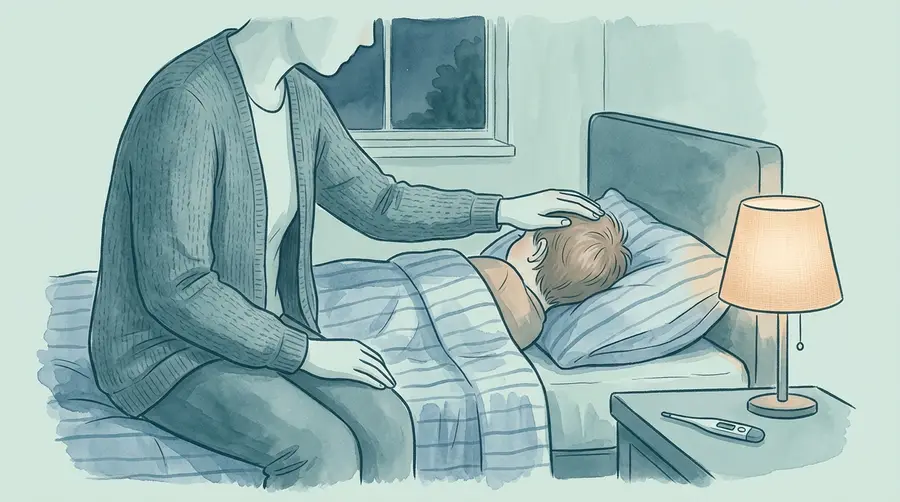
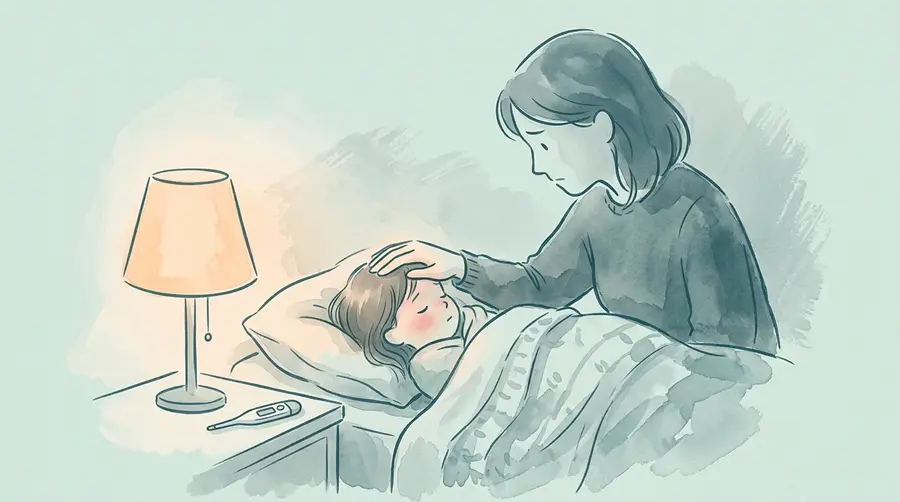
It's 2 AM. Your child is burning up, the thermometer reads 39.8 °C. They're whimpering, refusing to drink, and you're asking yourself: Do I need to go to A&E right now – or can this wait until morning?
Nearly every parent has been there – and nearly every one faces the same question. Here's what matters most: fever is a protective response, not an enemy. What truly counts isn't the number on the thermometer, but your child's behaviour and a handful of clear warning signs. In most cases, observing, fluids and rest are enough. In a few cases you must act immediately – here's how to tell them apart.
Important note: This article does not replace professional medical advice. If in doubt or in an emergency, contact your GP or call 999.
Is My Child's Fever Dangerous?
Fever itself is usually not dangerous – it's a meaningful immune response. In otherwise healthy children, fever does not cause harm and rarely exceeds 41 °C. What's dangerous is the underlying illness, or the presence of clearly defined warning signs like breathing difficulty, altered consciousness, or a stiff neck.
NHS guidance is clear: the body raises its temperature to slow viruses and bacteria. The immune system works more efficiently. That's why the right question is never: "How high is the fever?" – but: "How is my child doing overall?"
A child with 39.5 °C who's happily taking apart toys is far less of an emergency than a child with 38.5 °C who lies listlessly on the couch. Behaviour beats temperature.
Which Warning Signs Need Emergency Care Right Now?
These symptoms mean: call 999 or go directly to the paediatric A&E. They apply regardless of the temperature reading – even a child with "only" 38.5 °C can be an emergency here.
In babies under 3 months, a temperature of 38°C or above needs urgent medical advice — contact a GP or call NHS 111 straight away (call 999 or go to A&E if your baby seems seriously unwell).
Call 999 or go to A&E immediately if your child:
- has a febrile seizure – convulsions, fixed stare, loss of consciousness
- has a stiff neck – can't bring chin to chest (possible meningitis)
- has a rash that doesn't fade under pressure – press a glass against the spot; if it stays visible, this can indicate sepsis or meningococcal infection
- has difficulty breathing or very rapid breathing – nasal flaring, retractions between the ribs
- is unresponsive, lethargic, confused or hard to wake
- has a shrill, unusual cry (in infants)
- has lips or skin turning bluish
Don't hesitate to call 999 in these situations. That's exactly what they're for. Better one call too many than one too few.
When Is a Same-Day Doctor Visit Enough?
Not every warning sign is an emergency. For these symptoms, contacting your GP on the same day or calling NHS 111 is usually sufficient – not an emergency call, but not something to put off either:
- Fever lasting 5 days or more without visible improvement
- Child refuses to drink or shows signs of dehydration (little urine, dry lips, no tears when crying)
- Repeated vomiting or diarrhoea combined with fever
- Ear pain or severe sore throat
- Fever that rises again after a calm phase
- Child is fussy and weak but no acute warning signs
38.7°C at 02:14, and again at 04:30?
You don't have to remember. Mona logs fever, medication and sleep in 10 seconds, and your partner sees it instantly.
What to Do During a Febrile Seizure
A febrile seizure is every parent's nightmare – and surprisingly common. About 3–5% of all children experience at least one febrile seizure, typically between 6 months and 5 years of age. The child suddenly stiffens, the eyes roll back, arms and legs jerk rhythmically. Most seizures last less than 5 minutes.
Here's how to respond:
- Stay calm – as hard as that is
- Place the child on a soft surface, never put anything in their mouth
- Recovery position so saliva and vomit can drain
- Time the seizure – the duration is the most important information for the doctor
- After the seizure: always seek medical evaluation. For a first seizure, call 999 directly.
Important: A febrile seizure looks dramatic but is medically harmless in the vast majority of cases and does not cause lasting damage. Even so: every first febrile seizure must be evaluated — see your GP. If the seizure lasts longer than 5 minutes, call 999 immediately.
When Does Temperature Matter, When Does Behaviour?
Temperature is a single number. Behaviour is the trajectory – and that's almost always more medically meaningful. GPs pay particular attention to four things:
- How fast is the fever rising? Rapid spikes may suggest bacterial infections.
- Does the fever respond to treatment? If it drops briefly after medication, that's a good sign.
- Does it rise again after improvement? This may indicate a secondary infection.
- How does the child behave between fever spikes? Do they drink, play, sleep in between?
Tip: Measure in the morning and evening – and whenever your child seems off. Record the time, temperature, and measurement method. If you give medication, note the active ingredient, dose, and time. This progression log is gold at your next doctor's visit.
What the GP Wants to Know
In the surgery, your GP will almost always ask the same four questions. Being able to answer them helps enormously:
- How long has the child had a fever?
- How has the temperature developed – rising, falling, plateau?
- What medications were given and when?
- How does the child behave between fever spikes?
Frequently Asked Questions About Fever in Children
At what temperature is it considered fever in children?
In children, a high temperature is 38°C or above (NHS). Axillary readings (under the arm) typically run about 0.5 °C lower than a rectal reading and are less accurate. In babies under 3 months, a temperature of 38°C or above needs urgent medical advice — contact a GP or call NHS 111 straight away (call 999 or go to A&E if your baby seems seriously unwell).
Should I bring my child's fever down or let it run its course?
It's not the fever itself that needs lowering – it's your child's discomfort. If they're drinking, sleeping, and responsive, no medication is needed. If the fever clearly hurts (headache, body aches, restlessness), paracetamol or ibuprofen helps – always strictly dosed by body weight.
Cool compresses on the calves – yes or no?
Cool calf wraps can provide short-term relief, but only if the legs are warm. With cold feet or chills, cool wraps strain circulation and are counterproductive. A lukewarm (not ice-cold) application for 10 minutes is enough – then bundle the child up warmly again.
When can my child go back to nursery?
Rule of thumb: 24 hours fever-free without fever-reducing medication – then your child is usually ready for nursery or childminder. Some infections (scarlet fever, hand-foot-and-mouth) require longer waits. When in doubt, ask your GP.
How long does fever typically last with a normal infection?
Most viral infections produce fever for 2–4 days that gradually subsides. If fever lasts 5 days or more or rises again after a calm phase, see your GP – this can indicate a bacterial secondary infection or a different course.
What if the fever suddenly hits 40 °C at night?
Stay calm – 40 °C is uncomfortable, but for otherwise healthy children over 3 months it's not automatically an emergency. Check the warning signs above (neck, breathing, consciousness, rash). If none apply: offer plenty of fluids, dress lightly, give a fever reducer if needed, and observe. If your child seems very unwell or their condition worsens, call NHS 111 or 999 — what matters is how unwell your child seems, not the exact number.
Summary: Call, Emergency, or Wait?
The shortest decision rule looks like this:
| Situation | What to do? |
|---|---|
| Baby < 3 months, 38°C+ | GP or NHS 111 straight away (999 / A&E if seriously unwell) |
| Febrile seizure, breathing difficulty, stiff neck, unresponsive | Call 999 / A&E |
| Skin spots that don't fade under pressure | Call 999 / A&E |
| Fever 5 days or more, won't drink, repeated vomiting | GP same day or NHS 111 |
| Ear pain, sore throat, fever spike returns | GP soon |
| 39 °C, child drinks, plays in between, sleeps | Observe, fluids, rest |
As a flow:
Fever by Age: Quick Reference
These values aren't where fever begins — they mark when to seek medical advice.
| Age | Contact a doctor from | What to do |
|---|---|---|
| 0–3 months | 38°C | Contact a GP or call NHS 111 straight away (999 / A&E if seriously unwell) |
| 3–6 months | 39°C | Call NHS 111 or see a GP |
| 6–24 months | 39°C | Monitor, see your GP if other symptoms appear |
| 2+ years | 39°C | Monitor overall condition, try home remedies |
| All ages | 5 days or more of fever | See your GP |
Good to know: In infants under 3 months, the immune system is still immature. A bacterial infection can deteriorate rapidly – which is why the rule here is absolute: better one trip too many to the doctor than one too few.
About this article
Sources
- AWMF S3-Leitlinie: Fieber bei Kindern (2025)(accessed 2026-05-08)
- DGKJ Elterninformation Fieber(accessed 2026-05-08)
- DGKJ Elterninformation Fieberkrampf(accessed 2026-05-08)
- BVKJ: Fieber beim Kind(accessed 2026-05-08)
- BZgA kindergesundheit-info.de: Fieber bei Babys und Kindern(accessed 2026-05-08)
- gesundheitsinformation.de: Fieber bei Kindern(accessed 2026-05-08)