Fever of 39.5 °C in a Toddler: When Do You Need to See a Doctor?

This blog only provides tips, tricks and hints and does not replace a doctor visit. For severe symptoms, always consult a doctor.
At a glance
- ✓A 39.5 °C fever in a toddler is high — what matters is overall behaviour and accompanying symptoms, not the exact number.
- ✓Call 999 immediately for: trouble breathing, stiff neck, decreased responsiveness, non-blanching rash, seizure. Any infant under 3 months with a 38°C fever needs urgent medical advice.
- ✓Otherwise: call your GP or NHS 111. If your toddler is drinking, alert and resting between fever spikes — observe and offer fluids.
Table of Contents
- Ist 39,5 °C bei meinem Kleinkind gefährlich?
- Welche Begleitsymptome sind ein Notfall?
- Wann reicht der Anruf am nächsten Tag — und wann sofort zum Arzt?
- Häufige Fragen zu Fieber 39,5 °C beim Kleinkind
- Ab welcher Temperatur ist es bei meinem Kleinkind Fieber?
- Warum ist 39,5 °C nicht automatisch ein Notfall?
- Ab wann sollte ich beim Kleinkind den Notarzt rufen?
- Was kann ich nachts tun, wenn die Praxis zu ist?
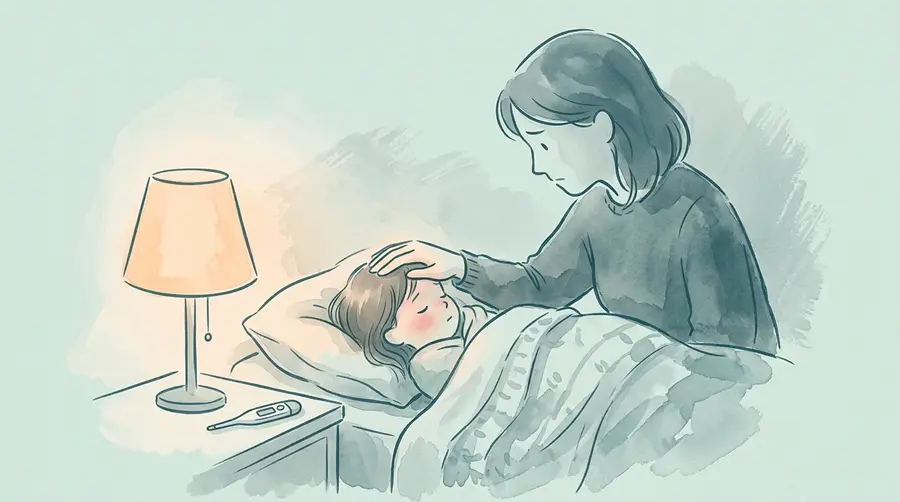
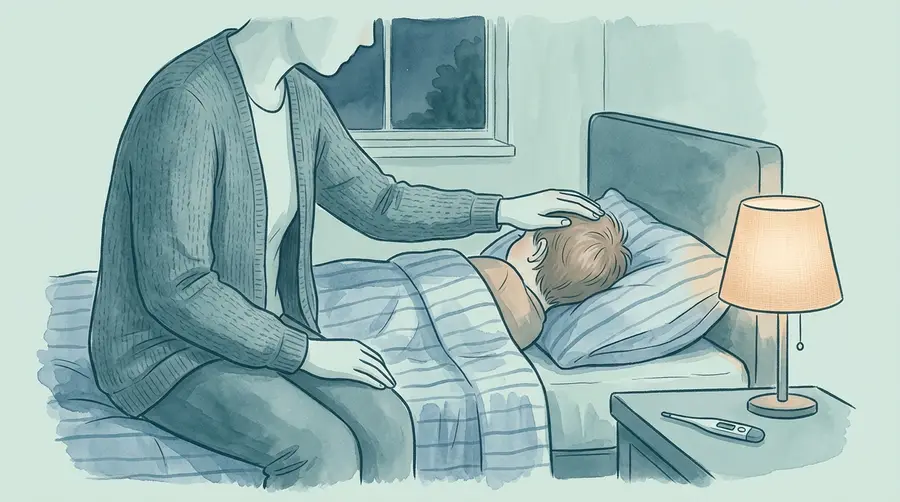
It's three in the morning. Your toddler is burning up, the thermometer reads 39.5 °C — A&E? NHS 111? Wait until morning?
Almost every parent faces this. The honest answer: The number on the thermometer is not the most important information. What matters more is overall condition, accompanying symptoms, and age. Here's a clear triage — from emergency to "morning call is fine."
Important: This article does not replace medical advice. If you are unsure or in an emergency, call 999 or NHS 111, or see your GP.
Is 39.5 °C dangerous in my toddler?
A temperature of 39.5 °C is a high temperature — in children, a high temperature is 38°C or above (NHS). That's not automatically dangerous: in an otherwise healthy toddler over 3 months, fever is the body's normal immune response, and what matters is how unwell your child seems, not the exact number. What counts is general condition: is your child drinking, alert and breathing comfortably?
NHS guidance is clear: don't treat the number — treat the discomfort. A toddler at 39.5 °C who falls back to sleep is in a very different situation than one lying floppy and unresponsive. The accompanying symptoms decide, not the number.
Which accompanying symptoms are an emergency?
These signs mean call 999 or go directly to A&E — regardless of the exact temperature. A child at 38.3 °C can be a true emergency, while another at 40 °C may not. What's decisive is what else is happening: breathing, awareness, skin and behaviour of your child.
In babies under 3 months, a temperature of 38°C or above needs urgent medical advice — contact a GP or call NHS 111 straight away (call 999 or go to A&E if your baby seems seriously unwell).
Call 999 or go to A&E immediately if your child:
- has difficulty breathing or very rapid breathing — nostril flaring, ribs drawing in
- has a stiff neck — cannot bring chin to chest
- is unusually unresponsive, apathetic or hard to wake
- has a non-blanching rash (glass test) — a possible sign of serious infection
- has a seizure — convulsions, fixed gaze, loss of consciousness
- has bluish lips or skin
This list follows NHS guidance. Don't hesitate — better one call too many than one too few.
38.7°C at 02:14, and again at 04:30?
You don't have to remember. Mona logs fever, medication and sleep in 10 seconds, and your partner sees it instantly.
When is it OK to wait until tomorrow — and when to see a doctor today?
If your toddler has 39.5 °C, none of the warning signs above, but you're still worried: get them seen today — your GP in office hours, or NHS 111. Waiting until the next workday is only safe if your child recovers between spikes, drinks and rests.
Concrete reasons to seek care today:
- Fever lasting 5 days or more without improvement (NHS)
- Fever reducers don't work — child stays listless despite paracetamol/ibuprofen
- Repeated vomiting, diarrhoea, abdominal or headache complaints
- Very little urine — over 12 hours without urine is a serious warning sign
- Dry mouth, pale skin, no tears when crying — possible dehydration
If none of these apply, your child drinks and sleeps in between? Then you may observe, offer fluids and give a fever reducer if your child is visibly suffering — see ibuprofen vs. paracetamol.
Frequently Asked Questions about a 39.5 °C fever in toddlers
At what temperature does a toddler have a fever?
In children, a high temperature is 38°C or above (NHS). In an otherwise healthy toddler over 3 months, this is usually a useful immune response. In babies under 3 months, a temperature of 38°C or above needs urgent medical advice — contact a GP or call NHS 111 straight away (call 999 or go to A&E if your baby seems seriously unwell).
Why is 39.5 °C not automatically an emergency?
Because fever itself is not an illness — it's an immune response. The underlying illness and accompanying symptoms like trouble breathing, decreased responsiveness or dehydration are the actual risk — not the exact number. A drinking, alert toddler at 39.5 °C is less concerning than another at 38°C who appears apathetic.
When should I call 999 for my toddler's fever?
Call 999 immediately for: trouble breathing, stiff neck, decreased responsiveness, seizure, non-blanching rash or bluish lips — regardless of how high the fever is. For babies under 3 months, a temperature of 38°C or above needs urgent medical advice — contact a GP or call NHS 111 straight away (999 if your baby seems seriously unwell). When in doubt, call 111 or 999 — they will help you decide what to do.
What can I do at night when the office is closed?
After hours, NHS 111 is the right starting point — it's available around the clock. For clear emergency signs (see above), always call 999. NHS 111 also helps you decide whether to go to A&E or wait until morning.
How long is it normal for a fever to last?
Most viral infections cause fever for about 2–4 days that gradually decreases. If a fever lasts longer than 3 days or rises sharply again after a calm phase, see your GP — that can point to a bacterial secondary infection or a different course (NHS).
Summary: 999, A&E, or observe?
| Situation | What to do? |
|---|---|
| Baby under 3 months with 38°C or above | Urgent — call NHS 111 or see a GP straight away (999 if seriously unwell) |
| Trouble breathing, stiff neck, seizure, decreased responsiveness, non-blanching rash | Call 999 / A&E |
| High fever + very poor condition, persistent vomiting, very little urine | A&E or NHS 111 |
| 39.5 °C + difficulty drinking, fever 5 days+, fever reducers fail | GP same day or next workday |
| 39.5 °C, child drinks, alert, sleeps between spikes, no warning signs | Observe, fluids, rest |
For more on fever course, warning signs and febrile seizures, see the fever hub.
About this article
Sources
- AWMF S3-Leitlinie: Fiebermanagement bei Kindern und Jugendlichen (2025)(accessed 2026-05-10)
- AWMF Elternleitlinie zum Umgang mit Fieber bei Kindern und Jugendlichen (2025)(accessed 2026-05-10)
- DGKJ Elterninformation Fieber(accessed 2026-05-10)
- BVKJ Kinderaerzte-im-Netz: Fieber(accessed 2026-05-10)
- BZgA kindergesundheit-info.de: Fieber bei Babys und Kindern(accessed 2026-05-10)
- BZgA kindergesundheit-info.de: Arztbesuch zwingend(accessed 2026-05-10)
- gesundheitsinformation.de (IQWiG): Fieber bei Kindern – wann in die Arztpraxis?(accessed 2026-05-10)