
Febrile Seizure in a Child: What to Do, Step by Step
This blog only provides tips, tricks and hints and does not replace a doctor visit. For severe symptoms, always consult a doctor.
At a glance
- ✓A febrile seizure looks frightening but is unlikely to harm your child or cause long-term effects. It usually lasts 2 to 3 minutes and mostly affects children between 6 months and 6 years old.
- ✓During the seizure: check the time, protect their head, move dangerous objects away, do not hold them down and do not put anything in their mouth. Afterwards, put them in the recovery position.
- ✓Call 999 if it is their first seizure, it lasts more than 5 minutes, they have difficulty breathing, only one side of the body is affected, they are more sleepy than usual for over an hour, or they have more than one seizure in 24 hours.
Table of Contents
- What should you do if your child has a febrile seizure?
- When should you call 999 for a febrile seizure?
- Is a febrile seizure dangerous for my child?
- Why do some children have febrile seizures?
- What happens at the hospital after a febrile seizure?
- How do you keep track of what happened during the seizure?
- Can you prevent a febrile seizure?
- Common questions about febrile seizures
Febrile Seizure in a Child: What to Do, Step by Step
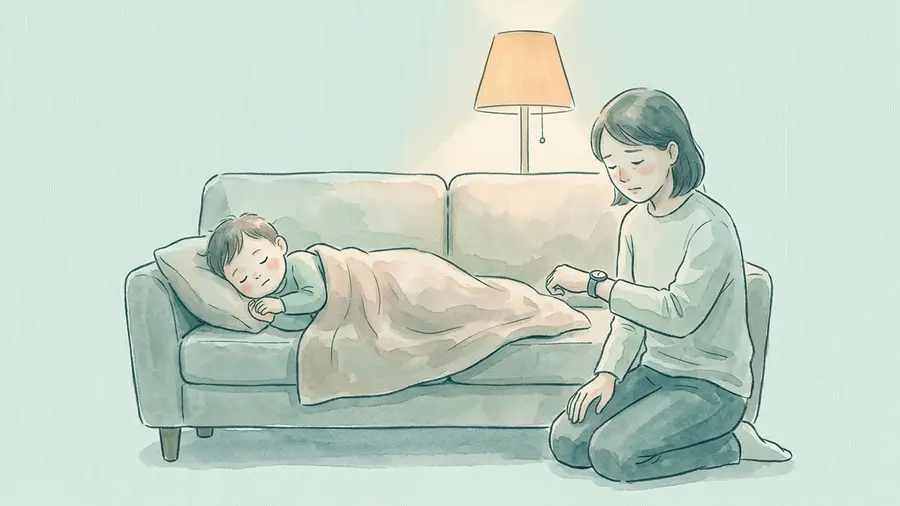
Your child has had a temperature since the afternoon and has dozed off on the sofa. Suddenly their eyes roll back, their arms and legs start jerking, their lips turn bluish, and they do not respond when you say their name. Anyone seeing this for the first time fears the worst.
The short answer first: a febrile seizure looks like an emergency, but it is unlikely to harm your child or cause long-term effects. It usually stops on its own within a few minutes. Your job during those minutes is small and clearly defined.
What to do during the seizure, when to call 999 and what happens afterwards — one step at a time.
Important: This article does not replace professional medical advice. If in doubt, call 111 for advice, or 999 in an emergency.
What should you do if your child has a febrile seizure?
During a febrile seizure you stay with your child, check the time and keep them safe from injury. You do not hold them down, you do not move them and you put nothing in their mouth. Once the seizure ends, you put them in the recovery position. If it is their first seizure, you call 999.
Step by step:
- Check the time the seizure starts and ends. It is one of the most useful things a doctor will ask you.
- Protect their head with your hands or something soft, and move any dangerous objects out of the way.
- Do not hold them in place and do not try to move them while the seizure is happening.
- Put nothing in their mouth — no drink, no food, no fingers, no objects.
- Call 999 if this is the first seizure. Put the phone on speaker so you can stay with your child.
- When the seizure ends, use the recovery position and make sure there is nothing in their mouth or throat that could affect their breathing.
The NHS febrile seizures page is explicit about one instinct that many parents have:
"do not try to lower your child's temperature by undressing them or sponging them with cold water"
The seizure usually stops on its own, not because of anything you do. Your part is to make sure your child does not get hurt while it runs its course.
When should you call 999 for a febrile seizure?
A first febrile seizure always means calling 999, because your child needs to be checked in hospital afterwards. The NHS lists a small set of further situations that also need an ambulance — about how long the seizure lasts, how it looks, how your child breathes and how quickly they come round.
Call 999 or go to A&E if your child:
- has a seizure for the first time
- has a seizure that lasts more than 5 minutes
- is having difficulty breathing
- has stiffness and twitching on only one side of their body
- is more sleepy than usual for more than 1 hour after the seizure stops
- has more than one seizure within 24 hours
If your child is still having a seizure or is unconscious, do not drive them to A&E yourself — call 999 instead. The NHS is clear on that point: do not drive to A&E, ask someone to drive you or call for an ambulance.
If the seizure stops after a short time and your child slowly comes round, it was most likely a typical febrile seizure. Being sleepy, irritable or confused for up to an hour afterwards is normal, according to the NHS (last reviewed June 2023). That is your window: an hour of drowsiness is expected, more than an hour is a reason to call 999.
38.7°C at 02:14, and again at 04:30?
You don't have to remember. Mona logs fever, medication and sleep in 10 seconds, and your partner sees it instantly.


Is a febrile seizure dangerous for my child?
A febrile seizure is usually not dangerous. It happens when a child has a high temperature, mostly affects children between 6 months and 6 years old, and usually lasts 2 to 3 minutes. The NHS says it is unlikely to harm your child or cause long-term effects, even though it can look very frightening.
The NHS gives two figures that are worth knowing: "Febrile seizures usually last for 2 to 3 minutes. It's rare for them to last more than 10 minutes." Most children who have one simply recover and get on with being ill in the ordinary way.
A febrile seizure is also not the same thing as epilepsy. Children who have had one have a slightly increased chance of having epilepsy later in life, the NHS notes, but this is rare.
A high temperature itself is defined simply: "A high temperature is 38C or more," according to the NHS page on fever in children (last reviewed January 2024).
Why do some children have febrile seizures?
Febrile seizures can sometimes happen when a child has an infection and a high temperature, and the NHS is clear that you cannot prevent them. The German Society of Paediatrics describes a tendency of the developing brain to react to fever with a seizure, and in some families they occur in several members.
The German Society of Paediatrics and Adolescent Medicine (DGKJ, 2018) adds a point that explains a lot of the shock: the temperature can sometimes rise so quickly that parents only realise their child has a fever at all when the seizure happens. Usually the cause is an everyday infection, such as one of the upper airways.
Only very rarely is a serious infection behind a febrile seizure. That is the real reason every first seizure needs a medical check — not because the seizure itself is harmful, but because the rare serious cause has to be ruled out.
What happens at the hospital after a febrile seizure?
After a first febrile seizure your child needs to be checked in hospital, and they may need to stay for a short time. Most febrile seizures need no treatment. The checks are there to find what is causing the high temperature and to rule out a more serious infection.
According to the NHS, your child may need some tests — blood tests, a urine test, or a lumbar puncture, where a sample of fluid is taken from the spine and checked for bacteria or viruses. If an infection is causing the high temperature, they may need medicine to treat it.
Very rarely, a child keeps having febrile seizures. In that case a doctor may prescribe a medicine to give during a seizure and explain how to use it. Whether your child needs one, and which, is a decision for your GP or paediatrician — never something to improvise.
How do you keep track of what happened during the seizure?
During the seizure, only your child matters. But straight afterwards, even before the ambulance arrives, it is worth writing down what you saw. The hospital team will ask about it in detail, and in a moment of shock it is easy to misjudge how long something lasted.
What helps the doctors: what time the seizure started and ended, whether the whole body was affected or only one side, whether your child went stiff or floppy, the colour of their lips, how long it took before they responded to you again — and how high the temperature was before and after.
In Mona you log the seizure time, the temperature and the last dose of fever medicine with its time in a few seconds. The temperature chart then shows how fast the fever rose in the hours before — exactly the course you would otherwise have to reconstruct from memory at night. And if a partner or grandparent takes over later, they see the same record.
The doctor will ask: how long did the seizure last? Did it affect the whole body or only one side? How long has your child had a temperature, and how high was it? Did they have any paracetamol or ibuprofen beforehand, and when? With a kept record you answer from your notes instead of from the shock.
The pediatrician asks. You can answer.
Symptom timeline, fever curve, last medication: With Mona you have it all in seconds, instead of guessing from memory.
Can you prevent a febrile seizure?
You cannot prevent febrile seizures. They can sometimes happen when your child has an infection and a high temperature. The German Society of Paediatrics adds that parents should not blame themselves if their child has another one — the seizures often come while the temperature is rising, so they cannot be foreseen.
The German parent guideline on fever, based on the S3 guideline (AWMF register 027-074, 2025 edition), is explicit that fever-reducing medicines do not prevent febrile seizures and should not be used specifically for that purpose.
Paracetamol or ibuprofen still have their place when your child is distressed or in pain. Follow the dose on the packaging or your pharmacist's advice — we compare the two in ibuprofen vs paracetamol. Checking the thermometer all night out of fear of the next seizure does not protect your child, and it costs you both sleep.
Common questions about febrile seizures
How long does a febrile seizure last?
Febrile seizures usually last 2 to 3 minutes, and it is rare for them to last more than 10 minutes. Afterwards a child can be sleepy, irritable or confused for up to an hour. A seizure lasting more than 5 minutes means calling 999, as does any seizure in a child who has never had one before.
What temperature causes a febrile seizure?
The NHS does not name a temperature at which febrile seizures start. It defines a high temperature as 38°C or more, and febrile seizures can happen when a child has a high temperature from an infection. The German Society of Paediatrics notes that the temperature can rise so quickly that the seizure is the first sign of a fever at all.
Will my child have another febrile seizure?
It is possible, but most children do not keep having them. Very rarely, a child has repeated febrile seizures, and a doctor may then prescribe a medicine to give during a seizure. Children grow out of the tendency; the German Society of Paediatrics says this happens by school age at the latest.
Does a febrile seizure mean my child has epilepsy?
No. Febrile seizures are not the same thing as epilepsy. Children who have had one have a slightly increased chance of having epilepsy later in life, but the NHS describes this as rare. Any first seizure means calling 999, with or without a temperature. If your child keeps having seizures, talk to your GP about what to do next time.
Does my child need to go to hospital after a febrile seizure?
After a first febrile seizure, yes. Your child will need to be checked in hospital and may stay for a short time. Tests look for the cause of the high temperature and rule out a more serious infection. Most febrile seizures need no treatment beyond treating the infection behind them.
My child is very sleepy after the seizure — is that normal?
Being sleepy, irritable or confused for up to an hour after a febrile seizure is normal. If your child is more sleepy than usual for more than an hour after the seizure stops, or is having difficulty breathing, call 999 straight away.
Summary: when to call 999 and when to see a doctor
| Situation | What to do |
|---|---|
| First seizure · lasts more than 5 minutes · difficulty breathing · only one side of the body · more sleepy than usual for over an hour · more than one seizure in 24 hours | Call 999 or go to A&E |
| Known febrile seizures, short seizure, child comes round quickly | Get medical help — call 111 or contact your GP |
| After a medical check: child sleepy but responsive, drinking | Rest, fluids, watch the temperature — log the seizure time and temperature in Mona |
About this article
Sources
- Febrile seizures — NHS(accessed 2026-09-14)
- High temperature (fever) in children — NHS(accessed 2026-09-14)
- Parent information: my child had a febrile seizure — German Society of Paediatrics and Adolescent Medicine (DGKJ, 2018)(accessed 2026-09-14)
- Parent guideline on fever in children and adolescents — AWMF register 027-074 (DGKJ, 2025)(accessed 2026-09-14)
You might also like

Track symptoms easily
With Mona you stay on top of things – even at 3 AM.