
Your Child's Temperature Rises at Night and You Are on Your Own: How to Decide
This blog only provides tips, tricks and hints and does not replace a doctor visit. For severe symptoms, always consult a doctor.
At a glance
- ✓A temperature that sits higher in the evening and overnight follows the normal daily rhythm — it is not a warning sign on its own.
- ✓A high temperature is 38C or more, but above that threshold how your child looks and responds matters more than the reading itself.
- ✓Call 999 for a first febrile seizure, a child who is drowsy and hard to wake, difficulty breathing or a rash that does not fade under a glass — otherwise NHS 111.
Table of Contents
- Why does my child's temperature rise at night?
- Which signs mean you should call 999 right now?
- What counts as a high temperature, and does the number decide?
- Should you wake a sleeping child to take their temperature?
- When should you call NHS 111, and when can it wait for the GP?
- How do you keep track on your own at night?
- How do you set yourself up for the next night?
- Frequently asked questions about a fever at night
Your Child's Temperature Rises at Night and You Are on Your Own: How to Decide
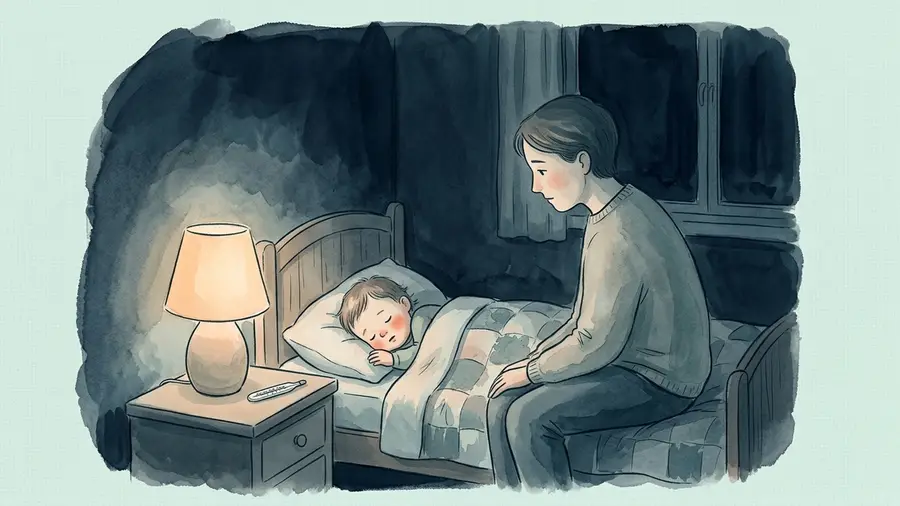
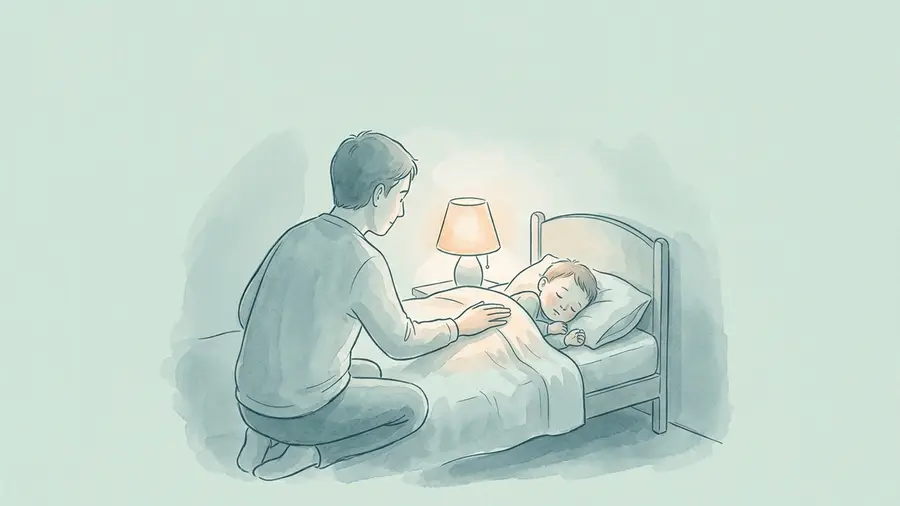
It is just gone two. You put your hand on your child's forehead and it is hotter than it was three hours ago. The thermometer says 39. Your partner is asleep because they are up at five — and the question of whether this is enough to ring someone sits entirely with you.
Here is the short version: a temperature that climbs overnight is normal and is not a warning sign in itself. What decides things is not the number on the display but how your child looks and responds. Which signs mean 999, when NHS 111 is the right call and when you simply let your child sleep on — section by section below.
Important: This article does not replace professional medical advice. If you are unsure or in an emergency, always contact 999, NHS 111 or your GP.
Why does my child's temperature rise at night?
Body temperature sits higher in the evening and overnight than in the morning, and that holds when a child has a fever too. So a higher reading at 2am follows the daily rhythm rather than signalling a sudden deterioration. A high temperature is the body's natural response to fighting infections.
That is why the picture flips between afternoon and night. At teatime your child seemed almost back to normal; by midnight they are burning up. The other half is that you are awake and alone, with nobody to check your judgement against.
Which signs mean you should call 999 right now?
Anything that points to a seriously unwell child — whatever the thermometer says. A first febrile seizure, a child who is drowsy and hard to wake, or difficulty breathing all mean 999. So does a rash that does not fade when you press a glass against it. You ring now, not in the morning.
🚨 Call 999 if your child:
- has a fit (febrile seizure) for the first time
- is drowsy and hard to wake, or is not responding like they normally do
- has difficulty breathing
- has a rash that does not fade when you press a glass against it
- has a stiff neck or is bothered by light
- has unusually cold hands and feet, or changes to their skin colour such as blue, grey, paler than usual or blotchy skin
- is extremely agitated or confused
When you take turns at night …
Mona Premium automatically syncs entries between partner devices, so no one doubles up on paracetamol.


What counts as a high temperature, and does the number decide?
A high temperature is 38C or more — that is the NHS definition. For babies under 3 months, the number counts on its own. Above that threshold the reading matters less than how your child looks, behaves and responds to you at three in the morning.
Under 3 months, a temperature of 38C or higher needs urgent advice: ring NHS 111 or your GP surgery straight away. Between 3 and 6 months, the same call applies from 39C or higher. Those are the two ages where the number itself carries the decision.
For older children the reading is one input among several. Our guide on how to judge a fever covers what the thresholds do and do not tell you.
Should you wake a sleeping child to take their temperature?
NHS guidance on a high temperature in children does not ask you to wake a sleeping child for a reading. What it flags is the opposite state: a child who is drowsy and hard to wake is a 999 sign. Normal sleep and that drowsiness are not the same thing.
A sleeping child stirs when you speak to them, grumbles and settles again. A child you cannot properly rouse belongs in the red block above.
Waking your child for the next dose is a separate question the NHS fever page does not answer. Dosing intervals and daily maximums depend on the product and your child's weight, so check the packaging. Ring NHS 111 if you are still unsure at 3am.
When should you call NHS 111, and when can it wait for the GP?
Call 111 or your GP surgery now if your child is under 3 months with a temperature of 38C or higher. Between 3 and 6 months, the same applies from 39C. Also call if other signs of illness appear, or the fever has lasted 5 days or more. Or if your child is dehydrated, or is not their usual self.
That last one deserves saying plainly: not their usual self and you are worried is an NHS criterion in its own right. You do not need a number to justify the call.
What can wait is a day or two of fever with none of those points attached, in a child who is drinking and responding. At five days it becomes a GP appointment — during surgery hours, not at four in the morning.
How do you keep track on your own at night?
By writing down every reading and every dose as it happens, instead of trying to remember it. At four in the morning your memory is the least reliable part of the setup. A scrap of paper on the bedside table disappears into the duvet; what you need is a log you can still read at breakfast.
In Mona you log the temperature with a timestamp and every dose in seconds. You see the curve of the last few nights at a glance. That curve answers the exact question keeping you up: is it higher than it was at this time yesterday, or does it just feel that way?
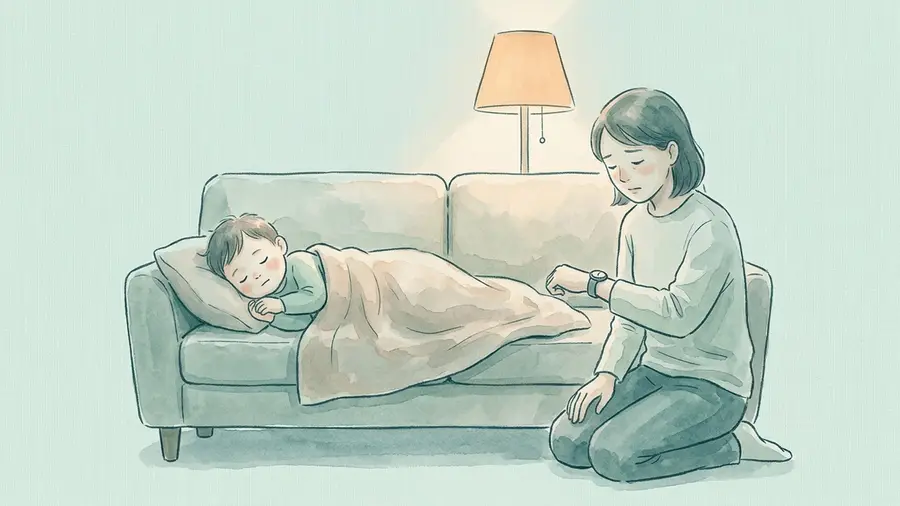
If you and your partner take turns, whoever wakes next sees on their phone what happened overnight. Nobody has to be shaken awake to be asked when the last dose went in. Mum works the night shift covers that in shift-working families.
It pays off again in the morning. Your GP will ask: When did it start? How high was it overnight? When did you last give something — and what? Those answers are already written down instead of reconstructed from a night you barely slept through.
38.7°C at 02:14, and again at 04:30?
You don't have to remember. Mona logs fever, medication and sleep in 10 seconds, and your partner sees it instantly.
How do you set yourself up for the next night?
By making the decisions while you are still awake and clear-headed. The thermometer, the numbers for 999 and NHS 111, and the log so far go in one fixed place beside the bed. Three in the morning is the worst possible time to work out who to ring.
Commit to a rule in advance rather than renegotiating it at 3am. Any sign from the red block and I dial 999. Any 111 criterion and I ring 111. Anything else and I let them sleep. If the doubt lingers anyway, Did I miss something? is about exactly that feeling.
Frequently asked questions about a fever at night
Should I wake my child at night to take their temperature?
NHS guidance on a high temperature in children does not tell you to wake a sleeping child for a reading. What matters is the reverse situation. A child who is drowsy and hard to wake, or not responding as they normally do, needs a 999 call.
Should I wake my child for the next dose of medicine?
The NHS page on high temperature in children does not set a rule for this. Dosing intervals, daily maximums and the right age range differ between products and are printed on the packaging, so check there first. If you are still unsure in the middle of the night, call NHS 111 rather than guessing.
Do I call 999 or NHS 111 at night?
Call 999 for a first febrile seizure, a child who is drowsy and hard to wake, or difficulty breathing. The same goes for a non-fading rash, a stiff neck or unusual skin colour. Call 111 for a baby under 3 months at 38C or higher, or when your child is not their usual self.
At what temperature should I ring about my baby at night?
Under 3 months, a temperature of 38C or higher needs urgent advice: ring NHS 111 or your GP surgery straight away. Between 3 and 6 months, the same call applies from 39C or higher. Older children are judged more on how they look than on the reading.
What matters more, the thermometer reading or my child's behaviour?
Above the 38C threshold, behaviour. The NHS signs that trigger a 999 call say nothing about the number: drowsy and hard to wake, difficulty breathing, a non-fading rash, unusual skin colour. And not being their usual self is enough on its own to justify calling 111.
Summary: when do you have to act during the night?
| Situation | What to do |
|---|---|
| First febrile seizure, drowsy and hard to wake, difficulty breathing, non-fading rash, stiff neck, unusual skin colour | Call 999 |
| Under 3 months with a temperature of 38C or higher | Call NHS 111 or your GP straight away |
| 3 to 6 months with 39C or higher, or other signs of illness alongside a high temperature | Call NHS 111 or your GP now |
| High temperature for 5 days or more, or your child is not their usual self and you are worried | GP appointment |
| Sleeping calmly, responding as usual, no warning signs | Let them sleep and reassess in the morning — log it in Mona |
About this article
Sources
- NHS: High temperature (fever) in children(accessed 2026-08-04)
You might also like
Track symptoms easily
With Mona you stay on top of things – even at 3 AM.