
Meningitis Rash in Children: The Glass Test and When It's an Emergency

This blog only provides tips, tricks and hints and does not replace a doctor visit. For severe symptoms, always consult a doctor.
At a glance
- ✓Meningococcal disease does not spread easily, but meningitis and sepsis can develop suddenly and need treatment in hospital straight away. Babies, young children and teenagers are among those most at risk.
- ✓The glass test takes seconds: a rash that does not fade when you press the side of a clear glass firmly against the skin is a reason to call 999 or go to A&E immediately.
- ✓Not every child gets a rash, and it may not come first. If your child is floppy, difficult to wake, has a high-pitched cry or seems seriously unwell, trust your instincts — and keep the MenB vaccines at 8 weeks, 12 weeks and 1 year on time.
Table of Contents
- How does the glass test work for a rash?
- When is a rash with a high temperature an emergency?
- How dangerous is meningococcal disease for children?
- What are the signs of meningitis in babies and toddlers?
- How do you keep track while you're watching a rash?
- Do vaccines protect against meningococcal disease?
- What does a meningococcal case at nursery mean?
- Common questions about the meningitis rash and the glass test
Meningitis Rash in Children: The Glass Test and When It's an Emergency
Your child has had a temperature since the morning. While changing them you notice a few small red dots on their leg that were not there earlier. And somewhere at the back of your mind a phrase comes back that you once heard: the glass test.
The short answer first: large outbreaks of meningococcal disease are rare, and it does not spread easily. But when it does strike, it can develop within hours — and that is exactly why there is a check you can do in seconds with an ordinary drinking glass.
How the glass test works, which signs mean 999 straight away and what to watch while you wait — one step at a time.
Important: This article does not replace professional medical advice. If in doubt, call 111 for advice, or 999 in an emergency.
How does the glass test work for a rash?
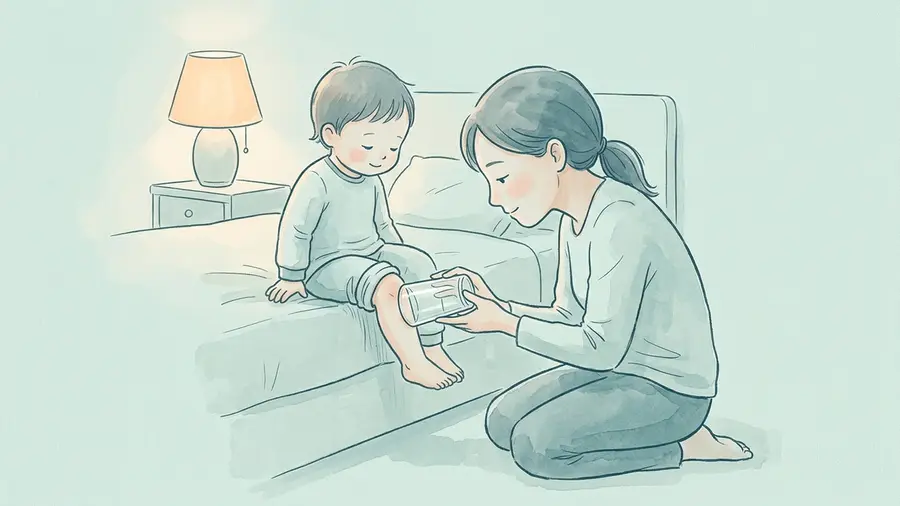
For the glass test you press the side of a clear drinking glass firmly against the spots and look through the glass. A rash that stays visible does not fade — one of the recognised warning signs of meningitis and sepsis. A rash that fades is often harmless, but it does not rule meningitis out.
The NHS meningitis page (last reviewed June 2026) describes what the rash usually looks like and how to test it:
"The rash usually starts as small red pinpricks before spreading quickly and turning into red or purple blotches."
It adds the test itself in one line: "The rash does not fade if you press the side of a clear glass firmly against the skin." Check more than one area, and repeat the test whenever new spots appear.
On brown or black skin the rash can be harder to see. The NHS advises checking paler areas as well — the palms of the hands, the soles of the feet, the roof of the mouth, the whites of the eyes and the inside of the eyelids.
When is a rash with a high temperature an emergency?
A rash with a high temperature is an emergency when the spots do not fade under a glass, or when your child seems seriously unwell. Then you call 999 or go to A&E immediately. Meningitis symptoms develop suddenly, and the NHS says you need to get medical help immediately if you think your child might have it.
If your baby is under 3 months old and has a temperature of 38°C or more, that on its own is urgent: the NHS fever advice is to call 111 straight away, and to call 999 if they seem seriously unwell.
Call 999 or go to A&E immediately if your child:
- has a rash that does not fade when you press a glass against it
- is floppy, difficult to wake, more sleepy than usual or not responding like they normally do
- has a weak, high-pitched or continuous cry, or is not feeding
- has blue, grey, pale or blotchy skin, lips or tongue
- is breathing very fast or having difficulty breathing
- has not had a pee for the last 12 hours
- has a very low temperature (less than 36°C), or feels cold to the touch or is shivery
- has a stiff neck and cannot look at bright lights, or has a seizure for the first time
These signs come from the NHS pages on meningitis and sepsis, which overlap closely, because meningococcal bacteria can cause both. Both pages carry the same instruction: trust your instincts. A child with meningitis might not have every symptom listed, and you do not need a rash to act if you think something is seriously wrong.
If the spots fade under the glass, your child is drinking and perks up between spells of fever, you have time to keep watching — as long as nothing about how they seem changes. How to tell harmless rashes from the ones that need a doctor is covered in child rash: when to see a doctor.
38.7°C at 02:14, and again at 04:30?
You don't have to remember. Mona logs fever, medication and sleep in 10 seconds, and your partner sees it instantly.


How dangerous is meningococcal disease for children?
Meningococcal bacteria can cause meningitis, an infection of the lining of the brain and spinal cord, and sepsis, a life-threatening reaction to an infection. Both need urgent treatment in hospital. The disease does not spread easily, and large outbreaks are rare, but it can become serious very quickly, which is why the warning signs are worth knowing.
According to the NHS, meningitis is more common in babies and young children, teenagers and young adults, older people and people with a weakened immune system. It is usually spread by people who carry the bacteria without being ill themselves.
Bacterial meningitis is rarer than viral meningitis but more serious. It needs to be treated in hospital, usually for at least a week, and it can cause long-term problems such as hearing or vision loss. The NHS is plain about the stakes: bacterial meningitis can be fatal. That is the reason speed matters so much — not because every rash is dangerous, but because the rare serious one cannot wait.
What are the signs of meningitis in babies and toddlers?
In babies and toddlers, meningitis can be hard to spot at first, because some early symptoms look like flu or a stomach bug. A high temperature, very cold hands and feet, vomiting, being very sleepy or hard to wake, not wanting to feed, a high-pitched cry and a floppy or stiff body can all appear.
The NHS lists four signs specifically for babies and children under 5: they may not want to feed, have a high-pitched, unusual cry, have a stiff body or be floppy or unresponsive, and have a bulging soft spot on the top of their head.
The most important sentence for parents is on the same page: "Not everyone with meningitis gets spots or a rash." A child can be seriously ill before a rash appears, or without one at all. If your child seems unwell in a way you do not recognise, that impression counts for more than a clear glass test.
How do you keep track while you're watching a rash?
With a rash that does not fade, there is nothing to write down — you call 999. More common is the other situation: your child has a temperature, the glass test is clear, and you want to watch whether anything changes over the next few hours. That is when a kept record helps.
At every check, note the time, the temperature, whether the spots faded under the glass, where they are and whether there are more of them. Add when your child last drank and when their nappy was last wet — the NHS sepsis page (last reviewed May 2026) lists not having had a pee for the last 12 hours as a reason to call 999 in children under 5.
In Mona you log each of those checks in seconds, with temperature and time, and see at a glance whether the temperature chart is rising and when the last dose of paracetamol or ibuprofen was given. If someone else takes over during the night, the same record is right there — no guessing when anyone last looked.
At the GP, NHS 111 or A&E you will be asked exactly this: how long has your child had a temperature, and how high? When did the spots appear, and have they spread? When did they last drink and pee? What medicine did they have, and when? With a kept record you answer from your notes instead of your memory.
The pediatrician asks. You can answer.
Symptom timeline, fever curve, last medication: With Mona you have it all in seconds, instead of guessing from memory.
Do vaccines protect against meningococcal disease?
Vaccines are one of the safest and most effective ways to protect children against meningitis. In the UK, babies are offered the MenB vaccine at 8 weeks, 12 weeks and 1 year old, and teenagers are offered the MenACWY vaccine at 14. Other routine vaccines, including pneumococcal and 6-in-1, also protect against causes of meningitis.
The NHS MenB vaccine page says it is best to have the vaccines on time, so children are protected when they are most at risk — and a child who has missed a dose can still have the MenB vaccine up to the age of 2. It also recommends giving your baby paracetamol after the MenB vaccinations at 8 and 12 weeks, to help prevent or treat a high temperature.
No vaccine covers every cause, though. Meningitis can be caused by many different viruses and bacteria, and the NHS notes that it is possible to get meningitis more than once. A fully vaccinated toddler still needs parents who know the glass test. Whether your child needs any additional vaccine, for example because of a weakened immune system, is a decision for your GP.
What does a meningococcal case at nursery mean?
A meningococcal case at nursery does not mean your child has caught it. The bacteria need prolonged, close contact to spread, and the UK Health Security Agency does not usually count children in the same nursery room as close contacts. Close contacts are people like those living or sleeping in the same household, and they are offered antibiotics.
The UKHSA guidance for education and early years settings (updated 7 September 2026) puts it directly:
"if you have not been contacted directly by UKHSA, the risk to you or your child is low."
Close contacts can attend nursery as normal and do not need to stay at home. If they become unwell with signs of meningitis or sepsis, they should seek medical advice. The local health protection team will contact a setting directly if any action is needed.
Common questions about the meningitis rash and the glass test
What does a meningitis rash look like?
It usually starts as small red pinpricks and can then spread quickly into red or purple blotches. The key feature is that it does not fade when you press the side of a clear glass firmly against the skin. On brown or black skin, check paler areas such as the palms, soles and the inside of the eyelids.
My child has spots that do not fade but no temperature — what should I do?
A rash that does not fade when pressed is on the NHS list of reasons to call 999 or go to A&E, with or without other symptoms. Do not wait for a temperature to appear. It is far better to have a non-fading rash checked and found to be harmless than to wait on one that is not.
How quickly does meningitis develop?
The symptoms of meningitis develop suddenly. Early symptoms can look like flu, a stomach bug or a hangover, and then a child can get much worse. Sepsis usually develops quickly over a few hours, according to the NHS. That is why suspected meningitis or sepsis needs medical help immediately.
Does every child with meningitis get a rash?
No. Not everyone with meningitis gets spots or a rash, and when it appears it may not be the first sign. A clear glass test therefore does not rule meningitis out. If your child is floppy, difficult to wake, has a high-pitched cry or seems seriously unwell, act on that.
How contagious is meningococcal disease?
Not very. It needs prolonged, close contact to spread, such as living in the same household, and it is not as contagious as infections like measles. People can carry the bacteria in the nose or throat without being ill. Close contacts of a case are offered antibiotics to stop the bacteria spreading further.
Can my child get meningitis even if they are vaccinated?
Yes, it is possible, because each vaccine protects against specific causes and meningitis can be caused by many different viruses and bacteria. Vaccination on time still protects against the main causes and is one of the most effective ways to lower the risk. Knowing the warning signs matters for every child.
Summary: 999, 111 or keep watching?
| Situation | What to do |
|---|---|
| Rash that does not fade under a glass · floppy, difficult to wake or unresponsive · weak, high-pitched cry · blue, grey or blotchy skin · breathing very fast · no pee for 12 hours · very low temperature · stiff neck with dislike of bright lights | Call 999 or go to A&E |
| Baby under 3 months with a temperature of 38°C or more, otherwise not seriously unwell | Call 111 or your GP straight away |
| Close contact of a case (for example, the same household) | Follow the health protection team's advice on antibiotics and watch for symptoms |
| Spots fade under the glass, child drinking and perking up | Keep watching, repeat the glass test on new spots — log each check in Mona |
About this article
Sources
- Meningitis — NHS(accessed 2026-09-14)
- High temperature (fever) in children — NHS(accessed 2026-09-14)
- Sepsis — NHS(accessed 2026-09-14)
- MenB vaccine — NHS(accessed 2026-09-14)
- NHS vaccinations and when to have them — NHS(accessed 2026-09-14)
- Information for education settings in England regarding cases of invasive meningococcal disease — UKHSA (GOV.UK)(accessed 2026-09-14)
You might also like

Track symptoms easily
With Mona you stay on top of things – even at 3 AM.