
Googling your child's symptoms at night: why Dr Google doesn't know your child

This blog only provides tips, tricks and hints and does not replace a doctor visit. For severe symptoms, always consult a doctor.
At a glance
- ✓Googling symptoms at night is understandable — the surgery is closed and a search engine always answers. The problem is not the search, it's that the search doesn't know your child.
- ✓A search engine doesn't know how the fever has moved since yesterday, how much your child has drunk or when the last dose was. Those facts about your child are more reassuring than any forum post.
- ✓Difficulty breathing, blue or grey lips, a rash that doesn't fade, a seizure, a child who is hard to wake: don't search, call 999 or go to A&E. A baby under 3 months at 38C or higher: 999 or A&E. Worried and not sure what to do? For a child under 5, call 111.
Table of Contents
- Why do we google our child's symptoms at night?
- Why does searching at night often make the fear worse?
- Who can you ask at night instead of Google?
- What doesn't Google know about your child?
- What does a better routine for the next night look like?
- Frequently asked questions about googling symptoms at night
- Is it bad to google my child's symptoms at night?
- Why does googling always lead to the worst illness?
Googling your child's symptoms at night: why Dr Google doesn't know your child
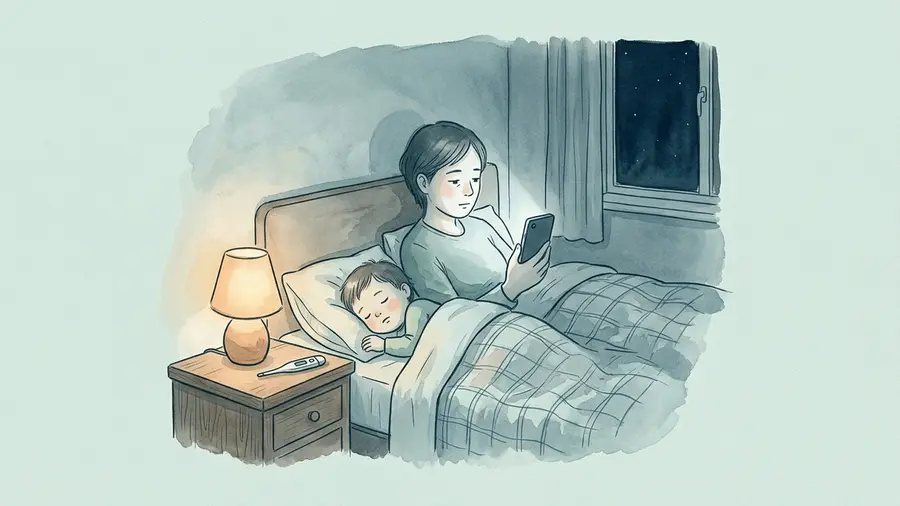
It's 3:07am. Your child is finally asleep, hot and pink-cheeked, and you're lying next to them with your phone above your face. You type "child fever rash tummy ache". The first result is a forum thread from 2014, the third is someone's personal story, and four tabs later you're reading about an illness you had never heard of.
That's not a failure. Many parents do it, and it makes sense: the surgery is closed, your partner is asleep and you want an answer. Why the search rarely calms you down, what it cannot know about your child and what helps instead — it's all below.
Important: This article does not replace professional medical advice. If you are unsure, contact your GP or NHS 111. In an emergency, call 999 or go to A&E.
Why do we google our child's symptoms at night?
Because at night there is nobody to ask, and a search engine always answers. When the surgery is closed and the worry won't wait until morning, the phone is simply the nearest thing to hand. Reaching for it is not unusual, and it is not a sign that you are doing anything wrong.
And in principle there's nothing wrong with looking things up. Quick access to information at any hour is exactly what you want at 3am. The trouble is the moment the search lands in.
You're exhausted, alone with the decision and frightened for your child. Nobody reads calmly in that state. Every result that matches the worry weighs more than ten that would reassure you.
Why does searching at night often make the fear worse?
Because a search engine has no idea how likely an illness is in your child. Rare, dramatic cases can sit right next to harmless ones, and forums often show single stories rather than what is typical. On top of that, once you already suspect something, it is easy to click on whatever seems to confirm it.
The NHS describes the far end of a similar pattern — for people worried about their own health — on its page about health anxiety: people who "obsessively look at health information on the internet" and "worry that a doctor or medical tests may have missed something". Googling at 3am is usually nowhere near that. But it shows where more checking can lead.
After an hour of searching you don't know any more about your child than you did before. You just have more possibilities in your head.
There are some signs, though, where you don't need to search at all, because the answer is already clear.
Don't search — call 999 or go to A&E if your baby or child under 5:
- has swollen lips, tongue or throat with difficulty swallowing or talking
- is breathing very fast or has difficulty breathing — they may make grunting noises or suck in their tummy when they breathe
- has blue, grey, pale or blotchy skin, lips or tongue
- has skin that feels cold or damp (clammy) to touch
- has a rash that does not fade when you press it
- has a very low temperature — less than 36C, or feels cold to touch or is shivery
- has a weak, high-pitched or continuous cry
- has fainted, is difficult to wake, or cannot be woken
- has not had a pee in the past 12 hours
- is having a seizure (fit)
These points come from the NHS page on urgent help for babies and children under 5, which lists them as reasons to call 999 or go to A&E. The same list adds a very high temperature in babies: 38C or higher under 3 months, or 39C or higher at 3 to 6 months. And the NHS adds a rule that no list replaces: "Get immediate medical help if your child is unwell and you think there's something seriously wrong." You'll find the other warning signs for fever, vomiting or a fall sorted by situation in When to take your child to hospital.
If none of that applies, two questions remain that no search engine can answer. Can this wait until morning? And is it getting better or worse right now? For the first there is a phone number. For the second you need your child's own history.
38.7°C at 02:14, and again at 04:30?
You don't have to remember. Mona logs fever, medication and sleep in 10 seconds, and your partner sees it instantly.


Who can you ask at night instead of Google?
NHS 111. It can tell you where to get help when your GP is closed, and for a child under 5 you call 111 rather than using 111 online. Being worried and not knowing what to do is reason enough to call. For signs of life-threatening illness, call 999.
The NHS urgent-help page puts it plainly:
"Call NHS 111 if: you're worried about any of your child's symptoms or do not know what to do"
The NHS page on when to use 111 explains how it works. Anyone aged 5 and over can check symptoms online or call; for children under 5, you call. Depending on the symptoms, you may be offered a callback from a nurse. While you wait, you don't need to contact 111 again unless the symptoms change or get worse — and if any sign from the list above appears, call 999 straight away.
The difference from searching comes down to one thing: on the phone, you talk to a person about your child, not about an average. Expect questions such as these, for example: How old is your child? How long has this been going on? How do they seem right now? Not knowing what to do is not a reason to hold back — it is exactly the situation the NHS names for calling.
If you want to read up during the day, stick to sources you can check, such as the NHS website. Look at who is behind a page and when it was last reviewed, and be wary of forums built on single experiences.
What doesn't Google know about your child?
Everything that matters. Google doesn't know that the fever has been falling since last night, that your child drank more today, or that the last dose of ibuprofen was at 10pm. A search engine knows illnesses on average. What you need are facts about your child, over time.
Was the fever higher at midnight than now? Has your child had anything to drink since the evening? Was the medicine at ten or at eleven? At 3am you scroll back through your messages to your partner and can't find it. This is exactly where another tab won't help.
That history answers the questions that actually matter at night. A fever that is lower each evening tells a different story from one that keeps climbing. But how your child seems matters more than the number on its own. A child who is drinking and responding to you is in a different place from one who has refused everything for hours. None of that is on a website — only in your own notes.
The NHS asks parents to "keep checking for new or changing symptoms when they're unwell, even during the night". Here's the same night with a record: at 3:07am you open Mona instead of the search engine. The fever chart shows 39.2C at 9pm and 38.6C at midnight. The medication log says ibuprofen at 10:04pm. Below it, today's drinks. In ten seconds you can see what has happened so far — instead of piecing it together from memory.
And if you do call, whether that's 111 at night or the GP in the morning, expect exactly these questions: When did the fever start? How high was it? When did your child last have medicine, and are they drinking? With the history in Mona, you answer from your entries rather than from your 3am memory.
The pediatrician asks. You can answer.
Symptom timeline, fever curve, last medication: With Mona you have it all in seconds, instead of guessing from memory.
What does a better routine for the next night look like?
Set out the steps before the next night comes. Then at 3am you don't have to think, only work through them — and your phone turns from a search device into a tool. Five steps are enough, and none of them needs a search engine.
- Look at your child first, not your phone. Are they breathing calmly? Do they respond to you? Have they had a drink and a wet nappy? How does their skin look?
- Check the warning signs. If any of the points in the list above apply, call 999 or go to A&E — no detour through a search.
- Write the reading down. Temperature, time, drinks, last dose of medicine. An entry takes seconds and saves the scrolling.
- When in doubt, call rather than keep searching. A conversation with 111 does more than a fifth tab.
- Set a limit on searching. If you do read up, use one reliable source instead of many forums.
This routine won't take the worry away. But it gives it a direction. Instead of an hour with the phone above your face, you have three minutes, a decision and, hopefully, a few more hours of sleep. How to decide when a fever climbs at night and you're on your own is covered in detail in Fever rising at night and you're alone with your child.
Frequently asked questions about googling symptoms at night
Is it bad to google my child's symptoms at night?
No — many parents do it. It becomes a problem when the search makes the worry bigger rather than smaller. At that point, looking at your child and their history helps more than more results. And if you're worried or don't know what to do, the NHS says to call 111 — for a child under 5, by phone.
Why does googling always lead to the worst illness?
Because a search engine doesn't know how likely an illness is in your child. Rare, dramatic cases can appear next to harmless ones, and forums often show single stories, not what is typical. Once you suspect something, it is easy to click on the results that seem to confirm it. Four tabs later, an ordinary infection can look like an emergency.
When should I call 111 instead of searching?
Whenever you're worried about any of your child's symptoms or don't know what to do — that is exactly how the NHS describes it. For children under 5, call 111 rather than using 111 online. 111 can direct you to the best place to get help. If there are signs of a life-threatening illness, call 999 straight away.
Which websites can I trust if I want to read up?
The NHS website, including its page on when to get urgent help for children under 5, is a good place to start. In general, check who is behind a page, when it was last reviewed and whether claims are backed by sources. Forums built on single experiences are especially poor advisers at night, because they rarely show what is typical.
Is an AI chatbot better than a search engine?
Not when it comes to your child's history. A chatbot doesn't know it any more than a search engine does: not the fever since yesterday, not the drinks, not the last dose. If you're worried at night, calling 111 puts you in touch with the NHS service built for exactly that question.
What is health anxiety?
The NHS describes health anxiety — about your own health — as spending so much time worrying you're ill, or going to get ill, that it starts to take over your life. Obsessively looking at health information on the internet is one of the signs it lists. If worry about your child's health starts to run your days, talk to your GP.
Summary: search or act?
| Situation | What to do |
|---|---|
| Any sign from the NHS list above — e.g. difficulty breathing · blue, grey, pale or blotchy skin · rash that doesn't fade · seizure · difficult to wake · no pee in 12 hours · 38C or higher under 3 months, 39C or higher at 3 to 6 months | Call 999 or go to A&E — don't search first |
| You're worried about any symptom or don't know what to do | Call NHS 111 (for a child under 5, call rather than going online) |
| None of the warning signs: your child is breathing calmly, responds to you, has had a drink and has had a wee, but you can't settle | Write the readings down, check the history in Mona, put the phone away. If symptoms persist or you're worried: call 111 |
About this article
Sources
- When to get urgent medical help for babies and children under 5 — NHS(accessed 2026-10-05)
- When to use 111 — NHS(accessed 2026-10-05)
- Health anxiety — NHS(accessed 2026-10-05)
You might also like

Track symptoms easily
With Mona you stay on top of things – even at 3 AM.