
Day 3 of Fever – and You've Lost Track Completely

This blog only provides tips, tricks and hints and does not replace a doctor visit. For severe symptoms, always consult a doctor.
At a glance
- ✓With a fever that drags on for days, you almost inevitably lose track — when was the last dose, how high was it this morning? That's normal, not a failure.
- ✓This isn't about the childhood illness roseola (also called three-day fever) — it's about the days when the fever simply won't stop.
- ✓See a GP: babies under 3 months with a temperature of 38°C or above (urgent), any child with a high temperature lasting 5 days or more, or any quick deterioration — and always when your gut says something is wrong.
Table of Contents
- Why do you lose track during a multi-day fever?
- How do I get back on top of it?
- When should I see a GP about a multi-day fever?
- What to do during a multi-day fever — the quick overview
- Common questions about multi-day fever
- How long can a fever last in children?
- When should I see a GP about a multi-day fever?
- Is this the childhood illness "three-day fever" (roseola)?
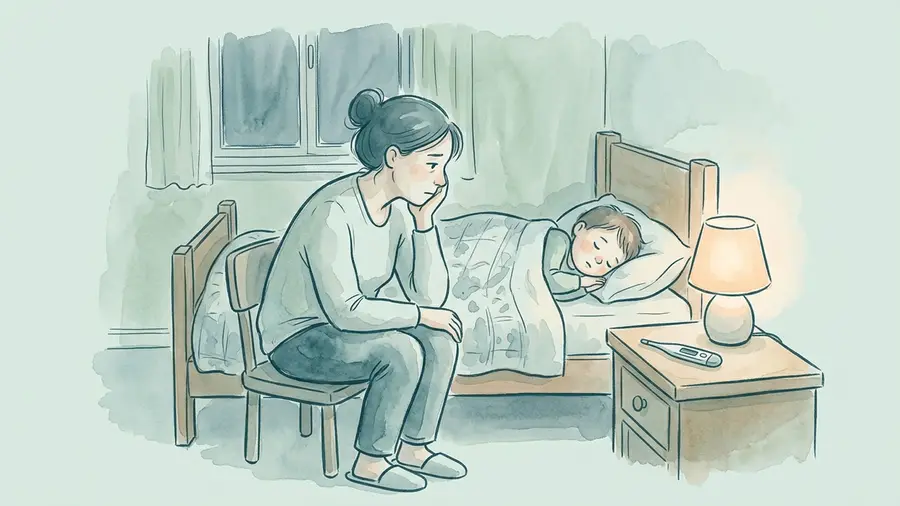
It's 3 a.m. Day 3. You're standing in the half-dark by the bed, and you simply can't remember: when was the last dose? Half past ten? Or was that yesterday? How high was the fever this morning — 39, or more like 38.7? Has your child had enough to drink today?
And as you stand there, a quiet, ugly thought pushes to the front: I should know this.
You don't have to know it. No one could keep all of that straight after three broken nights. The most important thing first: losing track like this is not a failure. It's the normal result of too little sleep and too many small numbers. And there's a simple way out of it — you'll read it in a moment.
Important note: This article does not replace professional medical advice. If in doubt or in an emergency, contact your GP or call 999.
One thing before we start: this is not about the childhood illness roseola — sometimes called three-day fever (caused by human herpesvirus 6). It's about something far more everyday: the days when the fever simply won't stop and you lose track of it all, whatever infection is behind it.
Why do you lose track during a multi-day fever?
Because your brain was never built to keep a logbook while sleep-deprived. On Day 1 you hold it all in your head. On Day 2 it gets fuzzy. On Day 3 everything blurs into one long day.
The spiral almost always runs like this:
- Day 1 – You track it in your head. Fever taken, medicine given, time noted. All within reach.
- Day 2 – The night was short. You remember "roughly," but the exact time of the last dose is already gone.
- Day 3 – You're sure of nothing. Was the fever higher today than yesterday? Did your partner give something at two, or just offer water?
This isn't weakness. Sleep deprivation hits exactly the brain regions responsible for short-term memory and your sense of time. No matter how hard you try, after the third interrupted night the small numbers simply slip through.
And here's the catch: those small numbers are the ones that matter. The gap since the last dose. How the fever moved across the days. How much your child drank. No one expects you to hold all of that in your head. Only you expect it of yourself — and you're allowed to let that go.
How do I get back on top of it?
You write it down. That's all it takes. The moment you jot down the time, the temperature, and how much was drunk, it's out of your overloaded head and safely captured.
It sounds almost too simple. But that's exactly where the relief sits. You no longer have to remember. You no longer have to guess whether the last dose was "around eleven." You look — and you know.
Three things are entirely enough:
- Time + medicine + dose, every time you give something. This guards against gaps that are too short and against an accidental double dose.
- Temperature with the time, a few times a day. That shows you the trend, not just the current reading.
- Roughly how much was drunk – one tick per cup, bottle, or feed is plenty.
Tip: Keep your phone wherever the thermometer lives. Then logging isn't an extra step — it happens automatically, in the same movement.
A sheet of paper on the fridge gets lost fast by the third night — or it's never where you're taking the temperature. Mona holds exactly this for you: the medicine log with times, the fever curve across the days, the fluid-intake record. It remembers what you forget when you're running on no sleep — and at the GP, you have it all at a glance.
If you and your partner take turns through the night, a shared record is especially worth it. There's more on that in "Mum works the night shift — and no one knows when the last fever dose was".
38.7°C at 02:14, and again at 04:30?
You don't have to remember. Mona logs fever, medication and sleep in 10 seconds, and your partner sees it instantly.


When should I see a GP about a multi-day fever?
Most fevers are harmless and pass on their own. But there are clear points where you shouldn't keep waiting. With a multi-day fever, what counts most is the duration — and, more importantly, how your child is doing overall.
A fever from a viral infection usually starts to improve within a few days; the temperature normally returns to normal within 1 to 4 days. That alone is no cause for alarm. What matters isn't the number on the thermometer but how your child seems alongside it.
Here's how the NHS frames it:
- Baby under 3 months with a temperature of 38°C or above — get urgent advice, contact a GP or call NHS 111 straight away (call 999 or go to A&E if your baby seems seriously unwell).
- Baby 3 to 6 months with a temperature of 39°C or above — contact a GP or call NHS 111.
- Any child whose high temperature has lasted 5 days or more — see your GP.
- Your child won't drink, isn't their usual self, or you're worried — contact a GP, whatever the number says.
Call 999 or go to A&E immediately if your child:
- is unresponsive, lethargic, or hard to wake
- has difficulty breathing or is breathing very fast
- has a stiff neck — can't bring chin to chest
- has a rash that doesn't fade when pressed with a glass
- has a febrile seizure — twitching movements, fixed gaze
And the single most important sentence: if your gut says something is wrong, you don't need a number to justify it. Behaviour and overall condition beat any reading. Better to call once too often than once too late. For more on age-specific thresholds, see "Fever in children: when is it dangerous?".
What to do during a multi-day fever — the quick overview
When your head is empty, a simple list helps. These are the three things that really count:
| Situation | What to do? |
|---|---|
| Breathing trouble, unresponsive, stiff neck, non-fading rash, febrile seizure | Call 999 / A&E |
| Baby < 3 months at 38°C or above | Urgent — NHS 111 / GP straight away (999 if seriously unwell) |
| High temperature 5 days or more, won't drink, signs of dehydration, or getting worse | GP same day or NHS 111 |
| Fever, but child drinks, sleeps, and is responsive in between | Observe, plenty of fluids, write it down |
On fluids: a child with a fever needs more fluids than usual. Offer small amounts often — water, and for babies keep breastfeeding as normal. Small portions, by the spoonful if needed, and look out for signs of dehydration.
And write down what happens. Not because you have to do it "right," but because it clears your head and gets you straight to the point at the GP.
Common questions about multi-day fever
How long can a fever last in children?
A fever from a viral infection usually starts to improve within a few days, and the temperature normally returns to normal within 1 to 4 days. On its own, that's normal. If a high temperature lasts 5 days or more, see your GP — and don't wait that long if your child is getting worse or isn't their usual self.
When should I see a GP about a multi-day fever?
For babies under 3 months, any temperature of 38°C or above means getting urgent advice straight away. For older children: when a high temperature has lasted 5 days or more, keeps climbing again, or your child's overall condition gets worse. And always when your gut says something is wrong — behaviour beats any number.
Is this the childhood illness "three-day fever" (roseola)?
No. Roseola — also called three-day fever (caused by human herpesvirus 6) — is its own illness, with a typical rash appearing after the fever. This article means something different: the everyday situation where a fever runs across several days and you lose track of it all.
How do I keep track of fever and medicine?
Write down three things: the time and dose of every medicine given, the temperature with the time a few times a day, and roughly how much was drunk. Mona keeps this in the medicine log with times and the fever curve, lifting the mental load and guarding against an accidental double dose. At the GP, you then have everything ready.
About this article
Sources
- NHS: High temperature (fever) in children(accessed 2026-06-08)
You might also like

Track symptoms easily
With Mona you stay on top of things – even at 3 AM.