
Handing Over a Sick Child: A Checklist for Grandparents and Babysitters

This blog only provides tips, tricks and hints and does not replace a doctor visit. For severe symptoms, always consult a doctor.
At a glance
- ✓A carer needs six things: how ill the child is, the last temperature with the time, the last dose of medicine with the time, what the child may eat and drink, every emergency number, and a clear rule for when to ring you.
- ✓The most common handover mistake is the double dose: two adults, one child, no shared record — and the medicine goes in twice.
- ✓A high temperature does not have to be brought down just because the number is high. Fever medicines are for pain and comfort, which takes a lot of pressure off whoever is looking after your child.
Table of Contents
- What does the carer absolutely need to know?
- What is the most common mistake at handover?
- Which warning signs does the carer need to recognise?
- How much should the carer decide alone?
- How do you hand over the course of the illness, not the whole story?
- When should an ill child not be handed over at all?
- Common questions about someone else looking after your ill child
- Can a grandparent give my child fever medicine?
Handing Over a Sick Child: A Checklist for Grandparents and Babysitters
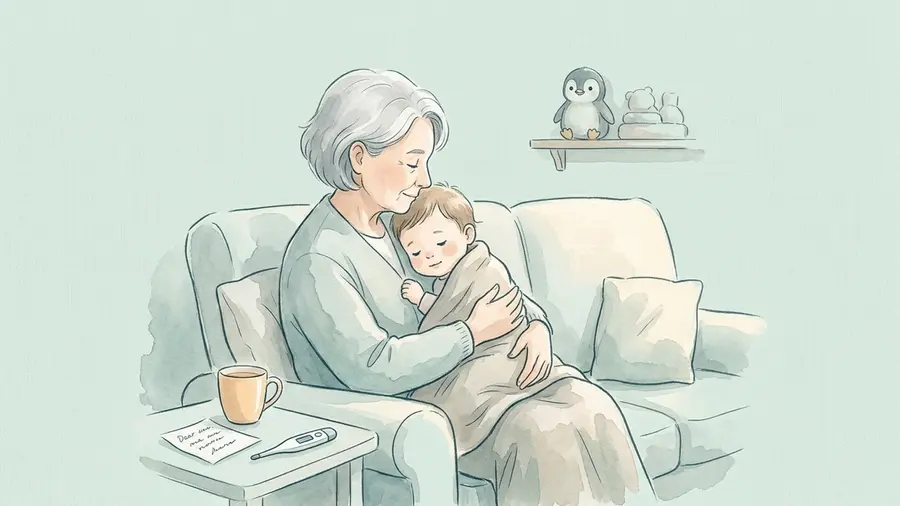
You have to get to work, your child is ill, and their grandmother is stepping in. You are already at the door, calling two more sentences over your shoulder — and in the car it hits you that you never said when the last dose of medicine went in. The short answer first: handovers almost never fail on goodwill. They fail on three or four pieces of information that exist only in your head. What the carer actually needs is set out as a checklist in the next section.
Important note: This article does not replace professional medical advice. If you are unsure, contact your GP or call NHS 111. In an emergency, call 999 or go to A&E.
What does the carer absolutely need to know?
Six blocks are enough: how the child is right now, when the temperature was last taken, when the last dose of which medicine was given, what the child may drink and eat, which numbers apply in an emergency, and the point at which they should ring you. Everything else is a bonus.
| What | Why it matters |
|---|---|
| Ill since when, which symptoms | Without the backstory, nobody can judge whether things are getting worse |
| Last temperature with the time | A reading without a time says nothing about the trend |
| Last medicine: which, how much, when | The only real protection against an accidental double dose |
| Drinking and eating | Fluids come before food — how much, and what stayed down |
| Emergency numbers | Your mobile, a second reachable adult, the GP surgery, NHS 111, 999 |
| When to call you | A clear threshold instead of "let me know if anything happens" |
Put the numbers somewhere visible — on the fridge, not only in a phone. Add the child's date of birth and any known allergies, because those are the first things anyone will ask for on the phone. If you suspect your child has swallowed something they should not have, NHS advice is to call 999 or go to A&E; NHS 111 can advise when it is less clear-cut.
And one line that is often missing: who is allowed to take the child to a doctor? If the carer is not a parent, a short written note saying they are looking after your child on your behalf saves an awkward conversation at reception.
What is the most common mistake at handover?
The double dose. Two adults look after the same child, nobody writes anything down, and the fever medicine goes in twice — once from you just before you leave, once an hour later because the child still feels hot. It is the classic, and it comes purely from missing information.
NHS guidance on children's medicines is firm on the point: give the dose stated for your child's age and weight, do not exceed the maximum number of doses in 24 hours, and leave the stated gap between doses. Whatever your child is taking, the packaging and the leaflet belong within reach of the carer, not in your bag.
Three rules every carer should know: never make up for a missed dose by giving a double one next time. Never give a child medicine intended for adults. And do not give aspirin to anyone under 16 unless a doctor has prescribed it.
If something has gone wrong anyway — too much given, or the child was sick shortly after a dose — the GP surgery or NHS 111 is the right place to ask what to do next. We have written a separate article on what to do when a child has been given a double dose by accident.
Which warning signs does the carer need to recognise?
Fever warning signs are not parent knowledge, they are carer knowledge. Anyone looking after an ill child should be able to recognise them, and that list belongs on the fridge next to the phone numbers. The NHS defines a high temperature as 38C or above.
Call 999 or go to A&E immediately if the child:
- has a stiff neck
- has a rash that does not fade when you press a glass against it
- is bothered by light
- has a fit (seizure) for the first time
- has unusually cold hands and feet, or skin that looks blue, grey, pale or blotchy
- is very difficult to wake up, or seems confused or extremely agitated
- has difficulty breathing
- is not responding as usual, or has no interest in feeding
One step below that sits the same-day call: a baby under 3 months with a temperature of 38C or above, a child aged 3 to 6 months with 39C or above, a fever that will not settle, a child who is not drinking, or simply the feeling that something is off. NHS 111 is available around the clock — being unsure is reason enough to ring, and that applies to a grandparent exactly as much as to you.
38.7°C at 02:14, and again at 04:30?
You don't have to remember. Mona logs fever, medication and sleep in 10 seconds, and your partner sees it instantly.


How much should the carer decide alone?
Less than most people assume — and that is a relief. The most useful piece of reassurance is this: a high temperature does not need to be brought down for its own sake. Fever medicines are painkillers. They are given when a child is uncomfortable or in pain, not because the thermometer shows a particular number.
That takes the pressure out of the moment. Nobody has to make a decision at 39.2C that is not really a decision at all. What an ill child mainly needs is calm, closeness, undisturbed sleep and plenty to drink, in a room that is airy without being draughty.
It still helps to agree what may happen without checking with you. A workable split: offering fluids, taking and noting the temperature, keeping things quiet — always fine. Giving medicine — only after checking with you. Getting medical help — always, without asking first, if any warning sign appears. One call too many beats one too few.
The bit that gets forgotten: say out loud that you want to be called. Grandparents and babysitters often hesitate because they do not want to interrupt you at work. A sentence like "ring me rather than wonder" works better than any checklist.
How do you hand over the course of the illness, not the whole story?
Handovers fail on detail, not on the big picture. Four values matter, and every one of them carries a timestamp: temperature with the time, medicine with dose and time, how much the child drank, and any new symptom. Those four are exactly what gets lost in a rushed conversation at the front door.
In Mona this runs through the record you are keeping anyway. Partner sync turns it into one shared view: whoever takes a reading enters it, and everyone else sees it straight away, even when nobody is at home. "When was the last dose?" stops being a question of memory and becomes a glance at a phone. A note on the kitchen worktop cannot do that while you are at the office and your child is at their grandparents'.
The record stays useful afterwards, too. Your GP will ask how long the fever has been going, how high it got in the evenings, and when the last dose of what was given. If someone else was looking after your child in between, those are precisely the gaps nobody can fill later. We have written about why your memory fails at the GP and what helps.
When you take turns at night …
Mona Premium automatically syncs entries between partner devices, so no one doubles up on paracetamol.
When should an ill child not be handed over at all?
There are two reasons to call it off: the child, and the carer. A child running a high temperature and wanting constant closeness is fine with someone familiar — but not with someone they barely know. And a child whose condition is actively getting worse does not belong in a handover; they belong in front of a doctor first.
The second side gets overlooked. Grandparents are themselves vulnerable to infections, and anyone with a long-term condition or on medicines that affect the immune system should be able to say so without guilt. With a tummy bug or chickenpox, a no is not a rejection of the family — it is sensible.
For going back to nursery, a simple rule works: wait until your child is properly fit and free of fever again. Where several children in one household are ill at once, a shared overview helps even more — we have described why siblings keep passing infections back and forth.
Common questions about someone else looking after your ill child
Can a grandparent give my child fever medicine?
Yes, provided you have agreed it in advance: which medicine, how much, and the earliest time the next dose may be given. The packaging and your doctor's instructions are what count. Nothing should be given without that agreement — including anything from their own cupboard.
What belongs on the emergency note?
Your mobile number and a second reachable adult, the GP surgery, NHS 111, and 999. Add the child's name and date of birth, any known allergies, and where their medicines are kept. Written on paper, somewhere visible, not buried in a phone.
Does a babysitter need written permission for a doctor's visit?
It is worth having. A short note saying the person is caring for your child on your behalf and may seek medical care if needed avoids friction at reception. In a genuine emergency a child is treated regardless — then the call to 999 is what matters, not the paperwork.
How do I explain warning signs without causing panic?
Keep it concrete and short. Not "if he seems worse", but the printed list from this article next to the phone. Naming warning signs makes people calmer, not more anxious: someone who knows what to watch for does not have to watch everything.
Can I get time off work if a grandparent is doing the caring?
Rules on time off to care for a dependant depend on your employment and your circumstances. Check with your employer or the current government guidance before you rely on a particular arrangement — it is not something to work out on the morning your child wakes up ill.
How long should my child stay off nursery?
It depends on the illness, and for some infections the nursery will have its own exclusion rules. As a rule of thumb, wait until your child is fit and free of fever before they go back, and follow whatever the nursery specifies for that particular infection.
Summary: who decides what?
| Situation | What to do |
|---|---|
| Warning signs such as a non-fading rash, difficulty breathing, very hard to wake | Call 999 — immediately, without checking with the parents first |
| Fever that will not settle, or a child who stays listless as the temperature falls | Contact the GP today, or call NHS 111 |
| Suspicion of too much medicine, or something swallowed | Call 999 or go to A&E; NHS 111 for advice if less clear-cut |
| Child has a temperature but is responsive and drinking | Calm, closeness, offer fluids — medicine only by prior agreement |
| Unsure whether something is serious | Ring the parents — one call too many is fine, and log the course in Mona |
About this article
Sources
- NHS: High temperature (fever) in children(accessed 2026-08-26)
- NHS: Looking after a sick child(accessed 2026-08-26)
- NHS: Paracetamol for children(accessed 2026-08-26)
- NHS: Ibuprofen for children(accessed 2026-08-26)
- NHS: Poisoning(accessed 2026-08-26)
You might also like
Track symptoms easily
With Mona you stay on top of things – even at 3 AM.