
Headaches in Children: Warning Signs, Causes and What Actually Helps
This blog only provides tips, tricks and hints and does not replace a doctor visit. For severe symptoms, always consult a doctor.
At a glance
- ✓Headaches are common in childhood and are rarely a sign of something serious — what matters is how they appear, not that they appear.
- ✓Call 999 for a headache that starts suddenly and is extremely painful, comes with a stiff neck and very high temperature, follows a head injury, or brings seizures, confusion, loss of vision or weakness.
- ✓See a GP for headaches that keep coming back, get worse, or wake your child at night — a headache diary is what makes that appointment useful.
Table of Contents
Headaches in Children: Warning Signs, Causes and What Actually Helps
Your child comes home from school, lies down on the sofa and says their head hurts. That is the third time in two weeks. And while you fetch a cool flannel, a quieter question runs in the background — the one you would rather not say out loud. Is this still normal?
The short answer: headaches are common in childhood, and in the vast majority of cases there is nothing dangerous behind them. But there is a manageable list of warning signs where that is not true, and those are worth knowing by heart.
Which ones they are, what helps in the moment and how to find the pattern behind the pain — one section at a time.
Important: This article does not replace professional medical advice. If in doubt, call 111 for advice, or 999 in an emergency. For a child under 5, NHS advice is to call 111.
Are headaches in children normal?
Headaches in children are usually harmless. They are one of the most common complaints in childhood and are only rarely a sign of serious illness. What matters is not that your child has a headache, but how it behaves: sudden or gradual, one-off or recurring, alone or with other symptoms.
The triggers are usually ordinary and sit in everyday life: too little sleep, stress at school, worries, long stretches of screen time, noise, poor air, bright light or heat. An undetected vision problem can also be behind it, because the eyes are strained all day without anyone noticing.
On duration, the NHS (last reviewed 17 April 2024) is deliberately broad: "Headaches can last 30 minutes, several hours, or sometimes several days." A single episode that passes with rest and fluids is not the thing to worry about.
Very often a headache is simply part of an infection. Feverish illnesses frequently come with headaches, as do sinus, ear, throat and tonsil infections. In those cases the headache goes when the illness does.
Which warning signs need urgent care?
Some headaches in children must not be watched and waited on. The NHS lists a clear set of situations that mean A&E or an ambulance — most importantly a headache that starts suddenly and is extremely painful, one that comes with a stiff neck and a very high temperature, or one that follows a head injury.
Call 999 or go to A&E if your child:
- has a headache that started suddenly and is extremely painful
- has a very high temperature, a stiff neck, or bright lights are bothering them
- has had a head injury within the last 3 months
- has had a seizure (fit), or is drowsy or confused
- has numbness or weakness in the body or face, or loss of vision
- is finding it difficult to speak, balance, walk or remember things
- has a rash that does not fade when a glass is rolled over it
That list is not ours. It is what the NHS headaches page tells you to act on, including the one that surprises most parents:
"has had a head injury within the last 3 months – for example, from a fall or accident"
If none of that applies, your child is responsive, eating and drinking and back to themselves between episodes, then you have time. This is not emergency medicine any more. It is the calmer question of where the headaches come from — and that one is not answered in a single night, but over a few weeks.
The pediatrician asks. You can answer.
Symptom timeline, fever curve, last medication: With Mona you have it all in seconds, instead of guessing from memory.


When should you call 111 or see a GP?
Beyond the emergency signs, headaches in children fall into a second group: not urgent, but not something to leave for six months either. What matters here is not the single episode but the pattern — how often they come, how long they last, and whether they are getting worse over weeks.
NHS advice (reviewed April 2024) names four situations for an urgent GP appointment or NHS 111. A headache with vision or eye problems. One triggered or made worse by coughing, sneezing, bending down or exercising. One your child is being sick with. And one that is getting worse or wakes them at night.
Book a routine GP appointment if your child regularly gets headaches, or if you have tried treating one yourself and it is not getting better.
Never give adult painkillers. Medicines formulated for adults are not suitable for children in either composition or dose. Whether your child should have any pain relief at all, and which, is a decision for your GP or pharmacist — we compare the common options in ibuprofen vs paracetamol.
What helps your child in the moment?
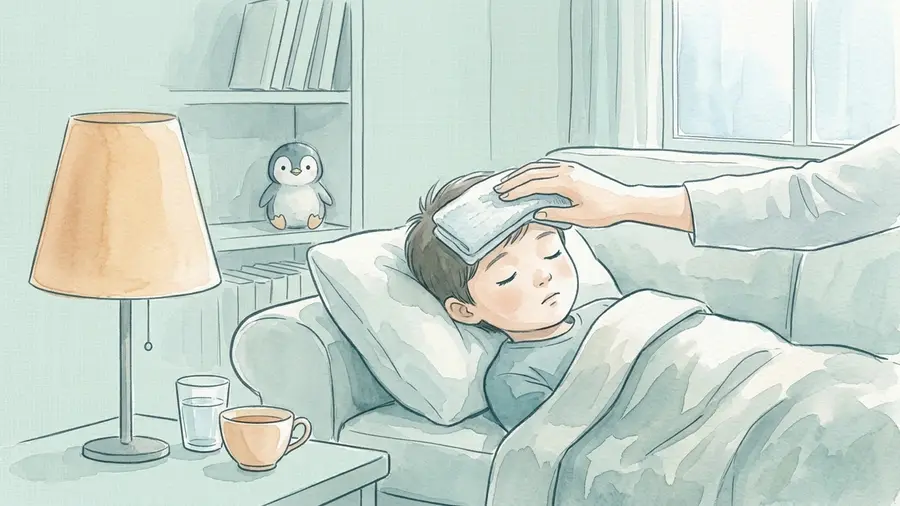
With headaches in childhood the simple route works surprisingly reliably, well before you reach for medication. Three things cover most episodes: a low-stimulus, darkened room to lie down in, a cool cloth or some fresh air, and something to drink and eat. All three together take less than ten minutes to set up.
Quiet, darkness, sleep
Most children need one thing above all: a low-stimulus room and permission to lie down. Dimmed light, no screen, no music. Sleep is often the single most effective remedy for a childhood headache episode.
Cooling and fresh air
A cool, damp cloth on the forehead helps many children. So does a walk outside, if your child feels up to it — pushing them into it does not help.
Food and drink
Children's headaches often appear when a meal has been skipped or nothing has been drunk for hours. A glass of water and something small to eat resolves a surprising share of cases.
How do you find out what triggers them?
With recurring headaches, the decisive information is not the single episode — it is the pattern across weeks. That is exactly why a headache diary is a standard tool in paediatric pain medicine: it makes visible what clusters, and answers questions nobody can answer from memory weeks later.
The German Paediatric Pain Centre describes headache diaries as a great help in telling headache types apart and, over the course of treatment, in judging whether that treatment is working — and sends every patient one to keep until the first appointment.
For each episode, note the day and time, how long the pain lasted, how strong it was, where it sat, what your child had done, eaten and drunk beforehand, how they slept — and whether they had any medication, which one and when.
This is precisely the information that evaporates in everyday life. Three weeks later nobody remembers whether Tuesday's headache came before or after PE. In Mona you log an episode in seconds, and after a few weeks the pattern view shows you what clusters: the short nights, the test days, the long afternoons in front of a screen.
Where that record stops being enough is worth saying plainly: writing things down is your part. Which kind of headache your child has, and whether anything needs treating, is a decision for your GP — diagnosis and treatment belong with a clinician, not with an article.
Your GP will ask exactly these questions: how long has this been going on, how often per week, how long does an episode last, what did your child take and did it help. With a kept record you answer from your notes instead of your memory, and the appointment does not start from zero.
Is this the fourth infection now — or the fifth?
The weeks blur together. Mona shows every illness at a glance, so you spot patterns before the GP asks.
How can you prevent headaches?
The most effective prevention is unspectacular and concerns the rhythm of the day: regular sleep and mealtimes, enough breaks, movement outdoors, and sports such as cycling or swimming. Alongside that comes an honest look at the load your child is carrying — school pressure, over-scheduled afternoons and lack of sleep are among the most common triggers in childhood.
If your child has recurring headaches over weeks, an eye test is also worth booking. An unnoticed vision problem is one of the easiest causes to fix.
Common questions about headaches in children
At what age can children get headaches?
From preschool age onwards. Younger children often cannot locate the pain well and instead seem irritable, pale or withdrawn. If a small child repeatedly holds their head, becomes unusually quiet or wants to lie down in a darkened room, take it seriously even without a clear description.
How long can a headache in a child last?
A single episode that settles with rest, fluids and sleep is usually not a concern. A headache that keeps getting worse, that wakes your child at night, or that keeps coming back over weeks should be seen by a GP — with those, the direction of travel matters more than the intensity on any given day.
Can my child take ibuprofen or paracetamol for a headache?
Only after speaking to your GP or pharmacist. Adult painkillers are not suitable for children in composition or dose and must not be given. Frequent use of pain relief can also make headaches worse over time, which is why non-medication measures come first.
Can headaches in children be caused by stress?
Yes. Stress, anxiety and worry are among the common triggers, along with school pressure and lack of sleep. That does not make the pain any less real — it is physically felt. What helps is looking together at which days it happens, rather than hunting for a single cause.
My child has a headache and a temperature — should I worry?
Headaches very often accompany feverish infections and disappear with them. It becomes urgent when a stiff neck, bright lights bothering your child, or drowsiness and confusion come with it. That combination needs emergency care, not a wait-and-see approach.
When is a headache in a child an emergency?
When it starts suddenly and is extremely painful, when it follows a head injury, when neurological signs appear — seizure, loss of vision, weakness or numbness on one side, confusion — or when a very high temperature comes with a stiff neck. In those cases, call 999.
Summary: when to seek help for a headache
| Situation | What to do |
|---|---|
| Sudden and extremely painful · very high temperature with stiff neck · after a head injury · seizure, loss of vision, weakness or confusion | Call 999 or go to A&E |
| Getting worse · wakes them at night · with vision problems or vomiting · worse when coughing or bending down | Call 111 or ask for an urgent GP appointment |
| Recurring headaches, child otherwise well | Routine GP appointment — and keep a record of the episodes |
About this article
Sources
- Headaches — NHS(accessed 2026-09-08)
- Headache diary for children and adolescents — German Paediatric Pain Centre(accessed 2026-09-08)
- Headaches in children — kindergesundheit-info.de (BZgA)(accessed 2026-09-08)
You might also like

Track symptoms easily
With Mona you stay on top of things – even at 3 AM.