
Summer Cold in Children: Symptoms, Course, and When to See a Doctor

This blog only provides tips, tricks and hints and does not replace a doctor visit. For severe symptoms, always consult a doctor.
At a glance
- ✓"Summer cold" isn't a medical diagnosis — it's an umbrella term for viral infections in summer, usually caused by entero-, adeno-, rhino- or RS viruses.
- ✓The course is usually milder than real influenza. A typical respiratory infection clears in about 1 to 2 weeks (NHS).
- ✓See a GP: for babies under 3 months with a temperature of 38°C or above (urgent — contact a GP or call NHS 111 straight away), when your child won't drink, with breathing trouble, or when a high temperature lasts 5 days or more.
Table of Contents
- What is a summer cold, really?
- Summer cold, real flu, or common cold — the difference at a glance
- Which symptoms does my child show with a summer cold?
- Typical symptoms at a glance
- How long does a summer cold last, and when is it no longer contagious?
- Which warning signs mean: see a doctor now?
- When does a same-day call to your GP suffice?
- What helps my child at home?
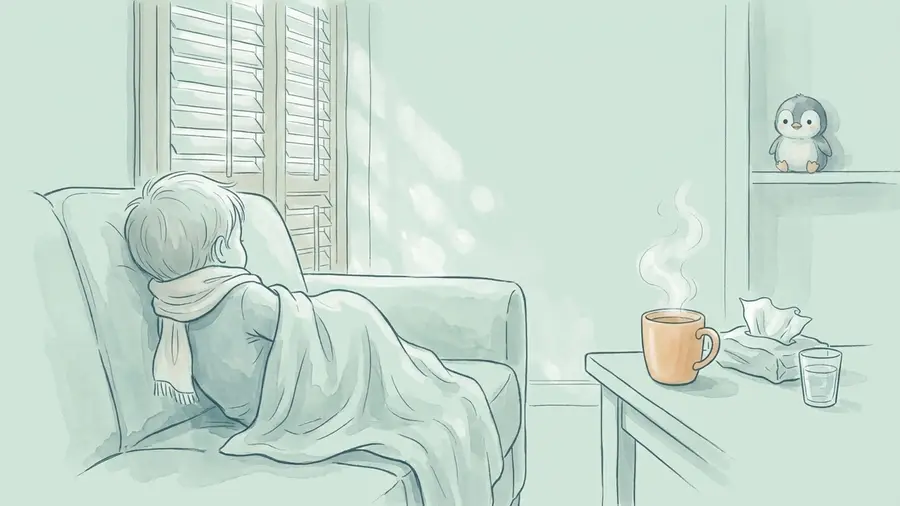
It's June, 28 °C outside — and your child is lying on the couch with a sore throat, runny nose, and that washed-out look. A cold? In the middle of summer? That's the moment many parents pause and google "summer cold." You're in good company — and you can get a handle on this quickly. What's behind it and which warning signs really matter, we'll walk through step by step.
The good news first: a summer cold is, in the vast majority of cases, a harmless viral infection — much like an ordinary cold, just in the warm season. It usually runs a clearly milder course than real influenza and fades after a few days. What matters: knowing a handful of warning signs, offering plenty of fluids, and knowing when a call to your GP makes sense. That's what you'll get next.
Important note: This article does not replace professional medical advice. If in doubt or in an emergency, contact your GP or call 999.
What is a summer cold, really?
"Summer cold" — sometimes called "summer flu" — is not a medical diagnosis. It's a colloquial umbrella term for cold-like respiratory infections that crop up in the warm months. It has nothing to do with the "real flu" (influenza). The culprits are viruses that thrive in summer temperatures.
The main triggers are enteroviruses (such as Coxsackie viruses), adenoviruses, rhinoviruses, and the respiratory syncytial virus (RSV). Rhino- and enteroviruses are typical summer pathogens. A summer cold is less a single disease than a season.
These viruses spread mainly by droplet infection when coughing, talking, or breathing. Swimming pools, playgrounds, nurseries, and crowded ice-cream parlours are classic transmission spots. Enteroviruses are also shed in stool, which adds faecal-oral spread to the mix.
Summer cold, real flu, or common cold — the difference at a glance
| Feature | Summer cold (viral summer infection) | Common cold | Real flu (influenza) |
|---|---|---|---|
| Season | May–September | year-round, peak in autumn/winter | usually December–April |
| Onset | usually gradual | gradual | often sudden, "out of the blue" |
| Fever | often moderate, but may not occur at all | often low-grade | often high, rapid spike |
| General state | child is tired but usually responsive | mildly affected | clearly affected, "belongs in bed" |
| Accompanying symptoms | with enteroviruses also vomiting/diarrhoea, possible rash | cough, runny nose, sore throat | severe body aches, dry cough |
| Vaccine available? | no (no vaccine against summer cold) | no | yes (seasonal influenza vaccine) |
Which symptoms does my child show with a summer cold?
The typical symptoms look like a classic cold — just in the middle of summer. Sore throat, runny nose, cough, and a generally tired, slightly off mood are the staples. Fever may join in, but doesn't have to — in many rhino- and enterovirus infections a fever may or may not occur.
With enteroviruses, which are particularly active in summer, gastrointestinal symptoms often join the picture. Many children suffer from vomiting and diarrhoea during summer infections. Medically that's not unusual, but for parents it's often confusing: "Is this a stomach bug or a cold?" — with enteroviruses, it can be the same infection wearing two hats.
Typical symptoms at a glance
- Sore throat, scratchy feeling — often the first sign
- Runny or blocked nose, sneezing
- Cough — dry at first, often loosening up later
- Tiredness, listlessness, low energy
- Moderate fever (often, but not always)
- Mild headache and body aches (in contrast to influenza)
- Nausea, vomiting, or diarrhoea — especially with enteroviruses
- Conjunctivitis (possible, especially with adenoviruses)
- Skin rash — rare, but possible with certain enteroviruses (overlapping with hand, foot and mouth disease)
Tip: If you find yourself unsure looking at your child on the couch — "Is this the summer cold or something else?" — simply jot down what you see: temperature, fluid intake, stools, sleep, mood. That little curve helps you sort things out and is gold when you do call your GP.
The pediatrician asks. You can answer.
Symptom timeline, fever curve, last medication: With Mona you have it all in seconds, instead of guessing from memory.


How long does a summer cold last, and when is it no longer contagious?
A normal respiratory infection usually clears in about 1 to 2 weeks, with or without treatment (NHS). The first days are usually the symptom-heaviest. A cough can linger for some time as the last phase.
How long your child stays contagious can't be pinned to a single number — it depends on the virus. For echoviruses (a subgroup of enteroviruses), the incubation period is around 2 to 10 days, and even a small viral load can be highly infectious. In plain language: your child may already be infectious before you even notice they're sick.
A common nursery-readiness rule of thumb for many respiratory infections: 24 hours fever-free without fever-reducing medicine, and the child is back to drinking, eating, and playing normally. Binding rules can vary by nursery and pathogen — check with your GP or nursery lead / childminder when in doubt.
Important to know: Even after your child feels better and no longer has a fever, enteroviruses can still be shed in stool for a while. Thorough hand-washing — especially after nappy changes and before meals — stays particularly important for a few days.
Which warning signs mean: see a doctor now?
Most summer-cold courses are harmless. But there are clear red flags where you shouldn't wait — regardless of whether the fever reads 38.5 °C or 40 °C. In infants and any child whose general condition deteriorates quickly, every hour counts.
In babies under 3 months, a temperature of 38°C or above needs urgent medical advice — contact a GP or call NHS 111 straight away (call 999 or go to A&E if your baby seems seriously unwell).
Call 999 or go to A&E immediately if your child:
- has difficulty breathing or very rapid breathing — retractions between the ribs or flaring nostrils
- is unresponsive, lethargic or hard to wake
- has a stiff neck — can't bring chin to chest
- has a rash that doesn't fade under pressure when pressed with a glass
- has bluish lips or skin
- has a febrile seizure — twitching, fixed gaze
For details on fever red flags and age-specific thresholds, see Fever in children: when is it dangerous?.
When does a same-day call to your GP suffice?
Not every symptom is an emergency — but some things shouldn't be left to sit. The following situations are reasons to contact your GP the same day (or call NHS 111):
- High fever lasting 5 days or more
- Cough or runny nose lasting more than one week unabated, or getting worse instead of better
- Your child drinks noticeably less or shows signs of dehydration (little urine, dry lips, no tears when crying)
- Sudden barking cough (suggesting croup)
- Ear pain, persistent severe sore throat, or difficulty swallowing
- Fever that drops, then climbs sharply again after a calmer phase
What helps my child at home?
A summer cold is a viral infection — antibiotics don't help. What does help is the unglamorous housekeeping of recovery: plenty of fluids, plenty of rest, and a handful of concrete measures that ease the load. NHS guidance for respiratory infections emphasises drinking plenty of fluids and rest.
The three core building blocks
- Drink, drink, drink — water, unsweetened tea, diluted fruit juice. Small amounts often beat large amounts rarely. With vomiting or diarrhoea: offer a spoonful every few minutes.
- Rest and sleep — the body needs energy for the immune response. Less screen time, cuddle days, fewer activities.
- Fresh, humidified air — air the room well, don't overheat or over-cool. For a blocked nose, saline nasal sprays or rinses help.
Caution with essential oils: Menthol, camphor, eucalyptus, or peppermint oil should not be used in babies and young children under two years — they can trigger breathing problems or laryngospasm. Check with your GP if in doubt.
Fever- or pain-reducing medication (paracetamol, ibuprofen) can be reasonable when your child is visibly suffering — headache, sore throat, uncomfortable high fever. Dosing strictly by body weight and only after checking with your GP or pharmacist.
What makes the course easier for you to track
A multi-day infection blurs the days fast: was the fever higher yesterday or today? When was the last dose? Did your child drink more today than yesterday? A simple symptom diary in Mona takes that mental load off your shoulders: the fever curve, medication log with exact times, and fluid-intake tracking show you the course at a glance. At your next GP visit, you're straight to the point.
38.7°C at 02:14, and again at 04:30?
You don't have to remember. Mona logs fever, medication and sleep in 10 seconds, and your partner sees it instantly.
Common questions about summer colds in children
Is there a vaccine against the summer cold?
No. Unlike seasonal influenza (real flu), there is no vaccine against the summer cold. The reason: "summer cold" is not one disease but an umbrella term for many different viruses — enteroviruses, adenoviruses, rhinoviruses, and others. Protection comes mainly from hand-washing, hygiene, and a well-supported body (sleep, fluids, balanced food).
Why do children catch colds in summer?
Summer-cold viruses such as enteroviruses thrive in warm temperatures. On top of that, several factors stress the immune system: air-conditioned rooms, cold drinks, wet swimwear, car drafts, sun, and heat. Nurseries, swimming pools, and playgrounds are crowded in summer — many children, many viruses, short distances.
When can my child return to nursery?
A common rule of thumb for many respiratory infections: 24 hours fever-free without fever-reducing medication, and the child is back to drinking, eating, and playing normally. For certain pathogens (such as hand-foot-mouth disease or stomach bugs), longer waiting periods may apply. When in doubt, check with your GP or nursery lead / childminder.
Is a summer cold dangerous for infants?
In otherwise healthy older children, summer colds usually run mild. In babies under 3 months, any fever of 38°C or above is a reason to contact a GP or call NHS 111 straight away — the immune system is still immature, and an infection that initially looks harmless can deteriorate rapidly. Younger toddlers can also dehydrate quickly through vomiting and diarrhoea.
How do I tell summer cold and stomach bug apart?
The lines are blurry. Enteroviruses — typical summer-cold triggers — can cause both respiratory symptoms (cough, sore throat) and gastrointestinal symptoms (vomiting, diarrhoea). If your child mostly vomits and can't keep fluids down, read "My child can't keep down fluids" separately. For combined symptoms: just document both.
How long is high fever acceptable with a summer cold?
A high temperature lasting 5 days or more is among the situations where you should contact your GP. The same applies if the fever briefly drops and then sharply rises again. For age-specific fever thresholds, see Fever in children: when is it dangerous?.
Do antibiotics help against a summer cold?
No. Summer colds are caused by viruses — antibiotics only work against bacteria. They don't help and shouldn't be given "just in case." If a viral infection turns into a bacterial secondary infection (such as middle-ear or tonsil infection), a GP will decide case by case whether antibiotics are appropriate.
Summary: summer cold — wait, call, or emergency?
The shortest decision rule looks like this:
| Situation | What to do? |
|---|---|
| Baby < 3 months, temperature 38°C or above | Urgent — NHS 111 / GP straight away (999 if seriously unwell) |
| Breathing difficulty, reduced responsiveness, stiff neck, non-fading rash | Call 999 / A&E |
| First febrile seizure, bluish lips | Call 999 / A&E |
| High fever 5 days or more, child barely drinks, persistent vomiting | GP same day or NHS 111 |
| Cough/runny nose > 1 week or worsening | GP soon |
| Ear pain, sudden barking cough | GP soon |
| Moderate symptoms, child drinks and plays in between | Observe, fluids, rest |
Good to know: Up to school age, a string of respiratory infections each year is entirely normal and no cause for alarm. Summer colds are part of that count. They show that your child's immune system is working and learning. What matters isn't preventing every cold but spotting the few serious courses in time.
About this article
Sources
- NHS: Common cold(accessed 2026-06-02)
- NHS: Flu(accessed 2026-06-02)
- NHS: High temperature (fever) in children(accessed 2026-06-02)
You might also like

Track symptoms easily
With Mona you stay on top of things – even at 3 AM.