
Tonsillitis in Children: When Are Antibiotics Needed?

This blog only provides tips, tricks and hints and does not replace a doctor visit. For severe symptoms, always consult a doctor.
At a glance
- ✓Tonsillitis in children is usually viral and clears up on its own — antibiotics are only needed for a confirmed bacterial (strep) infection.
- ✓Your GP decides, usually after a test — if antibiotics are prescribed, finish the whole course, even once the temperature has gone.
- ✓See your GP if the symptoms have not gone within a week; get urgent help if your child has pus-filled spots or a throat too painful to eat or drink, and call 999 if they struggle to breathe or swallow.
Table of Contents
Tonsillitis in Children: When Do They Need Antibiotics?
Your child has a bad sore throat, barely wants to eat, and has a high temperature. You look inside their throat and see swollen, red tonsils — maybe with white patches. Straight away the question is there: does my child need antibiotics now?
Here's what matters most: tonsillitis in children is usually viral and clears up on its own. Antibiotics are only needed when bacteria — most often a type of streptococcus — are actually behind it, and even then they aren't always necessary. When a GP really does prescribe antibiotics, what helps at home, and when you need to act straight away — you'll find it here, step by step.
Important note: This article does not replace professional medical advice. If in doubt or in an emergency, contact your GP or call 999.
How Do I Recognise Tonsillitis in My Child?
Tonsillitis usually causes a sore throat, problems swallowing, and a high temperature, along with red, swollen tonsils. Other signs include a cough, headache, earache, feeling sick, and tiredness. In more severe cases you may see pus-filled spots or white patches on the tonsils. Most tonsillitis in children is viral rather than bacterial.
The bacterial form is caused by group A streptococcus — the same bug behind scarlet fever, sometimes called "strep throat". But most children and adults get viral tonsillitis, which clears up on its own. So swollen tonsils and white patches don't automatically mean bacteria are to blame.
You can't reliably tell viral from bacterial tonsillitis just by looking — not from the temperature and not from how the tonsils look. That difference matters for treatment, though, and only a GP can make it, usually with the help of a quick test.
Does My Child Need Antibiotics for Tonsillitis?
Usually not. Most tonsillitis in children is viral, and antibiotics do not work against viruses — they only help against bacteria. A GP may prescribe antibiotics for bacterial tonsillitis (strep throat), but will usually wait for a test to see which type your child has. If antibiotics are prescribed, finish the whole course.
The GP looks at your child's symptoms and often runs a throat swab or test to check for group A streptococcus. Only when that confirms bacteria does an antibiotic make sense. Until the results are back, a GP will usually hold off — starting antibiotics for a viral infection wouldn't help and isn't the right call.
If your child is prescribed a course of antibiotics, one thing matters above all: keep giving every dose until the course is finished, even once the temperature has gone and your child feels much better.
Important: Never stop the antibiotics on your own just because your child seems better. Only the full course does its job — stopping early can let the infection come back. Tonsillitis can be caused by the same group A streptococcus behind scarlet fever, which is treated the same way.
When did she last have paracetamol?
The question that drives everyone crazy at night. Mona tracks doses and intervals automatically, so no one doubles up.


When Is Tonsillitis an Emergency?
Serious complications are very rare, but some signs need emergency care. Call 999 or go to A&E if your child has difficulty breathing, has difficulty swallowing or is drooling, or shows signs of quinsy — a throat abscess causing severe one-sided pain with trouble opening the mouth. These need immediate attention.
Get help from NHS 111 now if your child has pus-filled spots on their tonsils, or a sore throat so painful it's difficult to eat or drink. This isn't a 999 emergency, but it does need urgent advice the same day, and NHS 111 will tell you what to do next.
🚨 Call 999 or go to A&E if your child:
- has difficulty breathing
- can't swallow or is drooling because they can't swallow their saliva
- has severe one-sided throat pain and struggles to open their mouth (possible quinsy, a throat abscess)
- is not responding as usual, is very drowsy, or hard to wake
For the youngest, one rule stands out: in babies under 3 months, a temperature of 38°C or above always needs urgent advice — contact a GP or call NHS 111 straight away (call 999 or go to A&E if your baby seems seriously unwell). In children, a high temperature is 38°C or above. If you're unsure how to read a temperature, our guide on fever in children walks you through it. And see your GP if the symptoms of tonsillitis do not go away within a week.
How Do You Keep Track of the Course?
With tonsillitis, three things are worth recording: the temperature over time, every dose of medicine with the time you gave it, and how the sore throat and any patches change from day to day. If your child is given antibiotics, taking every dose matters — and between work and siblings, it's easy to lose track of one.
In Mona you log each dose with the time in a few seconds and see at a glance when the next one is due — so you carry the prescribed course through to the end without missing a dose. The temperature chart builds itself, and a short daily note shows you whether the symptoms are settling.
That pays off at the appointment. Your GP will ask: how long has the temperature lasted? When was the first dose of antibiotics? Are the sore throat and any patches improving? Those answers are already in your Mona timeline, instead of something you have to piece together from memory.
The pediatrician asks. You can answer.
Symptom timeline, fever curve, last medication: With Mona you have it all in seconds, instead of guessing from memory.
What Helps at Home?
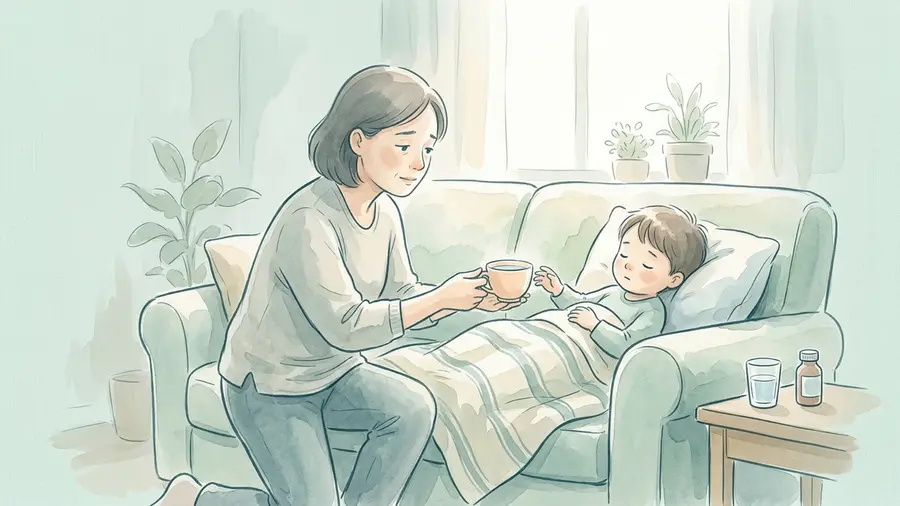
At home, rest and fluids do most of the work. Encourage plenty of rest and cool drinks to soothe the throat, and give paracetamol or ibuprofen for pain or a high temperature — but do not give aspirin to children under 16. Symptoms usually settle within 3 to 4 days, though they can last a little longer.
Skip the salt-water gargle: that advice is for adults, not young children. Warm, soft food is often easier on a sore throat, and steady drinking keeps things comfortable. Don't force your child to eat — in the first few days, drinking matters more than a full meal. If things haven't improved after about a week, or get worse, book an appointment with your GP.
Frequently Asked Questions About Tonsillitis
Does tonsillitis always need antibiotics?
No. Tonsillitis in children is usually viral and clears up on its own, and antibiotics don't work against viruses. A GP only prescribes antibiotics for a confirmed bacterial (strep) infection, and will usually wait for a test to see which type your child has. A sore throat alone is not a reason for antibiotics.
How long does tonsillitis last?
Symptoms of tonsillitis usually go away after 3 to 4 days, but they can last longer. Many children feel noticeably better within a few days. If the symptoms have not gone within a week — or if they get worse rather than better — see your GP to have your child checked.
When should I take my child to the GP?
See your GP if the symptoms of tonsillitis do not go away within a week. It's also worth a visit if your child has a high temperature, pus-filled spots or white patches on the tonsils, or is struggling to swallow. Only a GP can tell viral from bacterial tonsillitis and decide on the right treatment.
What is quinsy?
Quinsy is a throat abscess — a rare complication of tonsillitis. Signs include severe pain on one side of the throat and trouble opening the mouth. It needs urgent care: call 999 or go to A&E if your child struggles to breathe or swallow. Complications of tonsillitis are very rare overall.
Can my child gargle salt water?
No. Gargling salt water can ease a sore throat in adults, but this advice is not for young children, who may swallow it or can't gargle safely. For children, stick to rest, cool drinks, and paracetamol or ibuprofen for pain or a high temperature — never aspirin for a child under 16.
When do I need to call NHS 111?
Get help from NHS 111 now if your child has pus-filled spots on their tonsils, or a sore throat so painful it's difficult to eat or drink. NHS 111 is for urgent advice that isn't a 999 emergency. If your child struggles to breathe or swallow, call 999 or go to A&E instead.
What can I give my child for the pain?
Encourage plenty of rest and cool drinks to soothe the throat, and give paracetamol or ibuprofen for pain or a high temperature. Do not give aspirin to children under 16. Warm, soft food is often easier to manage. Don't force your child to eat — in the first few days, drinking matters more.
Summary: When Does Tonsillitis Need Antibiotics?
| Situation | What to do? |
|---|---|
| Difficulty breathing, can't swallow, or drooling | Call 999 / A&E |
| Signs of quinsy: severe one-sided pain, trouble opening the mouth | Call 999 / A&E |
| Baby under 3 months with a temperature of 38°C or above | GP or NHS 111 straight away (999 / A&E if seriously unwell) |
| Pus-filled spots on the tonsils, or a throat too painful to eat or drink | NHS 111 now |
| Symptoms not gone within a week | See your GP |
| Mostly viral tonsillitis, child drinking and responsive | Recover at home — keep track of it in Mona |
About this article
Sources
- NHS: Tonsillitis(accessed 2026-07-13)
- NHS: High temperature (fever) in children(accessed 2026-07-13)
You might also like

Track symptoms easily
With Mona you stay on top of things – even at 3 AM.